
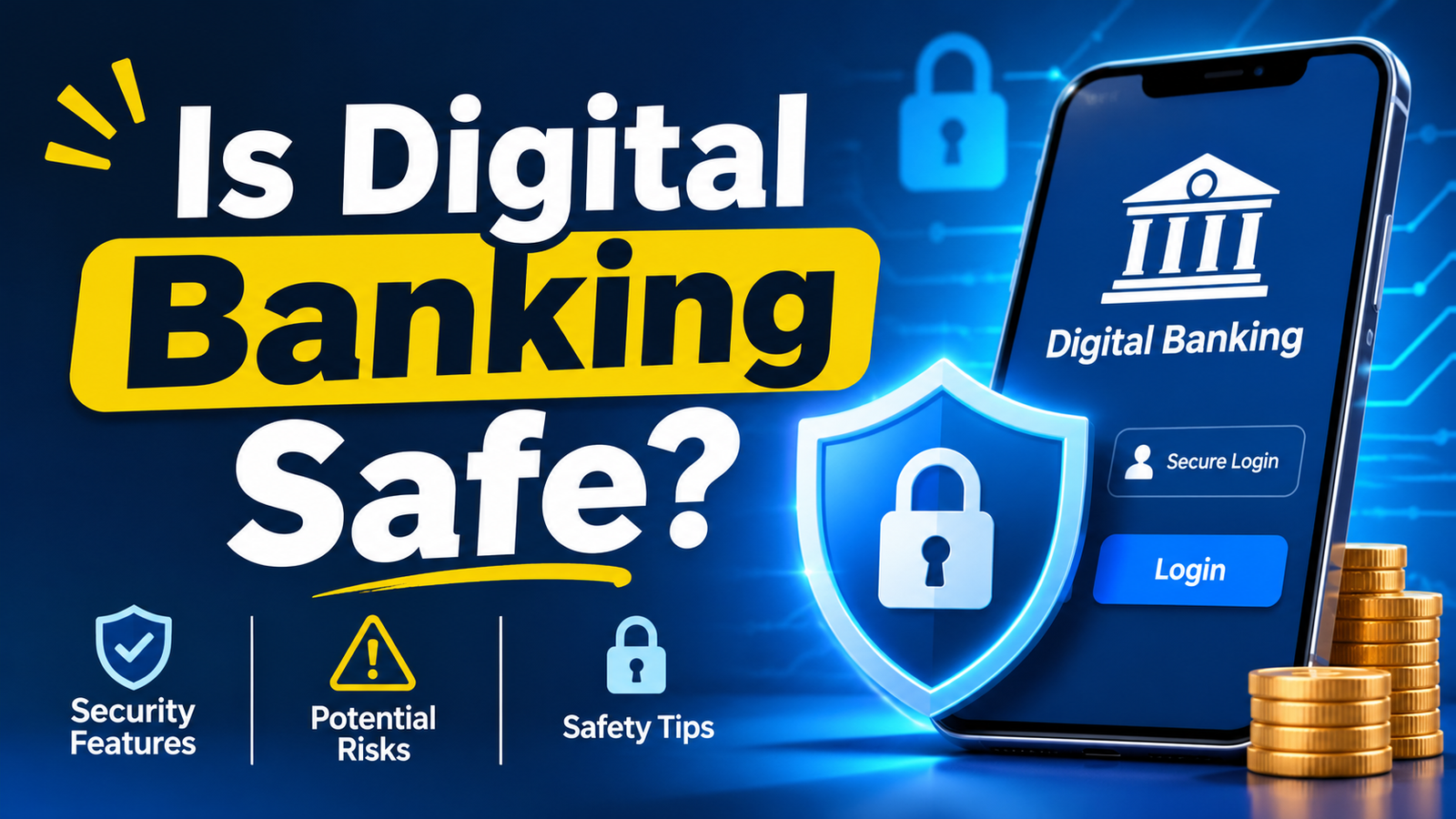
Quick – Answer: Yes—digital banking is generally safe to use with a legitimate FDIC-insured bank or NCUA-insured credit union and basic security practices. If the institution fails, your money is safe thanks to federal deposit insurance. Federal consumer laws protect you from loss for unauthorized transactions. The most significant threats are scams, weak passwords, and apps that are called “fintech” but are not banks.
People no longer need to visit a bank branch to open or maintain an account, check their balances, deposit checks, or pay bills, as millions of Americans now do it from a cell phone. Which is a fair question since digital banking was created with that ease and convenience in mind, is it safe if there’s no branch, no teller, and no paper trail?
This brochure will help you understand how to protect yourself, where the actual risks are and what you can do now to reduce your risk. It is about the United States and the rules and examples are based on US law and US institutions. Laws, limits and agency programs are subject to changes, please check for the latest information from the sources listed near the end.
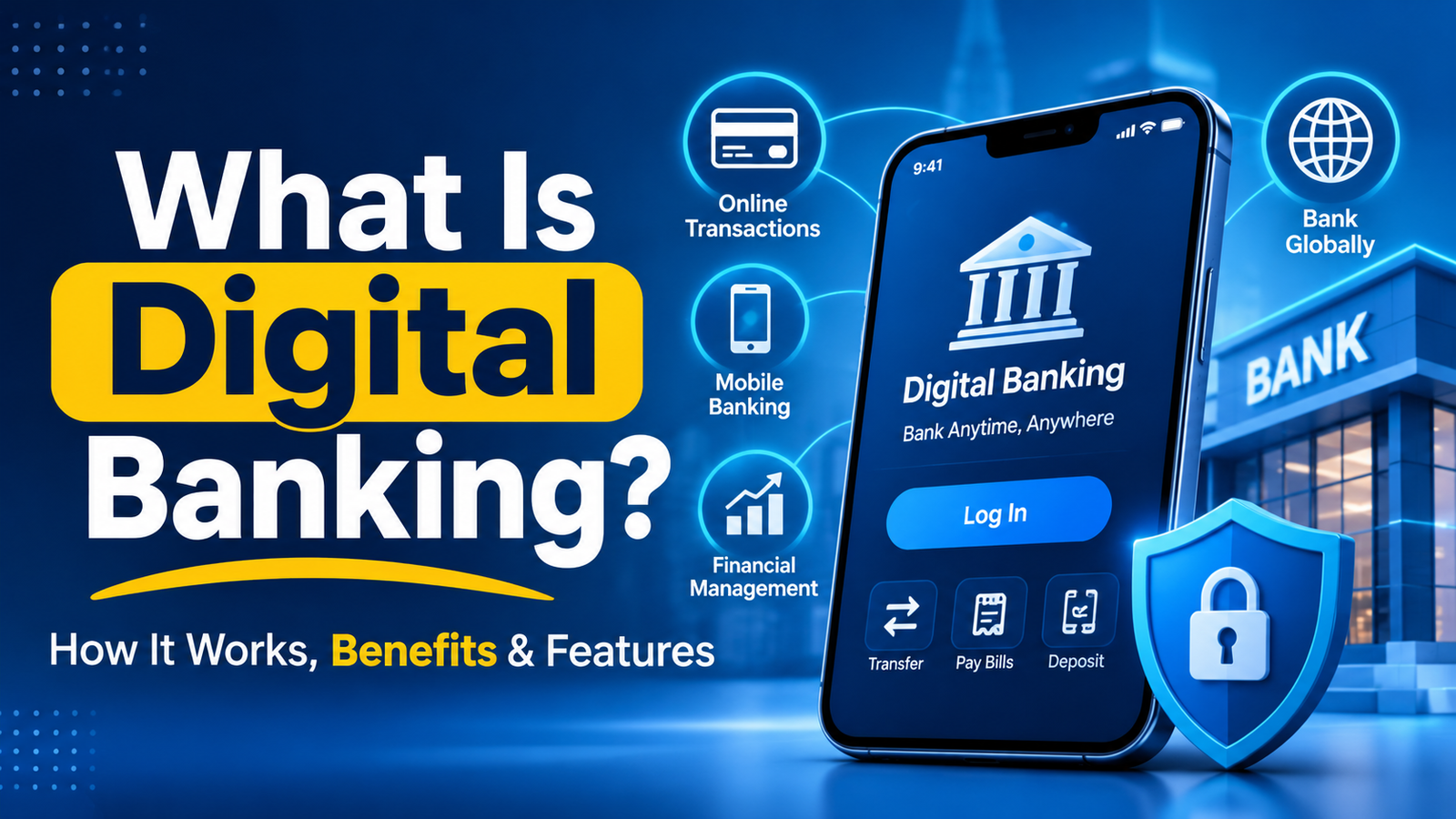
What is Digital Banking?
Digital banking involves controlling your finances online rather than face to face. Open accounts, transfer funds, pay bills, deposit checks via camera and speak with support via chat—all online.
There are three types commonly found:
- Older banks using digital services. Both large banks and community banks have applications as well as branches.
- Online-only banks. The banks here do not have any or very few branches. They are all online and mobile.
- Fintech and Neobank apps. This is a type of technology business that provides account related services. However, not all are banks. They typically go hand-in-hand with a chartered bank that will keep deposits.
The latter of those is important on safety grounds. A shiny app won’t let you know if your cash is in a federally insured account. You have to check.
What is Digital Banking?
Digital banking works with the same regulated banking system as a branch. The difference lies in the way you get there. The basic flow is as follows:
- You create an account. The bank checks to see if you are who you claim to be by using your name, address, date of birth and Social Security number. This is mandated by federal law.
- You log in securely. The application applies encryption to scrambled your data when it is transferring from one place to another. Most apps include multi-factor authentication, like a code that is sent to your phone.
- You request a transaction. You may transfer funds, pay bills or deposit a check.
- The bank looks for fraud. Unusual logins, new devices, and big transfers to new payees are examples of behaviour that automated systems can identify.
- The transaction settles. Various networks are paid (ACH, wire transfer, card networking, peer-to-peer).
Federal and state security and privacy regulations apply behind the scenes at banks. They are subject to frequent inspection by regulators too.
Why is Digital Banking Safety important?
Your paycheck, emergency savings, and in many cases, your other financial accounts, are all in your bank account! Breaches can cost you money, harm your credit and can be complex to unravel.
The answer is not so simple as yes or no to the question “is digital banking safe. The system is well protected. Criminals have also adapted to digital channels, and plenty of modern scams focus on people as opposed to software. If you know the other person’s side you can make proper selections.
What You Can Count On in a Digital Bank?
There are multiple layers of protection. Others have been taken from the law. Others are brought from the bank. Some depend on you.
The FDIC and Banks Insurance.Banks Insurance from the FDIC.
Federal Deposit Insurance Corporation (FDIC) Member Banks insure deposits. The coverage applies to each depositor, insured bank, ownership category up to $250,000 per deposit. This will safeguard you in the event that the bank falters. It will not protect against losses from fraud and it will not protect any investments like stocks, bonds, mutual funds, or crypto, even if purchased through the bank.
The types of accounts that are considered include single accounts, joint accounts, some retirement accounts and trust accounts. Someone who has several different types of accounts at the same bank might have coverage for amounts greater than $250,000. You can use an online tool called EDIE to check your coverage from the FDIC.
NCUA Insurance for Credit Unions
Federally insured credit unions are insured by the National Credit Union Share Insurance Program (NCUA). There is also $250,000 per member per institution per ownership category of standard coverage amount. There are credit unions that have great mobile banking.
Federal Protection Against Unauthorized Transactions
The Electronic Fund Transfer Act and Regulation E, which implements it, will safeguard consumers against unauthorized electronic transfers. There is a great deal of what you could be liable for as a result of how fast you report the issue. In general:
- The maximum loss if the unauthorized debit card or electronic transfer is reported within two business days of being found out.
- If reported after that but within 60 days of the statement indicating the transaction then the loss could become $500.
- If you delay for more than 60 days, you may incur much greater losses.
Many banks have more than these minimums with “zero liability” policies. Nevertheless, be sure to read your account agreement and report issues as soon as possible. Under a separate law, the Fair Credit Billing Act, credit cards have a limit of $50 for unauthorized charges.
Bank-Level Security Measures
A good bank would employ:
- Data in transit and data at rest are both encrypted.Data in transit and data at rest is encrypted.
- Multi-factor authentication
- Alerts for device login/disconnect.Device login/disconnect alerts.
- Automated fraud monitoring
- App lock controls to prevent the use of a debit card from the app
- Biometric login (fingerprint / face recognition)
These tools will help lower risk but only if they are turned on and kept turned on.
Before trust a digital bank, there are certain key things to consider:
Are all digital banking providers safe? No, before transferring money, consider these factors.
Does the Institution actually have insurance?
Check on the institution’s website for the words “Member FDIC” or “NCUA insured. Then check it on your own. Use the FDIC’s BankFind and the NCUA’s Credit Union Locator to verify the authenticity and insurance of a bank or credit union. Sometimes criminals also use the official logo; do not use a logo alone.
Is the Company a Bank or Fintech Partner?
Not all fintech apps are banks. They keep your money in the partner bank. There, the FDIC may provide coverage under the “pass-through” option, provided the fintech maintains proper records and the bank holding the fintech is insured. Insurance will cover you in case the bank goes bankrupt. It doesn’t necessarily safeguard you in the event that the fintech business fails or loses its records.
This risk was highlighted by the failure of 2024 fintech firm Synapse, which was a company that linked fintech apps to partner banks. Records were taking a long time to be reconciled, and that meant that some customers had to wait a long time before they got to access their money. Always read fine print of any apps that you use, and find out what they really collect.
What Security Features Does It Offer?
A reputable provider will provide multi-factor authentication, alerts and clear methods for reporting on fraud. If the app doesn’t have these essentials, then it is a red flag.
What is the Response of Customer Support?
When there’s a problem, the response should be fast and easily available. Look into the provider’s dispute procedure, secure chat and phone support. Be wary of customer reviews, but watch for recurring issues, such as frozen accounts and delays in fraud resolution.
What is the cost of the fees and the terms?
Hackers are not the only focus of safety. Surprises such as unexpected fees, frozen accounts and terms for disputes can cost you as well. Review deposit agreement and electronic funds transfer disclosures before signing up.
The advantages and disadvantages of digital banking services.The pros and cons of digital banking services.
So, is Digital Banking safe in practice? There is a right side and a wrong side to an honest answer.
Potential Benefits
- Real-time visibility. It’s easy to catch suspicious activity, as you can check your account balance anytime.
- Instant alerts. Abnormal transactions are immediately marked for text and push notifications.
- Card controls. A lost card can be frozen in just seconds.
- Less paper. Online statements decrease the odds that somebody steals mail that has account information.
- Lower costs. Online banks tend to have fewer fees (although this can differ).
Potential Risks
- Phishing and impersonation scams. Texts, emails or phone calls fooled into assuming the identity of your bank to steal your information.
- Account takeover. Stolen passwords, particularly when shared across different sites, can provide a full access.
- Authorized payment scams. Under Regulation E, banks usually aren’t required to refund money if you voluntarily send it to a scammer. This risk is extended to wire transfers as well as certain “peer-to-peer” payments.
- Malware and unsecured wireless networks. Your information can be exposed by infected devices and public networks.
- Data breaches. There could be a breach at a bank or third-party vendor, potentially exposing personal data.
- Fintech failures. As mentioned, a nonbank partner may also fail or do wrong with records.
- Limited in-person help. On-line-only banks might have minimal in-person service.
A pattern is emerging: The biggest threats are human error and deception, not a hacker exploiting bank security. This is good news, since there are many things you can do to manage a lot of this risk.
Two customers, two outcomes: real-world example.Real-world example: two customers, two outcomes.
The following example illustrates how habits impact results, using hypothetical numbers.
Maria has $8,000 in savings at a bank that is insured by the FDIC and operates online. She uses a special password, software and application authentication. She has transaction alerts also on.
On one Tuesday she gets a text message from her bank. It tells her there is “suspicious activity” and asks her to click on a link. Maria bypasses the link and accesses her banking app. Nothing looks wrong. She sends the text message to the bank’s fraud reporting address and removes the message. She loses nothing.
Daniel also has $8,000 in a bank with the same interest rate. He continues to use the same password at multiple websites and has no notifications set up. A web retailer from which he’s purchased items in the past experiences an information leak.A website he bought from years ago has a data breach. The robber uses the leaked information, and logs onto his bank account.
They deposit $3,000 into an outside account. Daniel doesn’t see for 10 days. He immediately reports it as soon as he sees it. He is protected from the higher losses, since the transfer was unauthorized and he made the report within 60 days after his statement, but his bank might need some time to investigate. If he had activated re-ports he might have reported it in two days, only adding a smaller amount to his losses.
Both customers were of the same bank type. The experiences they had because of their habits were quite different. This is merely an illustration. Of course, actual results will vary based on the bank’s policies, the facts of each case and timely reporting.
What to do First: Step by Step actions
These steps can be used to open up a new account or to update an existing account.
- Check the insurance of the institution. Visit the FDIC’s BankFind tool or the NCUA’s locator. When it comes to logos, don’t take anything on its own.
- Only download from Official Stores. Go to the bank’s website and follow its link to the app store. Don’t click on links in text or ads.
- Make a strong, long password. A combination of a few random words makes for a good passphrase. Do not reuse it in another area.
- Utilize a password manager. It generates and saves robust passwords which you aren’t required to remember.
- Enable multi factor authentication. Instead of text-message codes, use an authenticator app or a security key, if the bank provides them. Text codes are not ideal, but they can be hacked using SIM-swap attacks.
- Enable transaction alerts. Configure alerts for logins, large transactions, new payees and password changes.
- Use card controls. If your bank will allow it, lock your debit card when you are not using it.
- Maintain device upgrades. Be sure to promptly install operating system and app updates. Lock your phone with a screen lock.
- Check accounts on a regular basis – weekly. Give five minutes to look for transactions you don’t recognise.
- Maintain up-to-date contact details. Your bank requires a phone number and email address that is capable of receiving calls from them to inform you of fraud.
In the event of an issue, follow the steps below:
Speed matters. If you think you may have been the victim of a fraud:
- Promptly notify your bank. Please use the back of the card or the official website phone number.
- Change the password and lock your card. Do from a trusted device.
- Report it in writing, also. Record dates, times and names.
- Set up a fraud alert or credit freeze. It is possible to get a free version from the three major credit bureaus: Equifax, Experian and TransUnion.
- Report identity theft. IdentityTheft.gov is a website by the Federal Trade Commission to help you make a recovery plan.
- Report scams. Additionally, reports of Internet crime may be made at the FBI’s Internet Crime Complaint Center (IC3).
- Escalate if needed. If your bank is not able to resolve the problem, you may file a complaint with the Consumer Financial Protection Bureau (CFPB) and/or your bank’s primary regulator. Visit the agency’s website for up-to-date information on the process.
Top 10 Common Mistakes to avoid in unit testing.
The little things can add up to the largest losses. Watch for these.
- Clicking links in unexpected messages. There is little likelihood that a text link will prompt you to log in with a bank. Visit the app or official website to explore.
- Sharing one-time codes. Your verification code is not required by any real bank employee! Do not proceed if someone asks you to stop.
- Reusing passwords. If you get a breach anywhere else, your Bank account is open.
- Doing finance transactions over public wi-fi. If that’s a necessity, use a trusted VPN or make sure you’re on your mobile data connection.
- Ignoring alerts. An alert is a gift. Read and do what it says.
- If all applications are banks. Look at where the money is deposited and who insures the money.
- Having insurance coverage that exceeds the limit of the insurance company’s jurisdiction.Exceeding insurance coverage limits. When the balance in one ownership category reaches > $250,000, check the coverage application.
- Transferring funds to another person you do not know. After an authorized payment has been issued, it can be difficult to get it back.
- Delaying the reporting of issues. The clock begins running on Regulation E protections at the time of the receipt of the notice of the problem as well as at the time of the statements.
- Trusting caller ID. Scammers can impersonate the name of a bank’s phone number. Hang up and dial the following number on your card.
A brief comparison of Digital Banking to Traditional Branch Banking.
| Factor | Digital Banking | Traditional branch banking |
| Deposit insurance | Same FDIC or NCUA rules if the institution is insured | Same |
| Fraud monitoring | Often automated and real time | Automated plus in-person help |
| Convenience | Available 24/7 from any location | Limited by branch hours |
| Face-to-face help | Limited | Available |
| Main risks | Phishing, account takeover, weak passwords | Check fraud, card skimming, stolen mail |
| Fees | Often lower, but varies | Often higher, but varies |
Both are not safe options. They all have their own vulnerabilities. Many people use both; a local bank to access their physical transactions, and a digital bank for savings.
Frequently Asked Questions
Is it safer to use the Internet to conduct banking than to visit a branch?
Online banking isn’t necessarily more secure, or less secure. Both are covered by deposit insurance. With online banking you get faster alerts and controls of your card, and branch banking eliminates some phishing risks. The channel isn’t as important as the habit.
Is there a way to tell if online banks are FDIC insured?
Many are. Online-only banks with bank charters and FDIC membership are covered at $250,000, the same as with a traditional bank. Check with the FDIC’s BankFind before putting in any funds.
So, is it safe to use neobanks and fintech apps?
They may occur but must be safe depending on the structure. Most fintechs aren’t banks and maintain deposits with banks. You are protected by insurance in case the partner bank is in trouble, but not in case the fintech itself is in trouble. Read the app disclosures and check the insurance of the partner bank.
If someone hacks my bank account and takes my money, what should I do?
Notify your bank right away. If you promptly report an unauthorized electronic transfer, you are only liable for the $50 amount under Regulation E. The more you report later, the more you will be exposed. Banks should write off and many provide additional protections.
Is fraud or hacking covered by the FDIC?
Only deposits in an insured bank are protected by No. FDIC insurance. Fraud losses are subject to consumer protection rules of their own and the bank’s own rules. Which is why you need to be aware of insurance and have good security practices.
Can I safely use a banking application on my cell phone?
Yes, with the official app, an updated phone and a screen lock or biometrics. Don’t download apps from unknown sources. Activate two-factor authentication and notifications.
Are Zelle or other P2P apps safe to use?
These services are great for sending money to someone you know and trust but would be better for someone you knew in person. Payouts are usually instant and cannot be retracted. You may not get your money back if you give it to a scammer. Think of them as money.
Authoritative sources for verification.
Since rules and limits are subject to change, it’s important to check with these official sources before making any decisions:
- FDIC (Federal Deposit Insurance Corporation): Deposit insurance rules, EDIE estimator, BankFind
- National Credit Union Administration (NCUA): share insurance/credit union locator
- Consumer Financial Protection Bureau (CFPB): consumer guidance and complaints
- The Federal Trade Commission (FTC) provides a site for identity theft victims and a place to report scams, likewise known as IdentityTheft.gov.
- FBI Internet Crime Complaint Center (IC3): reporting internet crime
- Office of the Comptroller of the Currency (OCC) and Federal Reserve: information on bank regulation.
- Your bank’s deposits agreement and eFunds transfer statements
The information in this article is for general education purposes only. Not individual financial, legal or tax guidance. When making decisions for yourself, see a professional.
Final Takeaway
Digital banking can be safe for most people as long as they select an insured institution and engage in appropriate security practices. Federal consumer rules, bank-level security and deposit insurance provide strong protection. These holes are in scams, the use of the same password, delayed reporting and nonbank apps that muddy the waters where your money ends up.
So, can you trust digital banking to be safe enough for your paycheck and savings? If you do the proper due diligence—checking coverage by the FDIC or NCUA, enabling multi-factor authentication and alerts, and adopting a healthy measure of skepticism to all emergency messages—yes, for most consumers in the United States. Regularly review accounts, notify about issues promptly, and ensure that contact information is up to date.
On a simple level, this week, check if your bank is insured, and enable alerts for all logins and big transactions. The two things can make a difference.