
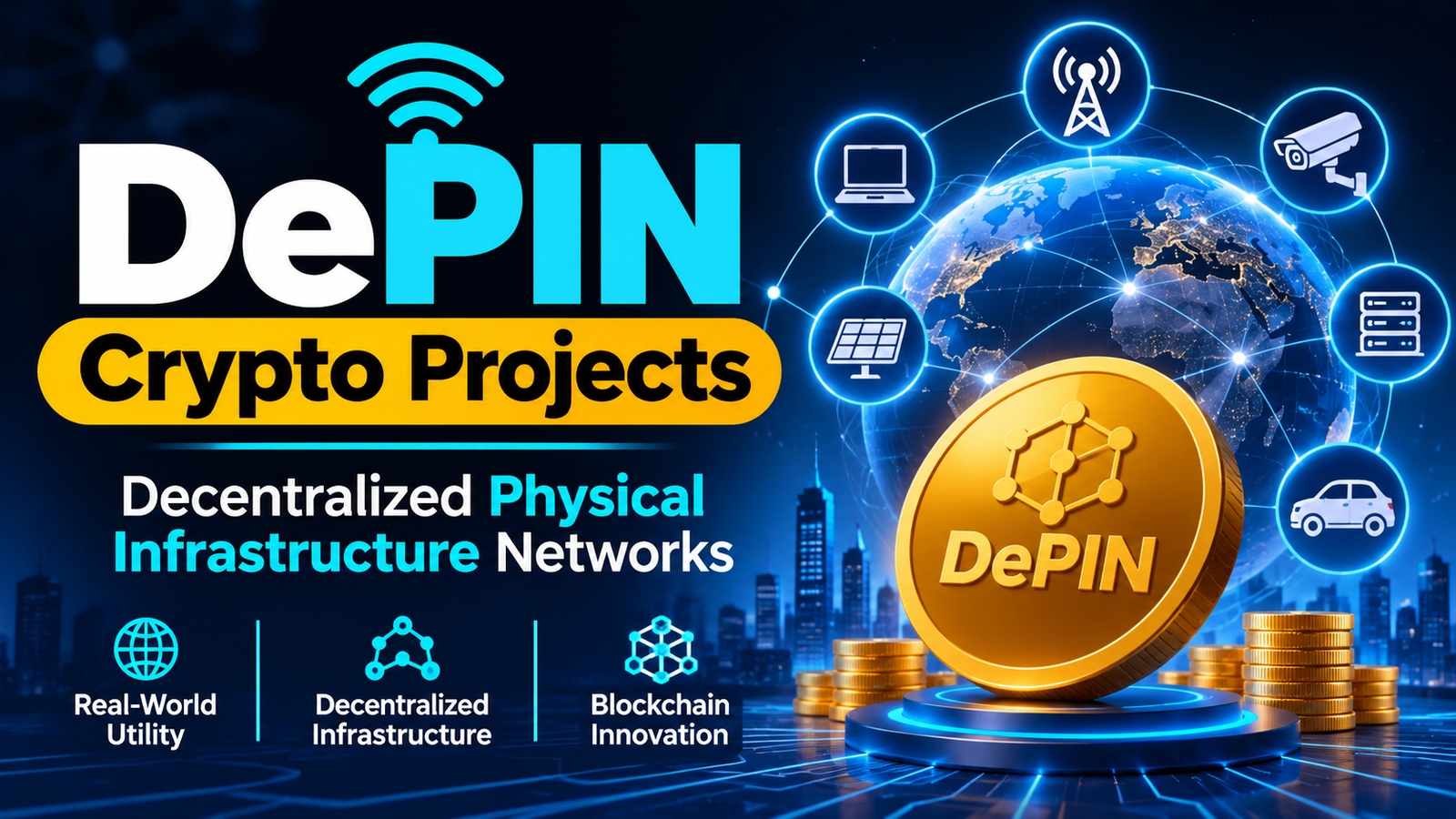
DePIN is an acronym for decentralized physical infrastructure networks. They are blockchain systems that reward ordinary users with tokens for providing real-life hardware like wireless hotspots, storage drives, graphics processors (GPUs) and mapping cameras. The network is not built by one company owning all the equipment, but rather thousands of independent contributors join to develop the network.
The topic is of practical interest to readers of the USA. Are any of the networks real businesses? What are token rewards? What do they consider the income to be? The ultimate guide to DePIN crypto projects made easy to understand and what every US investor and casual user should look at before investing money or hardware in any of them.
One caution first. This article is informative and is not intended to be financial, tax, or legal advice to any particular person. Cryptos tokens go up and down and can be wiped out.
What is DePIN in Crypto?
DePIN is a crypto model that coordinates and remunerates the individuals who deliver physical infrastructure. Contributors perform computing tasks, network validates the works, and they receive a token as a reward. The customers pay for the use of the service, e.g. storage, calculation capability, wireless connection, etc.
It refers to various types of services. Projects are usually classified into a few categories:
- Compute: Provide GPU and CPU resources for AI and rendering services through a rental scheme. Some examples are Render, Akash, io.net and Aethir.
- Storage: Networks that provide data storage services from multiple independent providers. There are some known names such as Filecoin and Arweave.
- Wireless: Community constructed networks for IoT gadgets, Wi-Fi, and cell coverage. Helium is the most famous.
- Sensors and mapping: Networks of sensors that gather information such as the street image, air quality, or location. This includes hive-mapper and planetwatch.
- Energy: Early-stage networks that link solar panels, batteries and charging equipment.
There are some projects that span the borders. For instance, Bittensor is not only featured in the list of DePIN tokens but is also dedicated to a machine-learning service marketplace rather than gadgets.
How Is DePIN Different From Regular Crypto?
Most cryptocurrency tokens, such as bitcoin, safeguard a digital ledger. Unlike a DePIN token, a token that is not connected to a service outside of the blockchain. The actual work comes from the hardware, the incentive is the token and the method of payment is that of the user.
The difference is important to investors. A DePIN token’s long-term value relies on whether or not customers will pay for the service. It can’t last long with hype.
What is the working of DePIN Networks?
The working of a DePIN network involves the following steps: Contributors provide hardware, the protocol validates the work, the blockchain rewards contributors with tokens, and the customers make payments for the services. If there is a need for it, that’s the money to keep the token alive. A loop is sometimes referred to as a flywheel.
The process is explained in more detail here.
- A contributor provisions hardware. A contributor provisions hardware. This may be a WIFI hotspot, a storage server or a GPU rig. Certain networks have certain approved devices. Others will take the general purpose computers.
- The network confirms the work, A technique that is frequently referred to as “proof of physical work” is often used on many projects. The system verifies that the hardware is real, at the expected location and providing the service. For example, helium uses nearby devices to verify coverage for each other.
- Reward tokens are issued by the protocol. The contributors are rewarded with a token for their contribution. Much of this reward is in the form of newly minted tokens, a sort of subsidy.
- The service is charged to the customer. The developers, businesses or individuals pay in tokens or sometimes in dollars. Some networks then use part of the revenue to be burned or to purchase tokens, which creates an interesting association of token demand and real usage.
- This will bring in more contributors and customers. Increased coverage/capacity can stimulate user uptake. In principle, such demand should be replacing the early subsidy.
Why is the subsidy important?Why is the subsidy relevant?
The key to the success of networks is token rewards. They also pose a danger. As long as there is no increased use, tokens can be issued to the contributors, but may have limited value over time.
It is therefore important to differentiate between two numbers: token emissions (rewards paid out) and protocol revenue (money paid in by customers). The healthy network demonstrates positive revenue growth over emissions.
Why are DePIN Projects important?
DePIN is impactful because it provides an alternative method for funding and building infrastructure, as well as because some networks are already earning revenue. It also provides a platform for ordinary people to participate in markets that used to be held only by the big companies. Meanwhile, the sector is still young and there are numerous projects that have failed to demonstrate long-term demand.
Especially: real demand for AI computing.
The best argument in the case today is the computing argument. GPU power is essential for AI companies, and it can be in short supply and costly. Distributed computing networks seek out unused or under-used computers at reduced rates.
Based on the data from the secondary sources, on-chain revenue generated by Render Network in January 2026 stood around $38 million. Beware of that number. It is not from audited financial reports, but from trackers and crypto media and should be verified with primary data before used.
A Sector with hugely varying Size Estimates
Figures for the value of the sector are published and range widely. Early-2026 reports placed it in the vicinity of $9 to $10 billion. Some say it’s more than $30 billion, and some say it’s more than $50 billion. The disparity is due to the specific tokens that a tracker includes and the definition of DePIN.
This is a dispute, and it’s a lesson. When comparing numbers, be sure to verify the definition of the data source you are using.
A brief overview of the major DePIN Projects
Leaders are inescapable from any DePIN crypto project guide. The following are examples of projects that are discussed broadly. Ranks and these are not recommendations. The market prices fluctuate from day to day, so please refer to a live data service like CoinGecko or CoinMarketCap.
| Project | Category | What it Does |
| Bittensor (TAO) | AI / compute | Rewards contributors who supply machine-learning services through specialized subnetworks |
| Render Network (RENDER) | GPU compute | Connects GPU owners with creators and AI developers who need rendering and compute power |
| Filecoin (FIL) | Storage | Pays independent providers to store data, with a track record of several years |
| Helium (HNT) | Wireless | Rewards people who run hotspots for IoT and mobile coverage |
| Akash Network (AKT) | Cloud compute | Offers a marketplace for cloud computing resources |
| Hivemapper (HONEY) | Mapping | Pays drivers who collect street-level imagery with dashcams |
| io.net and Aethir | GPU compute | Aggregate GPUs for AI workloads and sell capacity to enterprises |
Popularity does not translate to contributor profitability. Consider the cost of the hardware, income it generates and the likelihood of its changing.
Before committing to a participating event, there are certain factors to keep in mind:
Neither buying a token nor running hardware is different with the same basic questions. This checklist will help you analyse any DePIN network.
Does there actually exist a need for customers?
Search for indications that customers pay for the service. All of these come in handy with revenue numbers, named customers and usage statistics. If the project primarily focuses on token price and doesn’t talk much about user, be wary of it.
How is Reward funded?
Look at the amount of reward that is generated from new tokens vs customer payments. A network based primarily on emissions can find itself in difficulties if the emissions are reduced. There are a lot of projects that announce planned cuts, often referred to as halvings.
How much does it cost to participate?
Costs for hardware operators are equipment, electricity, internet service, maintenance and your time. There are also some networks that will need that you stake/lock tokens. Include all costs prior to estimating a return.
What is the concentration of ownership?
When a small group has a significant number of tokens, price movements may be dramatic. Check token distribution and inside/early investor vesting schedules.
Is the Token liquid?
Several are exchanged through big exchanges that are available in the US. Others deal in thin trade or just on foreign exchanges. Low liquidity can make it difficult to sell the item without causing the price to change.
Who is the Regulator?
Regulation determines which exchanges can offer a token, and how it can be sold. The following section is about the United States.
US-Specific Considerations: Regulation and Taxes
The rules of crypto in the United States (U.S.) have undergone dramatic shifts in recent years, and could shift yet again. All of the following is to be assumed as background and checked with official documents or a qualified professional.
What are US Regulators’ views on DePIN Tokens?
No federal legislation exists that is specific to DePIN. In contrast, the SEC and CFTC consider the facts of each token. The SEC (with CFTC) published an interpretive release on March 17, 2026, which establishes a five-part taxonomy of tokens. According to law firm summaries of the release, digital commodities, collectibles, tools and some stablecoins are not securities, in general.
Those same summaries emphasize the fact and circumstances basis for the framework. The classification of a token can vary from the way in which the token is marketed, or from the promises made, and over time. The SEC also said that protocol-level mining and staking aren’t securities sales.
Reading is easy for a reader. The risk of regulations is higher for a token with promised investment returns than for a token that is used for purchasing a service. Congress also has been considering market structure legislation, and regulations may change.

How is the IRS taxing DePIN rewards?
Notice 2014-21 states that the IRS considers cryptocurrency as property. Rewards earned are typically considered income. The IRS issued Revenue Ruling 2023-14, which states that the staking reward is considered gross income the year that you receive it.
That decision applies just to proof-of-stake blockchains, however. However, it does not directly address all kinds of DePIN rewards, and therefore, the treatment of hardware rewards may depend on the facts. Many tax pros follow the same income rules when it comes to them, but be sure to check with a tax pro.
While there are plenty of tax points you can discuss with someone, here are some practical ones:
- Reward income: Write down the dollar amount of the tokens when they are earned.
- Later sales: You might be liable to capital gains tax or incur a capital loss on your token sale or swap depending on the difference from what you recorded for the token.
- Business activity: If your activity is similar to a business, you might be required to pay self-employment tax and may be eligible for deductible expenses.
- Record keeping: Maintain the dates, token value, hardware and electricity prices, and receipts.
The IRS will also be probing digital asset activity on Form 1040. Please review current IRS instructions for the tax year you are filing as requirements will change.
Other US Considerations
Exchange access: The ability to trade tokens on the exchanges varies by DePIN and isn’t available on all US exchanges.
Scams: The FTC and the CFTC are both cautioning people against crypto scams. Don’t be fooled by guarantees of returns.
Benefits of DePIN and Potential Risks to DePIN
While DePIN holds promise, it also presents significant risks. A balanced perspective will help you determine if any exposure is right for you.
Potential Benefits
- Reduce the cost of services. It can be more affordable to pool redundant hardware and run some services for that cost than to pay a traditional provider.
- Wider participation. Anyone can be rewarded for contributing equipment without forming a company.
- Faster network growth. Early deployment can be achieved through the use of token incentives.
- Revenue-backed models. But unlike numerous pure-play tokens, some networks can cite paying customers.
Potential Risks
- Price volatility. Even if the network is running smoothly, the price of tokens might plummet.
- Reward dilution. Issuing new tokens may cause the worth of the older ones to drop.
- Hardware risk. Equipment may become obsolete, fail or fail to earn as much as expected. There are some gadgets that are difficult to resell.
- Demand risk. Not many networks have demonstrated a long-term customer demand.
- Regulatory risk. US classification rules may be different or change to individual tokens.
- Risk of smart contract and security. Losses are possible due to bugs or attacks.
- Low quality projects and fraud. There are a hundred small tokens that are relatively new to the sector.
A Hypothetical Example: A US Hotspot Operator:
In order to explain DePIN crypto projects, let’s take an example. Represents math with invented numbers. It isn’t an accurate indicator of actual earnings, and people’s actual earnings will differ.
Jordan in Columbus, Ohio, wishes to start running a DePIN network wireless hotspot.
Initial and continual expenses (assumed):
- Hotspot hardware: $400
- Antenna and mounting: $100
- Additional electricity costs: $5 per month
- Internet access that residents already have: priced, no extra charges.
Hypothetical rewards:
Jordan gets 40 tokens each month.
The monthly reward is worth $1.50, when the token is received.
Monthly math:
Rewards: $60
Electricity: $5
Net before tax: $55
If Jordan continues at this rate, it will take her just about nine months to make back the $500 setup fee. However, in reality, a number of other factors might swing the outcome. When the price of the token falls to half, the monthly rewards decrease to $30, and payback to approximately 20 months. The duration continues to increase if the network reward decreases. The cost could be lost if the hardware fails or the location gets a low rating.
Hypothetical tax angle: Jordan would be expected to have $60 of income each month, but this income would be at the token’s value on the day it was received. A capital loss may result if Jordan subsequently sells the tokens for $1.00 per token. You should have records and seek tax advice from a professional.
The conclusion of the lesson is that one big reward number is of little importance. All of these costs and changes in token prices and rewards.
What To Do Next: How To Get Started?
If you wish to learn more, or experiment with a small position, follow these steps. Nothing of them for certain delivers a profit.
- Define your goal. Choose to buy tokens, to do hardware or just to learn. There are various risks associated with each path.
- Pick a category first. Choose from storage, compute or wireless. Review the project’s documentation and Whitepaper.
- Estimate demand and revenue. Try to find data from an independent source regarding usage and paying customers. Make comparison with token emissions.Make comparison to token emissions.
- Check out the details of the token. Review supply, vesting and payout.
- Confirm US availability. Ensure that you are able to acquire the token legally and practically from a platform that is regulated by the United States and read the terms of that platform.
- Start small. Always bet with money that you can afford to lose. Numerous financial educators recommend that speculative assets make up a small portion of a portfolio.
- Secure your assets. For larger holdings, a hardware wallet is recommended, as are strong passwords and two factor authentication.
- Record all this for tax purposes. Document ALL transactions from the beginning. Try out crypto tax software or a tax lawyer.
- Reassess regularly. Rules and rewards, and demands can vary. Analysis position on agenda, not in response to daily price moves.
A financial planner and a tax professional who is knowledgeable about digital assets can help if it will be a significant component of your finances.
Common mistakes people make when learning a foreign language
There are a lot of common mistakes that many people make when playing DePIN, and they lose money because of them. Be aware of these common mistakes:
- Chasing advertised yields. High projected rewards frequently overlook token price drops, costs and dilution.
- Ignoring all costs. The profits can be wiped out by hardware, power and shipping, as well as downtime.
- Buying on hype. Social media doesn’t generate demand.
- Forgetting the token information. A large number of shares in the hands of a few (insider ownership) or significant sales of shares in the near future can create pressure on prices.
- The use of unofficial hardware and links. Scammers sell bogus devices or faux websites. Purchase from project official outlets only.
- Forgetting taxes. Gifts may make taxable income without having to sell them. The lack of records can cause stress in the future.
- Providing private keys or seed phrases. They won’t be required by any proper project.
- Taking this for granted. There is no guarantee of returns in crypto.
Frequently Asked Questions
What is DePIN in Crypto?
DePIN is the abbreviation of decentralized physical infrastructure networks. They are blockchain networks that pay out individuals tokens for providing actual physical equipment or services. These include, for example, wireless connectivity, data storage, and GPU computing.
Is it worth investing in DePIN tokens?
It is impossible to know whether or not a DePIN token is a worthwhile investment for you, as this will depend on the project, when it is, and what you are hoping to achieve. Many of these projects are in an early stage and these tokens are volatile. If you think about it, research revenue, token supply and risk, and talk to a financial expert.
What are the biggest DePIN projects?
Projects that have been talked about are Bittensor, Render, Filecoin, Helium, Akash and Hivemapper. The status of the rankings is constantly shifting and varies by source. Verify with an up-to-date tracker and each project’s documentation.
Is it profitable to operate DePIN hardware from home?
It’s probably, but returns are not guaranteed. The earnings vary according to the prices of tokens, the reward schedules, geographical location of a player, and expenses. Many operators get less than they bargained for, so work out costs and possible worst case scenarios before purchasing equipment.
Are rewards from DePIN taxable in the U.S.?
Generally, yes. The IRS sees crypto as property, and rewards are usually considered as income at FMV once you have control of them. It can result in capital gains or capital losses if sold at a later time. Rules can be complicated and could change, so check with a tax expert and with the IRS.
Are DePIN tokens securities?
It depends on the token’s facts. In March 2026, the SEC and CFTC jointly released an interpretation that included five categories with some categories not being securities by default. There is no universal answer for all DePIN tokens, as classification hinges on how they are marketed and used.
How to identify a DePIN scam?
If a warning is issued, it is likely that the person is not telling you the truth.Warning signs are promises of returns, a rush to purchase a certain hardware, lack of details about the tokens, requests for your private keys, etc. Look at the official website and documentation of the project to check. Warning from the FTC and CFTC can be obtained as well.
Final Takeaway
DePIN’s purpose is to create actual infrastructure using tokens as incentives. There are some networks, particularly in compute, that appear to have customers paying for their services. There are a lot of other ones which have not been tried out, and the returns are based on variables that no one can guarantee.
Remember the following tips: Try to find actual customer transactions, not only the price. Add up all the expenses, such as hardware, power, and time. Recognize that there can be taxable benefits in the United States, and that regulations are in development.
After reading what DePIN crypto projects explained from a US perspective, take baby steps. Check on the existing rules with the SEC, CFTC, and IRS and consult a qualified professional before investing significant cash.