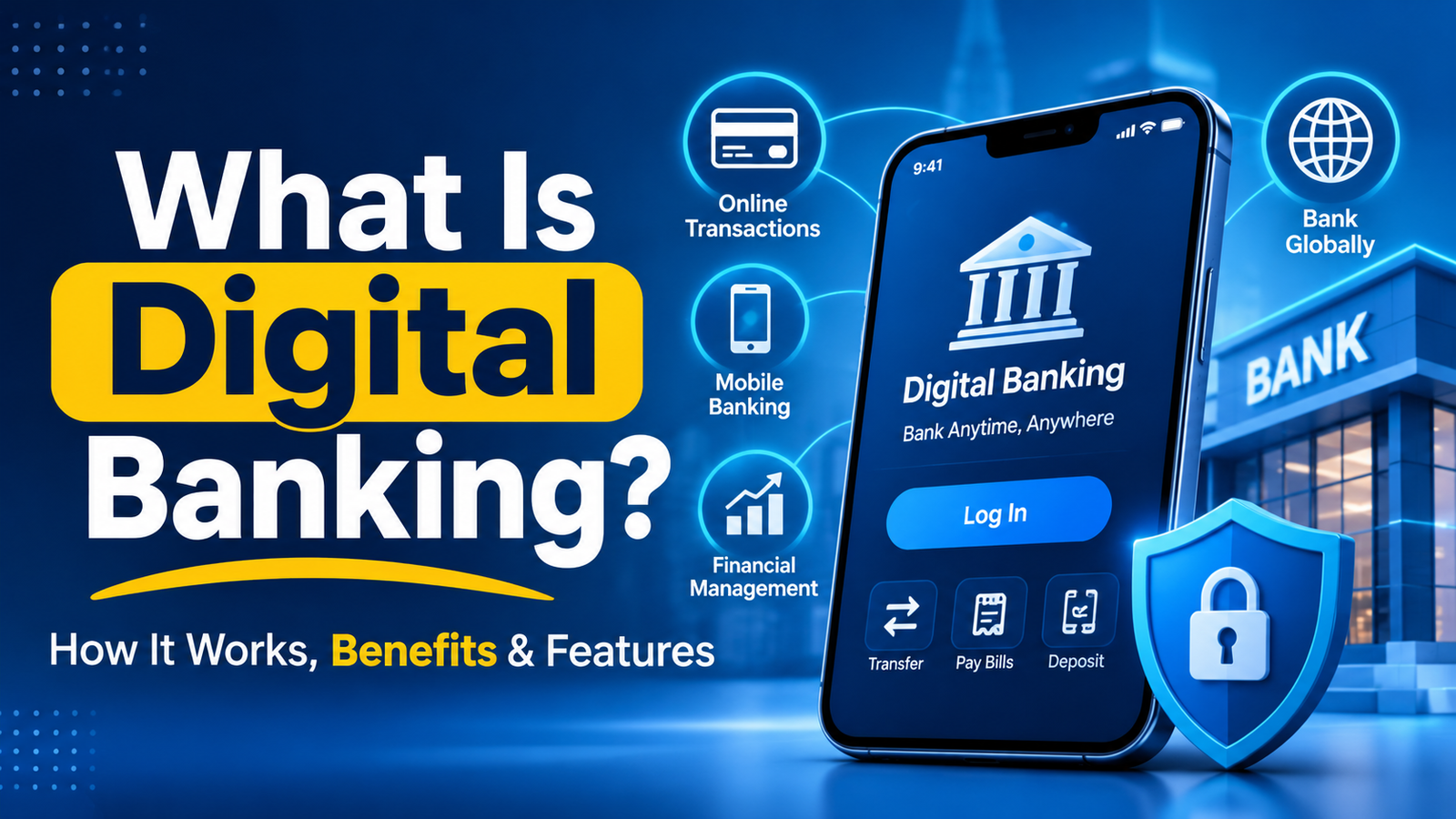

Digital banking is banking using a website or mobile app rather than a branch. It has a number of benefits, including access at any time, increased speed of daily procedures, reduced costs at many colleges, and improved budget monitoring. The compromises include a risk of cyber breaches, reduced face-to-face support, and having to verify whether the funds are covered.
That is important because there are a variety of products that fall under the digital banking umbrella. The picture features a mobile app from a large national bank, an online-only bank, a credit union’s web portal, and a fintech app that works in conjunction with a bank. They appear the same from a cell phone screen but vary in terms of fees, safeguards and customer service.
This guide will help you understand digital banking, how it works, and the areas in which digital banking benefits are most apparent. It also addresses the hazards, demonstrates an actual example using hypothetical figures, and provides the steps to take to get started safely. The aim here isn’t to provide personalized financial advice, but rather education.
What are the primary advantages of Digital Banking?
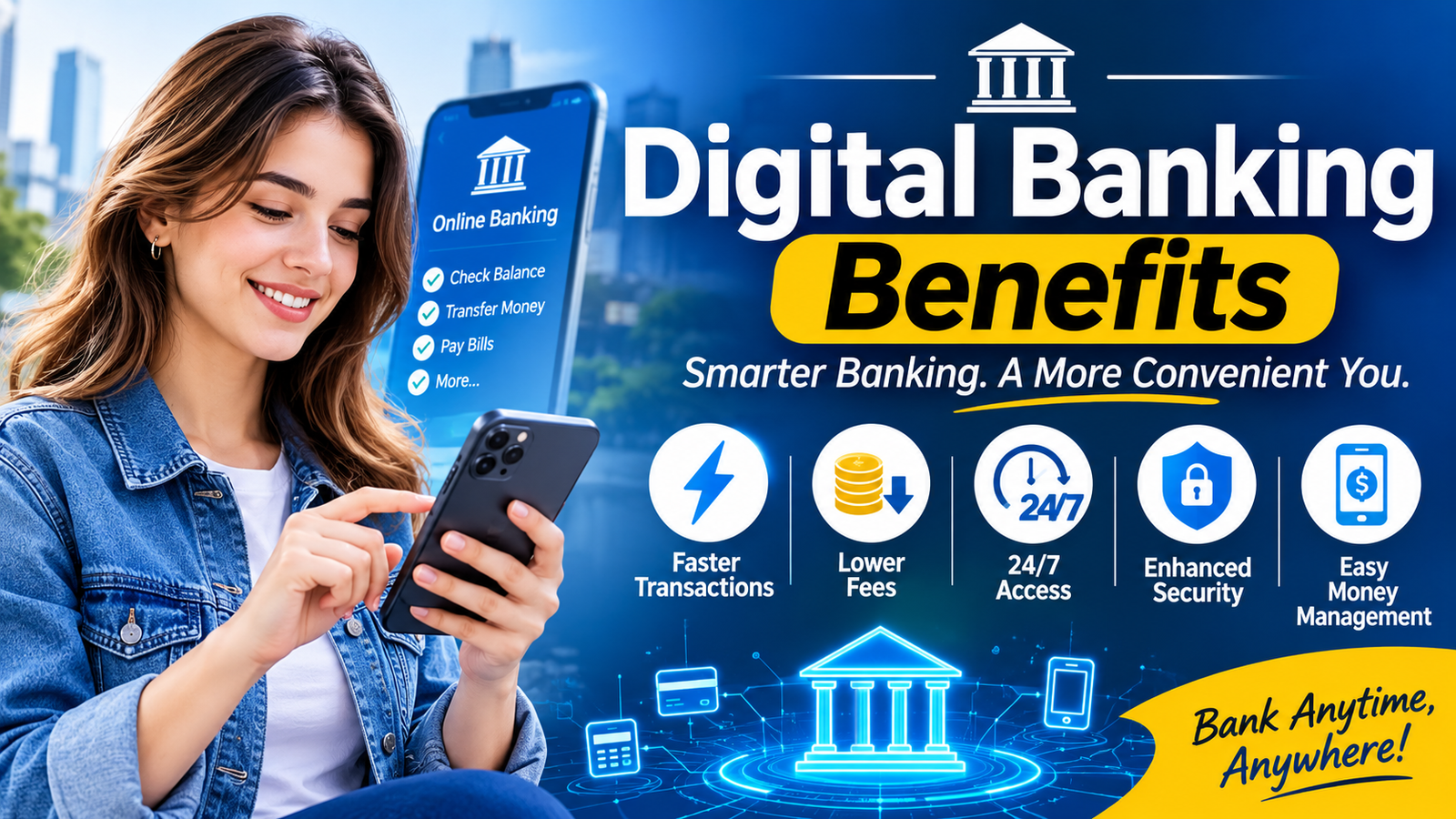
These advantages of digital banking are convenience, speed, reduced costs, improved money-management, and sometimes increased interest rates on savings. The specifics listed below are important for each benefit.
A brief overview:
24/7 access: Check balances, transfer funds and/or make payments anytime.
Quick daily transactions: Deposit a check using your cell phone’s camera, send money to a friend, or lock a lost debit card within seconds.
Possible savings: Often online banks have reduced overheads and lower fees.
More visibility: Categories, alerts, and savings goals will help you keep track of where your money is going.
Better competitive savings rates: Online banks may offer higher rates on savings than brick-and-mortar banks, but rates change frequently.
More control over security settings: You can freeze cards, set alerts and manage security settings yourself.
We will look at each of these in more detail later. Let’s clarify the definition of the term.
What is Digital Banking?
Digital banking refers to the application of online or mobile technology to conduct banking transactions, including checking balance, depositing checks, paying bills, transferring funds and more without having to visit a bank branch. It may refer to a traditional bank’s application, an online-only bank, or a financial technology (fintech) application.
While the terms “digital banking” and “online banking” are used interchangeably, they are not the same thing. Online banking is typically the process of making a visit to your bank’s website. Digital banking is a more comprehensive concept. That’s mobile applications, digital wallets, card controls and automated tools that are all interdependent and work across devices.
Digital banking providers in the US come in various forms.There are several digital banking provider types available in the US.
Knowing this can be useful to evaluate the protection you receive from the provider.
- Digital banks are traditional banks that offer digital services. Large national banks and community banks provide apps and websites, which are placed on their branch networks. Most deposits are insured by the Federal Deposit Insurance Corporation (FDIC) up to the federally insured amount of $250,000.
- Direct banks (online-only banks). These are banks that do not have any branches. Also, they are usually FDIC-insured, and they service their customers completely via applications, web pages, and phone support.
- Credit unions. There are plenty of mobile apps that are strong in the credit union space. The National Credit Union Insurance Fund (NCUA) normally provides insurance on deposits, not the FDIC.
- Fintech apps and neobanks. The companies develop the application, and the money is typically held by a partner bank. They are not usually banks, and insurance coverage may not apply so it’s important to find out where your money will be stored and how insurance will work.
What goes on behind the scenes.
The bank sends a payment request via a payments network when sending money or paying a bill. Common rails in the US include Automated Clearing House (ACH) network for bank-to-bank transfers, card networks for debit and credit transactions and instant payment systems. Bank connected services for peer-to-peer services are run by Zelle.
Money comes in various forms and travels at different paces. It can take 1-3 business days for an ACH transfer to post and may be as quick as real-time or card-based payments that post more or less immediately. Check your provider’s disclosures as this may vary from bank to bank and from account to account.
The process for mobile check deposit.Understanding how mobile check deposit works.
Mobile check deposit utilizes your cell phone’s camera. You take a picture of the front and the back of the check, endorse it following your bank’s guidelines, and then you return it. Funds may be subject to a hold by the bank and these may vary from one bank to another. Hold the paper check for a brief time, as directed by your bank, then properly shred it.
Why is Digital Banking important?
Digital banking is important because it is transforming savings, spending and risk management. It can help save time, can help save money and provides you with more control. It also helps budget for many households, since all the transactions are searchable and categorized.
The transition is also viable. Online bill pay, mobile pay and direct deposit are now commonplace in financial life in the United States. If a small issue can be fixed like denying a card or an unauthorized charge, people who are familiar with these tools can be able to solve it faster without waiting for the opening time of the branch.
Digital banking isn’t necessarily better for everyone, however. Certain individuals require cash deposits, notarized paperwork or face-to-face advice on complicated issues. Be mindful that many digital-first banks have fewer or no branches, so you’ll need to consider how you’ll do those things.
The Key Benefits of Digital Banking, Explained, is a thorough guide that outlines the advantages and disadvantages of digital banking.
1.Convenience and 24/7 access
Your balance will be viewable on Sunday night or pay a bill during lunch break. Don’t schedule your day around the hours of the branches. It’s a big benefit for individuals who work long hours, are caretakers or do not have access to a car.
2.Reduce fees for many institutions
Online banks typically don’t have a lot of physical branches so that they don’t have to pay for them. Some return part of those savings to their clients in the form of lower and/or zero monthly maintenance fees and lower minimum balances. However, fees vary from one to another and “digital” does not equal “free”.
Before opening an account read the fee schedule. Check monthly fees, overdraft, out-of-network ATM, wire, and paper statement fees. Other institutions may have a no-fee overdraft or may provide a small “overdraft buffer,” but there may be exceptions.
3.More tax benefits for higher savings, in many instances.5. Greater interest on savings in many cases.
Online banks often pay a higher annual percentage yield (APY) on their savings accounts compared with traditional banks. APY is the annual rate of return on your deposit, including compound interest. These rates are flexible – meaning the bank can alter the rate at any time. A high rate for the present time might not be as high the following year.
Rates fluctuate with the general interest rate system so please check current offers directly with the institution. A better APY isn’t a sure bet and is more important if you have a substantial amount of money to earn interest.
The third, which is not that noticeable, is improved budgeting and tracking tools.
There are various applications that automatically classify your expenses. Some charts for groceries, rent, subscriptions, and eating out might be around. Some allow you to set saving objectives, round buying, or perhaps divide your direct deposit into diverse containers.
These features can assist you in identifying recurring charges you might not be aware of, like an unused streaming service. Numbers that are seen on a frequent basis can help make better decisions, but the tools will only help you make better decisions when you use them.
4.. Quickly get your paycheck.
A few banks offer same day direct deposits a day or two ahead of schedule, depending on when they receive the payment notice. This does not exist at all banks and there are various policies. If early access is an important factor, check it out before assuming it will be available for bills.
5.. Instant security controls
It can be a stressful situation when you lose your debit card. Many banking applications allow the card to be frozen in a matter of seconds and unfrozen if it is found. It is also possible to set alerts on big purchases, foreign transactions, or low account balance. These controls provide you with a quicker response mechanism than a phone line.
6.Easier paperwork
The collection of digital statements, tax forms, and account documents are stored together. Usually, they can be downloaded when you need, such as tax time or when applying for a loan. Make sure that there is tight security on your email and your device as these documents have sensitive information.
7.Assistance to small businesses
Digital tools can assist freelance work and small business owners to isolate their personal and business finances. Faster time could be saved with features like invoicing, expense tagging, accounting software integrations, etc. Compare carefully as each business account has its own fee structure and requirements.
What are the risks posed by digital banking?
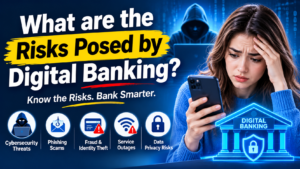
The most common threats include fraud, account takeover, phishing, weak passwords and the possibility that a fintech service provider is not covered as you think. With proper habits and the right provider, most of this risks can be mitigated.
Cybersecurity and fraud
Digital accounts are targeted via fake e-mail, text messages and phone calls. One well-used technique is to pretend to be a bank’s fraud department and request you to “confirm” a code. You don’t need to disclose one-time passes to real banks.
There is also a risk of peer-to-peer payment scams. Once you pay someone, you may not be able to get the money back if you pay a scammer. Think of them as cash and only send to individuals you know and trust.
Limited in-person help
Online-only banks may not have any branches. In cases when you must deposit cash or obtain a cashier’s check or deal with a complex matter in person, you may be restricted in your choices. Some online banks have a relationship with ATM networks or retail locations to provide cash services, but the terms and charges are different.
Technology problems
Applications can crash, websites can be down, phones can be lost and broken. Carry a Plan B, from another payment method to a Debit Card to having access to your account from another device.
When the insurance is not clear, some fintech applications will have unclear insurance.
One of the most critical issues for the U.S. consumer is this. If an insured bank fails, FDIC insurance would protect your deposits. It does not offer fraud loss protection, and isn’t effective against a fintech company itself unless the funds are kept at an insured bank in the right way.
Fintech applications are not all banks. They use partner banks for the storage of the customers’ money. Getting your money back may take time in case there are problems with the app or if there is a middleman between the app and the bank. Read the disclosures of the app, make sure to know which bank is the partner, and verify how the insurance will operate with your balance.
Knowing the FDIC/NCUAs limits:
The FDIC insures individual bank accounts for $250,000 per depositor per bank, per account type. At federally insured credit unions, NCUA offers equivalent insurance coverage. Coverage may be different for each of the accounts, for example, some retirement accounts or joint accounts.
The rules of insurance can be intricate. Verify your situation using the FDIC’s official resources, like the BankFind and deposit insurance tools, and the NCUA’s official share insurance information.
The fraud protection available under the rules of the United States
The Electronic Fund Transfer Act and Regulation E under the Consumer Financial Protection Bureau (CFPB) offer some consumer protection for electronic transactions, including debit card and ACH transactions. Those rules govern how fast you report unauthorized transfers, and may mean that you’re liable if you don’t report them promptly enough. For instance, if you report quickly, you may limit your losses, if you wait, your losses may be greater.
The following table provides a quick comparison between traditional banking and Digital Banking.
| Feature | Digital-first or Online Bank | Traditional branch bank | |
| Hours | Always available online | Branch hours plus online access | |
| Typical fees | Always available online | Often higher, but may be waived | |
| Saving rates | Often more competitive | Often lower | |
| In – Person rate | Limited or none | Available | |
| Cash Deposits | Can be difficult | Usually easy | |
| Loan Relationships | Varies | Often broader options |
Both of these models do not work all the time. Many Americans have a combination, with a branch bank account being used for cash and loans, and an online account for high-yield savings.
A Hypothetical US Household’s Digital Banking Experience.A Hypothetical US Household’s Digital Banking Experience.
The numbers used in the following example are fictitious and not meant to represent actual occurrences. The outcome you receive will vary with your bank, balances and actions.
Let’s say Maria is a freelance designer in Ohio. She has $10,000 in her traditional bank account with an APY of 0.40%. She also has a checking account with a $12 minimum balance requirement, so she pays a $12 monthly fee on her checking account.
Then, Maria does a cost comparison. She opens a checking account that doesn’t require a monthly fee and transfers her savings to an online savings account with the FDIC that offers a 4.00% APY. Actual rates may vary and these are not guaranteed.
What is simple math, without compounding and taxes:
- Old savings interest: $10,000 × 0.40% = $40 per year
- New savings interest: $10,000 × 4.00% = $400 per year
- Old checking fees: $12 × 12 = $144 per year
- New checking fees: $0
In this illustration, the total difference is approximately $504 per year. This is the kind of result that people envision when discussing digital banking benefits—but it’s not a guarantee. The interest earned may be subject to taxation, there may be conditions on the account and savings rates may decrease.
Maria has trade-offs, too. She gets occasional checks and cash from clients, so she verifies her new bank offers mobile check deposit and has a partner network for cash deposit. On day one she establishes transaction alerts and multi-factor authentication.
The initial steps for digital banking.Getting started with digital banking.
Here are the tips you need to open up a safe account with your provider of choice.
- Define your needs. Determine if you need a checking account, a savings account or a combination of both. Take into account cash deposits, ATM access, and branch proximity.
- Verify insurance. Ensure that the bank or credit union is insured by the FDIC or NCUA, respectively. Don’t take marketing claims for granted, use official FDIC and NCUA tools.
- Shop for the lowest fees and rates. Check fees, APY, minimum balances, overdraft policies and ATM access.
- Look at the type of provider. If it’s a fintech app, determine which bank has your money.
- Check reviews and complaints. The comments in the app store reviews can demonstrate the performance of the app. A company’s problems may also be reflected in the CFPB’s complaints database, which is available to consumers.
- Open the account. Do not click a link from an unsolicited email or message.
- Enable security features. Use multi-factor authentication, alerts and biometric login, if supported by device.
- Move money gradually. Do it with a smaller transfer first and test to make sure it is working before transferring all your money or paycheck.
- Keep a backup. Keep an alternate account and/or method of payment if there is a lockout or power outage.
How to protect your online accounts.Security of online accounts.
- Have a different long password for each financial account.
- If you have trouble remembering passwords, use a password manager that’s reputable!
- Use two factor authentication (preferably an authenticator app, not a text message).
- Do not give away one-time codes to anyone that contacts you.
- If available, don’t log on to public wireless networks.
- Install the latest operating system and banking application updates on your phone.
- Check your accounts regularly for unusual transactions.
- Enter your bank’s Internet address into your browser, rather than click on email links.
Common errors to steer clear of:
A lot of the issues occurring in digital banking are preventable. Watch for these.
- Let’s say all apps are a bank.Let’s say that all apps are a bank. Check if your funds are in an FDIC or NCUA-insured account.
- Only the highest rate, being pursued. A top rate can be one that has conditions, limited-time deals or service that’s not great. See the whole situation.
- Failure to follow the fee schedule. Overdraft and out-of-network ATM fees quickly accumulate.
- Reusing passwords. If you use the same login information on another site, you may be at risk of having your bank logins exposed.
- Skipping alerts. One of the quickest methods to identify fraud is through notifications.
- Not closing old account at the right time. Maintain the old account until all direct deposits and automatic payments and transfers have been completed.
- If you exceed the insurance limit, you’re not prepared. If the balance is over $250,000 at one institution, check the categories of bank ownership or diversify the funds among insured institutions.
- Trusting urgent messages. Scammers create pressure. Stop and call your bank from the number on your card or on the bank’s website.
- Getting rid of cash needs. If you are a tippers or have cash payments, plan accordingly.
Who is the biggest beneficiary of digital banking?
Digital banking is more suited to those who are tech-savvy and make most of their transactions online. Can be a good match for:
- Employees who work from home or as freelancers.People who work remotely or as freelancers.
- Students and young adults learning how to start their financial education.
- Those who are interested in generating additional income from their savings.
- Households who desire easy budgeting tools
- International travellers who appreciate mobile-savoir control of their cards.
It might be a less solid option for those who conduct most of their transactions with cash, require on-the-spot service or need manual instructions. For these families a combination of the two can be successful.
Frequently Asked Questions
Which is the most significant benefit to digital banking?
The main benefit is the convenience. Money management at your fingertips from your phone and computer. Many also like to have reduced fees and good tracking features, which rely on the provider.
Are there any risks of digital banking in the United States?
Digital banking can be safe if you bank with an institution that is insured and follow good security practices. If a bank fails, deposits are insured by the FDIC or NCUA, but not in all instances for fraud losses over the institution. Use strong passwords, multi-factor authentication and alerts to minimize your risk.
Do online banks have FDIC insurance?
Many online banks are FDIC insured but make sure to verify this on your own. Make sure the bank is listed in the FDIC BankFind Service. If you’re using a fintech app, check with the fund provider to know which bank the money is in, and understand how insurance works.
What is the difference between a bank and a neobank?
No. Neobanks are usually fintech firms that provide banking services via an app, usually with the support of a partner bank. It is possible that the app is not a bank, and that the deposits are held on the partner bank account. Read the disclosures to understand who is responsible for your money.
Is digital banking cheaper than conventional banking?
In many instances, but not all. Online Banks can offer lower fees due to lack of bricks-and-mortar branches. However, charges may apply for overdrafts, ATM withdrawals, wires or special service. Be sure to compare the full fee schedule before you select.
Can I put money in my account using a virtual bank?
It is dependent on the bank! Some online banks will not accept cash, and others will accept cash through a mail-in deposit or through an ATM network. Read the rules, limits and fees before opening the account.
But, are digital banks the right choice for small businesses?
They can be, particularly if your business operates primarily online. Check out business checking, accounting integrations, and straightforward terms and fees for invoicing. Before transferring operating funds, verify cash handling, lending policies and customer service.
Final Takeaway
Digital banking has tangible benefits for many consumers in the United States, such as access that is convenient, useful tools, and the opportunity to save more or pay less fees. These online bank benefits are not to be standard, though. This is subject to the institution, terms of the account and your personal habits.
First, check the FDIC/NCUa coverage. Next, compare fees, rates and features, turn on all security protections and have cash and emergency plans in place. If your financial circumstances are complicated, it may be worthwhile to consult an expert financial advisor.
Disclaimer: This article provides general education, and should not be interpreted as personalized financial, legal or tax advice. Be sure to check the latest rates, fees, rules and regulations, and insurance requirements from your financial institution and official U.S. sources before deciding.