
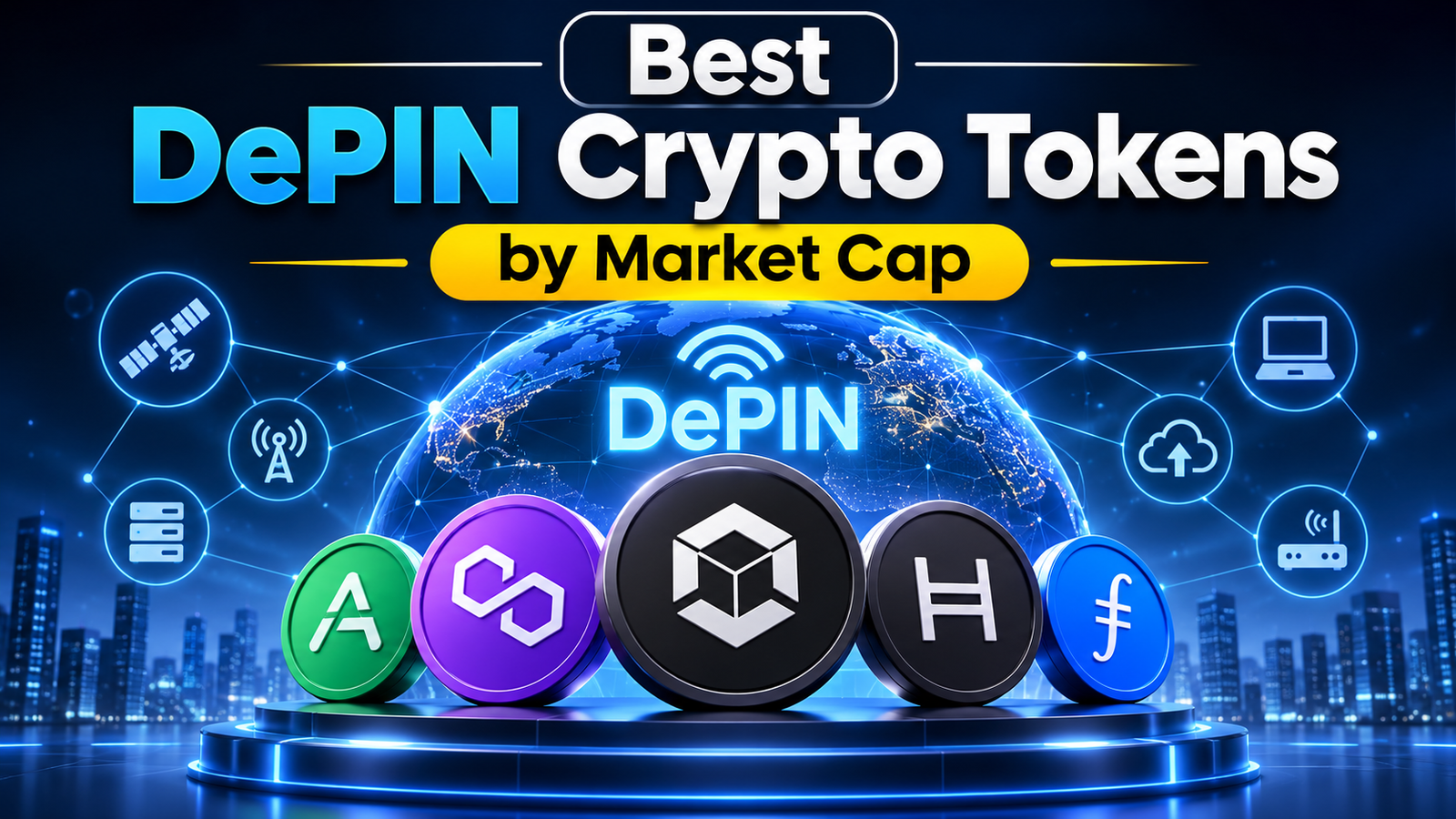
Bittensor (TAO) was the best performer in one of the May 2026 sector guides, with a current valuation of $3.12 billion, followed by Internet Computer (ICP) and Render (RENDER). The other top group was Filecoin (FIL). Many other lists like these list Helium (HNT), Arweave (AR) and Akash (AKT) in the top vicinity. Any ranking is a snapshot and will vary, depending on the tracker as well as each day.
That’s important to note for those who live in the United States. DePIN is decentralized physical infrastructure networks. The web networks pay individuals crypto tokens to provide real life assets like wireless coverage, data storage or computing power. Market cap is a measure of a token’s size. It doesn’t indicate if the network actually makes money.
The sector has also experienced a lot of volatility. According to the latest CryptoRank data in July 2026, DePIN is valued at approximately $3.46 billion. This is about 83% lower than a $20.2 billion high in March 2024. Other trackers had higher numbers due to different projects included.
This article provides context to read the best crypto tokens DePIN by market cap. It covers the mechanics of DePIN networks, the tokens that are in the lead, and potential risks. It also addresses US tax and regulatory issues and a hypothetical example. This is information and not financial advice.
What is DePIN and How is Market Cap used to rank DePIN Tokens?
Long answer: The largest tokens that are used to operate physical infrastructure networks are the best DePIN crypto tokens by market cap according to pricetimesupply. The larger the market cap the more trading and exchange listings. It doesn’t imply that it is safer, more lucrative or more probable of rising.
How market cap is calculated
Market cap is the product of a token’s price and the number of tokens in circulation. The value of a token is $2.00 and 500 million tokens are in circulation. The market value of the token is $1 billion. The figure is a size measure. It is not the quantity of cash investors invest.
Why two lists are not always the same
A DePIN token does not have an official definition. One tracker could have a data-indexing token, another doesn’t. This was highlighted in the July 2026 CryptoRank Report. It said CoinGecko valued the category at approximately $7.8 billion while DePINscan valued it at approximately $6.46 billion, compared to CryptoRank’s $3.46 billion.
Market cap vs. fully diluted value
There are also some trackers that display fully diluted valuation, known as FDV. FDV is based on the highest supply in the future and multiplied by today’s price. The substantial market cap to FDV ratio indicates that a number of tokens have not yet been introduced to the market, which may cause selling pressure later.
What are DePIN Networks?
A DePIN network incentivizes users to build and operate physical infrastructure, and provides the service to users for a fee. It consists of six steps.
- The network defines a need. These can be anything such as wireless coverage, storage space, GPU computing, or street-level mapping.
- Operators supply resources. People or companies deploy hardware (e.g. a wireless hotspot) or share computing resources.
- The protocol is used to verify the work. There are software checks that the operator used coverage, storage or processing.
- Operators earn tokens. Rewards are given to verified contributors in the form of the network’s native token, once they have contributed.
- The service is paid for by customers. Payment is done by the buyer in tokens, stablecoins or dollars. Some protocols have the revenue return to the tokens they have sold, and others allocate differently.
- Substitutes, rather than demand, should be used instead of subsidies. Rewards are the primary way that a network expands. In the long run, the payments of customers should be sufficient to cover the operator’s costs.
The reward flywheel is the token.The token is the reward flywheel
This loop is known as a flywheel by supporters. Operators are lured by the tokens, and in exchange they provide a better service, which attracts customers, and the customers’ revenue pays for the tokens. Loop can get stuck at any iteration. When the rewards are greater than the actual demand, operators sell their tokens to make up for expenses, driving prices down.
A real-world illustration
Examples include helium. Citizens offer “free Wi-Fi” and receive tokens in return.Users set up a wireless hotspot and receive tokens for the service. In a May 2026 sector guide, there were over 900,000 hotspots active, as well as over 120,000 paying subscribers. As numbers are approximate, they are from a third party summary.
Why Does DePIN Matter for US Investors and Businesses?
DePIN is important because it attempts to connect crypto tokens with services that people and companies purchase. These are big markets in the United States: Cloud storage, computing with graphics processors (GPU), and wireless coverage. DePIN networks seek to compete by leveraging unused or crowdsourced capacity, rather than company-owned data centers and towers.
The sector is yet to be established and small. According to the January 2026 report by Messari and Escape Velocity, cited by Cointelegraph, a value of approximately $10 billion was placed on DePIN, while on-chain revenue is estimated to reach $72 million during 2025. That’s a small amount of income pales in comparison to the valuation of the sector. It’s a reason to now focus on paying customers rather than the number of devices in use.
The same report revealed that the price of tokens may drop whilst the revenue rises. Helium’s price dropped 77% over the course of a year between December of 2024 and December of 2025, but Helium’s on-chain revenue increased by approximately eightfold. So, price alone is not a good metric of the performance of a network.
Adaptation of project teams is also under way. In November 2025, Filecoin launched Filecoin Onchain Cloud, which aims to enter the market of major cloud service providers like Cloudflare and AWS. It remains to be seen if that will work. The takeaway for US readers might be straightforward: Don’t evaluate a DePIN token based on its rank, evaluate it based on its usage and revenue.
What are the top ranked tokens by market cap for DePIN tokens?
The tokens mentioned below are the most popular ones on the top of the 2026 DePIN ranking. These are all listed by category and not by rank as there are different trackers and prices change daily. The only dollar amounts mentioned here are those of Bittensor, which is valued at approximately $3.12 billion in one of the May 2026 sector guides, Internet Computer valued at approximately $1.50 billion and Render valued at approximately $1.24 billion. Look at an up-to-date tracker for live numbers.
| Token | Category | What the Network does |
| Bittensor (TOA) | AI Compute | Rewards contributors to
machine learning tasks through specialized subnets |
| Internet Computer (ICP) | Cloud compute | Hosts web services and apps on a decentralized network |
| Render (RENDER) | GPU compute | Connects GPU owners with users needing rendering and AI processing |
| Filecoin (FIL) | Storage | Lets people rent out storage space and earn rewards |
| Helium (HNT) | Wireless | Pays hotspot owners for IoT and mobile coverage |
| Arweave (AR) | Storage | Offers long-term data storage with a one-time fee |
| Akash (AKT) | Cloud compute | Runs a marketplace for computing capacity |
| Grass (GRASS) | Bandwidth and data | Pays users who share unused internet bandwidth |
| The Graph (GRT) | Data indexing | Organizes blockchain data for apps; some trackers do not count it as DePIN |
| Livepeer (LPT) | Video | Provides decentralized video processing |
What the categories tell you
Compute and storage are the biggest segments on at least one DePIN ranking site. Much of that compute weight is due to AI demand. According to the May 2026 guide, Bittensor has an AI narrative premium, meaning that its price can fluctuate based on other market conditions affecting the AI sector, as well as the activity of its network.
How to read this list
This table is a summary table, and not a purchase list. The presence of a token in here does not indicate that a token is a good value, absence does not indicate that a token is weak. However smaller projects like Sensor, Mapping and Energy networks are lower in market cap lists but may have a strong usage trend.
What are some of the other things that matter other than market cap?
While market cap is a good first-cut filter, it is not the sole filter. A more complete picture is provided by 6 factors.
Paying customers revenue and real revenue
Binance CEO looks for off-crypto revenue sources. Questions that can be helpful are the amount of money customers pay, whether they return, and how much of the network capacity is actually utilized. The demand is not shown by connected devices. According to data point Forklog, reported by DePIN Pulse, Hivemapper’s annual recurring revenue increased from approximately $500,000 to approximately $3 million from August to November 2025.
Token supply and unlock schedules
New tokens are brought to the market via operator rewards, team and investor unlocks, and treasury releases. Every can can contribute to selling pressure. These factors were cited as contributing to the losses in the price of DePIN in the CryptoRank report.
Flow of liquidity and trading volume
It can be difficult to determine a fair price for a token with thin trading volume. Compare 24h trading volume and market cap. If very small, this is a warning sign.
Value capture
A network can generate income without any income being distributed to token owners. Review the project documentation and determine if there are fees for buybacks, burning, staking rewards or none.
The presence of existing providers, such as the local library.Presence of existing providers, e.g. local library.
Competition from established providers
Many DePIN networks cannot match the guarantees of service of large cloud, mapping and telecom companies. Explain the reasons for selecting the decentralized approach on price, performance or reliability.
Access and regulatory exposure for the United States
Some tokens are not available for trading on all US exchanges and state regulations vary. The SEC and CFTC are among the regulators that are continuing to influence the handling of crypto assets. Check current rules, before taking action, with official sources.
What is the pros and cons of DePIN tokens?
DePIN tokens provide investors with a genuine exposure to an actual infrastructure theme, but there is a lot of risk to them. As long as you are not putting your money in before you weigh both sides.
Potential benefits
Tied up with actual services. Value can be from customer usage, as networks sell storage, computing and/or connectivity.
- Exposure to multiple themes in cryptocurrencies. DePIN is not a payments or lending token, but it does share the crypto market’s momentum.
Increased revenue at some projects. Several of the top networks had verifiable recurring revenue as per the Messari report.
- Easy access. There are many major U.S. exchanges where large tokens trade.
Potential risks
- Severe price drops. CryptoRank indicated a decline of approximately 83% from its all-time high in the category in March 2024 to July 2026. Older-generation tokens are trading down from all-time highs by as much as 94% to 99%, according to Messari.
- Supply pressure. There’s continuous addition of rewards and unlocks to the game, and operators frequently sell these tokens.
- Narrative dependence. Sentiment may be a larger factor than network results in the swing of AI-related tokens.
- Weak value capture. The token owners won’t necessarily receive any revenue.
- Thin liquidity. Smaller tokens may be difficult to quickly sell.
- Regulatory uncertainty. Specific tokens’ treatment can change by the United States.
- No deposit insurance. If you store your cryptocurrencies in an exchange or on a wallet, they are not insured by the FDIC. Discuss protections with platform and FDIC to ensure they are current.
No one can guarantee profits from these investments. Only invest funds that you’re willing to lose.
Let’s take a look at a DePIN watch list and how a typical U.S. investor would react to it.
The numbers shown below are illustrative only. They are an example of the math and not a prediction or recommendation.
Assume that Maria is an investor in the USA who has $100,000 in her portfolio. She creates a watchlist of the top DePIN crypto tokens by market cap, and follows a rule of her own that she only invests 3% of her portfolio into speculative crypto. That limit is $3,000.
(Step 1):Test a worst case drop.Test a worst case drop..
As of now, the DePIN category has dropped approximately 83% from its peak in March 2024 to July 2026. Had it been the same drop as the $3,000, it would be worth approximately $510. This would result in a loss of approximately $2490, or about 2.5% of her total investment portfolio. Maria concludes that she will be fine with that.
Step 2: Check the tax result of a sale
Say Maria buys 100 tokens at $10 each, for a $1,000 cost basis. She later sells them at $14 each, for $1,400. Her gain is $400.
If she has been holding the tokens for over a year, she will generally incur long-term gains.
If she has held them for one year or less – they are generally short-term and taxed at ordinary income rates.
Step 3: Take into account reward.
The IRS normally considers the value of the tokens she’s earning to be income if she receives them.The IRS will consider the value of the tokens she’s earning to be income when she receives them, generally. The $50 is her cost basis in the tokens.
The tax law evolves and is based on individual circumstances. A tax expert will be able to verify their application to her case.
What are the first steps in research DePIN Tokens?
Research first, buy later – don’t buy first and research later. Here are seven steps to help you to have a careful process.
1.Decide on a target and a loss limit. Determine the percentage of assets you can risk as Maria did above.
- Subtract live market caps from two trackers. Check CoinGecko, CoinMarketCap or other websites. If the numbers are different, review each’s definition of DePIN.
- Read the documentation for each project. Understand the products/services the network offers, who buys them, and how they are utilized.
- Check revenue and usage data. Activity and fees can be displayed on dashboards like Token Terminal, DePINscan and Messari reports. Use only one dashboard at a time.
- Confirm US availability. Make sure that a US exchange that you have confidence in has the token and that it is open in your state.
- Secure your account. Turn on two factor authentication. If you have a significant number of assets, you may want to use a hardware wallet.
- Maintain day 1 tax records. Record all the dates, money, and quantity of each trade/reward.
Once purchased, review position on schedule. Avoid following all short-term price movements.Don’t follow all daily price moves.
What are some of the pitfalls to avoid with DePIN Tokens?
The biggest mistakes are treating a ranking as a recommendation. Be sure to keep an eye out for these 7.
Purchase due to the high rank of a token. Bigger isn’t necessarily better. There are also rapid changes in rankings.
- Trusting one tracker. This resulted in the totals varying from approximately $3.46 billion to approximately $7.8 billion in mid-2026, owing to the various definitions used.
- Ignoring supply. Review items in circulation, max supply, unlock dates prior to purchase.
- Chasing hype. AI tokens can be subject to fluctuations in the news cycle.
Instead of counting revenue – counting devices. It’s all about the paying customers when talking about millions of connected devices.
- Overconcentrating. It is easier to lose all the money in a portfolio if it is all allocated to one speculation.
- Skipping tax records. Lack of cost-basis information can cause challenges in filing a tax return and can result in errors. Records must be kept of reward tokens and trades.
A written plan will help. Before you make an order, determine your position size and justification for the purchase.
Frequently Asked Questions
What is the biggest market cap for a DePIN token?
Bittensor (TAO) was in the top spot in multiple 2026 snapshots. According to one guidance from May 2026, it was approximately $3.12 billion. These rankings will vary from day to day, and from tracker to tracker; always consult a live source for up-to-date information and do not count on any ranking.
What are the latest DePIN rankings?
To find out which crypto tokens are best to invest in DePIN, you are required to use a live tracker like CoinGecko or CoinMarketCap and check the market cap of the best crypto tokens on the day you research. Compare two or more locations. Different lists and totals will not equal each other as each sets its definition of the DePIN category.
Is DePIN tokens worthwhile?
These are what is known as high-risk assets and no one can guarantee outcomes. According to CryptoRank, the category has dropped by approximately 83% from its March 2024 all-time high to the current price of July 2026. While there is growth in revenue for some networks, token prices have not mirrored this. Take into account your objectives and loss tolerance, and consult with a certified financial professional.
Are DePIN tokens available for purchase by U.S. residents?
Yes, in many cases, but some are not available. While the smaller tokens might not be listed on major exchanges, many large DePIN tokens are available for trading on the major exchanges in the United States. Other factors, like state regulations and platform policies, can also restrict access. See what is being exchanged at the moment and see your state regulations.
What are the tax implications of DePIN tokens in the U.S.?
In general, the IRS considers digital assets property. Token sales or trading may result in a taxable gain or loss, and staking or mining rewards are typically taxable upon receipt. Rules for reporting are being rolled out, such as, for brokers, 1099-DA. Check IRS.gov and/or with a tax professional.
Is DePIN tokens a security?
There’s no one right answer. The determination of whether a token is a security is dependent on the facts and how the law is interpreted by the regulators and may vary over time. The crypto market is regulated by the SEC and the CFTC. Review the guidance they currently provide and if it applies to you seek advice from a securities lawyer.
Why did DePIN tokens fall so much?
According to the report, the CryptoRank-based report pointed to a number of factors. Valuations were ahead of adoption, and as token supply continued to increase, device numbers didn’t pave the way for income, and money flowed towards Bitcoin, stablecoins and other themes. Weak value capture for token holders was another factor.
Final Takeaway
The top DePIN crypto tokens by market cap provide a starting list rather than a buying signal. Leading 2026 snapshots are Bittensor, Internet Computer, Render and Filecoin but tracker prices are fast and variable.
Research using market cap, then revenue, token supply, liquidity and value capture. Determine a loss limit prior to purchasing and maintain clean tax records. Be sure to review the latest guidance by the IRS, SEC and CFTC, as rules may change. This guide is for informational purposes only and should not be used as a substitute for the advice of a licensed financial or tax advisor.