
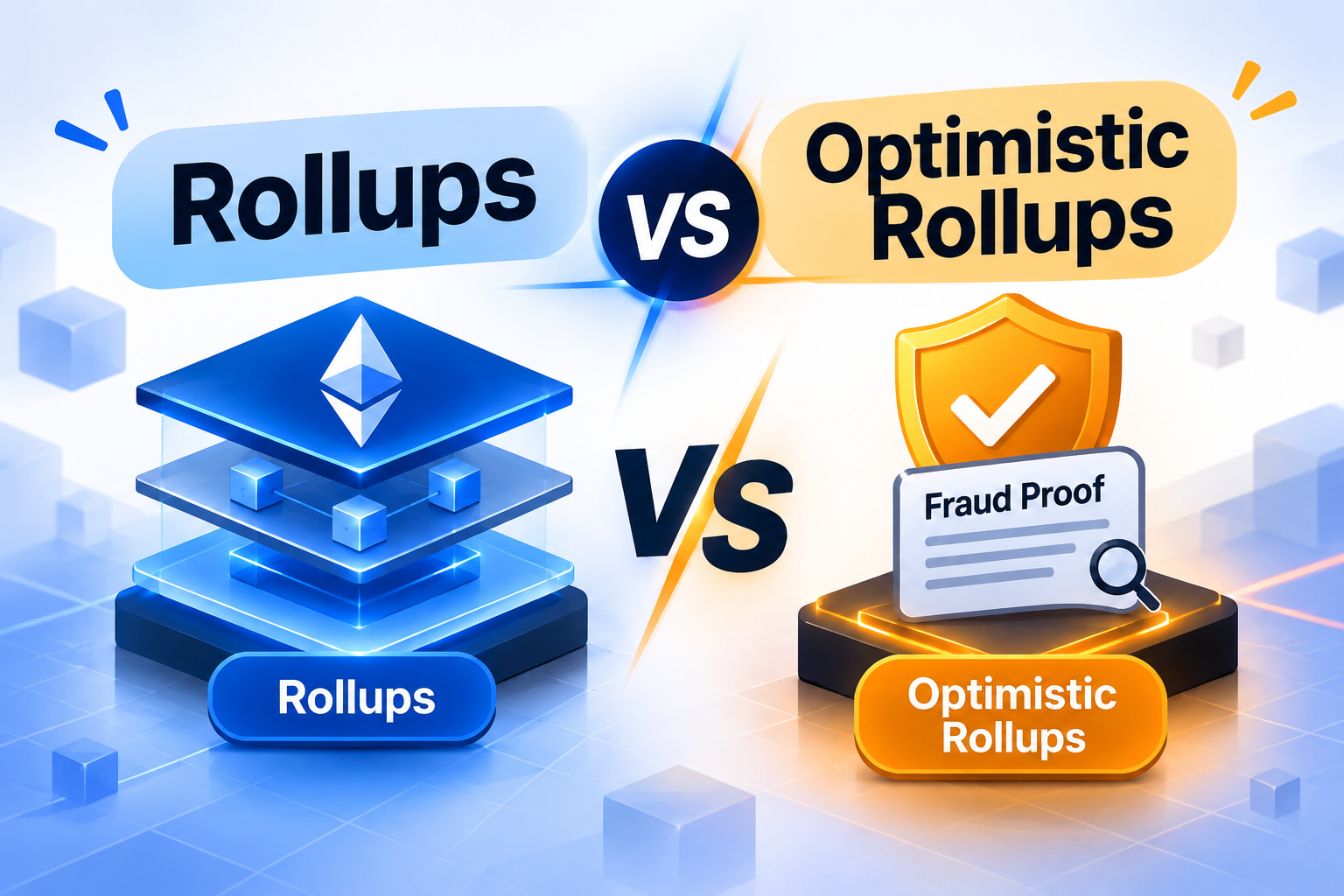
Quick Answer: Both types of rollups lower the costs and speed of Ethereum by taking transactions off the main chain and uploading compressed data to it. Optimistic rollups are optimistic, assuming but expecting transactions are valid and relying on a challenge window to detect fraud. Before Ethereum accepts the batch, ZK rollups prove that each batch is valid with cryptography. The outcome is a compromise: optimistic rollups are more developed and interoperable, while ZK rollups provide quicker finality and withdrawals.
Introduction
Ethereum is safe, but if you’re using it directly, you can get costly. A standard token swap can cost more than expected when the network is busy. Rollups, known as layer 2 networks, are meant to solve that issue.
If you have any crypto holdings in the United States, you may have come across the names of Arbitrum, Optimism, Base, zkSync, or Starknet. All are rolled ups. All of them will offer lower fees, but they accomplish this in different ways.
Knowing the difference between zero knowledge and optimistic rollups can help you decide which network is right for you. It also aids you to identify risks before transferring funds. This guide gives an explanation of each design, the differences between them, and what users in the USA should consider. This is an educational resource, not a financial, tax or legal one.
What is Optimistic Rollups & ZK Rollups?
A rollup is a Layer 2 blockchain that processes transactions off-chain, aggregates them into batches and uploads the results to Ethereum. Ethereum is then the ultimate record keeper and security layer. In this design, many transactions will benefit from a single Ethereum update.
Optimistic rollups make the presumption that each batch is correct. A batch can be challenged by anyone within a period of time, by providing a fraud proof. If successful, the network will reverse the bad batch.
Zero knowledge (ZK) rollups include a validity proof with each batch. This proof is a cryptographic result proving that the batch was compliant with the rules. Ethereum verifies the proof, and only accepts the batch if it passes.
In short, optimistic rollups assume that they are right and verify later if they’re called out. For rollups, ZK verifies first, and trusts second.
What does “Zero knowledge” mean?
Zero knowledge means it is possible to prove something is true without providing all the details. Most of the current ZK rollups do not offer privacy as their primary value. The advantage is that the benefit offers a short and efficient proof of the correctness of a batch of transactions. There are many ZK rollups that do not even conceal the transaction details.
But what is an Optimistic Rollup?
Optimistic rollups work in a straightforward manner. This is the general process:
- You make a transaction. You approve a swap, transfer or other action occurring on the rollup.
- It is sequenced by a sequencer. The sequencer is a server which gathers transactions and arranges them in order. Currently, this function is performed by a single company for most of the major networks.
- The sequencer groups up the data. It packs together numerous transactions into a single batch.
- It will be sent to the Ethereum batch. The rollup records the transaction information on Ethereum, enabling anyone to view it.
- A challenge window opens up. Validators and watchers can check the batch and provide a fraud proof if anything seems suspicious.
- The batch is complete. If no one is found to be a fraud: Ethereum says the result is settled.
The highlight is the challenge window. It’s generally been around seven days on the largest optimistic rollups. The official crossbridge typically takes several days to return to Ethereum, which is the reason for this delay.
The wait is the reason that many users prefer to use third-party fast bridges. A service that asks you to pay ahead of time for these services. It’s always a good idea to see the terms now, as networks may have changed their rules.
Why this design is popular
Optimistic rollups were introduced first and developers flocked to them. They closely interact with the Ethereum Virtual Machine (EVM) which powers Ethereum smart contracts. That way, existing apps can be ported over with minimal modification.
What is ZK-Rollups?
Steps 1-4 are the same for optimistic rollups. The difference is after the batch has been built.
- Send a transaction. This process is identical from your wallet.
- It is sequenced by a sequencer. A central sequencer is also used by most ZK rollups today.
- A prover creates a proof of validity. A prover is a special piece of software that will do the arithmetic to verify that the batch is correct.
- The proof and data are sent to Ethereum. Ethereum’s smart contract verifies the proof.
- Ethereum will accept or reject the batch. When the proof is valid, the proof is final. No challenge window is needed.
The network doesn’t require a week-long waiting period since it verifies the mathematics directly. The time to withdrawals can be in hours instead of days, but again, this depends on the network’s transaction confirmation frequency.
The catch
Creating the proofs requires significant computing power. It is also challenging technically to create a ZK system that supports all types of Ethereum smart contracts. Initial ZK rollups only worked for basic operations such as payments and swaps. Newer “zkEVM” designs are designed to be able to execute general smart contracts and have evolved rapidly.
What are the Major Differences at a Glance
| Feature | Optimistic Rollups | ZK Rollups |
| How batches are checked | Fraud proofs, only if challenged | Validity proofs, every batch |
| Official withdrawal time | Often about 7 days | Often hours, varies by network |
| Technical maturity | Longer track record | Newer, improving fast |
| EVM compatibility | Generally very high | Varies by network |
| Computing cost | Lower | Higher (proof generation) |
| Security assumption | At least one honest watcher | Math and proof system correctness |
However, computing costs have been observed to be lower than higher (proof generation).
The following security requirements are assumed: At least one honest watcher, correctness of the math and proof system. Keep in mind, these are basic patterns. Each network is unique and designs are continually evolving.
Why is the choice significant to US Users?
Most readers in the USA will not construct a rollup. They will use one. However, there are real effects of the design on your wallet.
Costs: The amount of fees charged for each transaction partly depends on how much the network spends to record the data on the Ethereum network.
Seven days to withdrawal: If you need cash for a tax bill or a purchase, it’s seven days that matter.
Failure points: Each security model has its own points of failure.
Availability of apps: Apps you desire could be available in just one network.
Rollups also influence the perception of Ethereum by institutions. The bigger the U.S. companies that are looking into tokenized assets or payments, the more they are interested in finality and auditability. Those priorities will shape what technology may be developed and funded.
There are key factors to take into account:
-
Fees
The two types are considerably less expensive than the main network of Ethereum. The 2024 “Dencun” update to Ethereum enhanced the rollup L2s with a reduced cost mechanism for posting data, known as blobs. That change lowered costs for both designs.
There’s still a fluctuation in fees depending on the network and demand. Use real-world examples of costs instead of blanket statements.
-
Withdrawal time and finality
Finality is the state of not being reversible. Validity is proven up-front, giving ZK rollups strong finality in a quicker manner. Optimistic rollups provide an immediate result but full settlement occurs during the challenge period on Ethereum.
The difference may be more significant than anything else if you will be transferring assets between the two networks frequently.
-
Security model
The optimistic rollups rely on the assumption that there is at least one honest participant that will monitor the process and be willing to provide a fraud proof. Bad batches can go undetected if no one is looking. The correctness of the proof system and code are crucial for ZK rollups. Even if the math is good, a bug in the proof software can be serious issues.
Both models are not 100% risk-free. The two are also smart contracts based, and smart contracts can have bugs.
-
Decentralization
These are the days when most major rollups are still using a single sequencer, and it’s built by the founding team. This poses risks of various kinds, including downtime or transaction censorship. There are many projects that announce that they will be decentralized over time, but plans are not guarantees.
Independent trackers like L2BEAT give “stage” ratings which defines the amount of potential power that a team has left on a rollup. Before you invest big bucks, review them!
-
Compatibility and ecosystem
Ensure that your preferred wallet, exchange or application supports the rollup. Older networks tend to be deeper and more liquid, that is, they are easier to trade without affecting the price of the stock.
-
Track record
Production time is scored. A network with billions of dollars of user money that has thus far had few serious incidents has a better record than a new network. Past performance still cannot predict future safety.
The benefits and potential hazards
Benefits and Potential Hazards:
- Optimistic rollups have several advantages.Optimistic rollups offer a number of benefits.
- Have more experience and support for more apps
- Good EVM compatibility, facilitating development
- Reduced computing needs compared to proof generation
Risks of optimistic rollups
- The time it takes for an official withdrawal is long.
- Having someone dependable to watch out for you.
- Fast bridges introduce third party risk and fees.
Benefits of ZK rollups
- More speedy finality and official withdrawals.
- Each batch correctly proved.All batches proven correctly, cryptographically.
- Efficient use of the data, as proofs can be used for compact posting.
Risks of ZK rollups
- Complex and newer technology that is on the shorter side of the record.
- Gaps in proof and circuits systems.Gaps in proof or circuit systems.
- Some apps don’t work with Ethereum.Incompatibility with current Ethereum applications
Risks that are applicable to both
- The vulnerabilities in smart contracts and bridge exploits.Bugs in smart contracts and bridge exploits.
- Centralized sequencers are a kind of upgrade keys or centralized sequencers.
- The volatility of token prices and the reduction of funds due to user mistakes.
- Changing regulation
US Considerations: Regulation and Taxes
The regulation of digital assets in the US is ongoing. Please check current guidance with official sources and a qualified individual, as information is subject to change.
Taxes.
Since Notice 2014-21, the IRS has deemed digital assets as property for federal tax purposes. If you transact in cryptocurrencies, it can trigger a taxable event whether you are selling, swapping, or spending the cryptocurrencies. The transfer of assets to a rollup through a bridge could constitute a disposal or it may not, depending on the specifics of the transaction and the tax adviser’s analysis. Make a record of each transaction, including network fees.
The IRS also asks about digital asset transactions on Form 1040. New broker reporting rules have been rolling in, such as the new Form 1099-DA. Refer to IRS.gov for updated guidelines for your tax year.
Securities and commodities regulations.
The SEC and CFTC share responsibilities in the oversight of cryptocurrencies in the United States. A rollup itself is software. Tokens, apps and services implemented on it may be subject to other regulations. Use caution when you hear anything about legal status; check, double check.
Consumer and custody protection.
Self-custody wallet on rollup funds are not FDIC insured. It’s the same with the majority of crypto exchange balances. If there are hacks or bugs or making a mistake, the losses may be irreparable.
Example: Transfer $2,000 to a Rollup (Hypothetical).
Let’s take two hypothetical users of the United States, Maria and James. Both would like to use a decentralized exchange without paying high Ethereum fees. The numbers below are only examples and are used to demonstrate the trade-offs.
Maria decides to take an optimistic rollup since her preferred lending app is there. She bridges $2,000 worth of USDC (a US dollar stablecoin) from Ethereum. The prices of her swaps are very low compared to the main network. Several months later she wants to transfer the money back to the Ethereum blockchain for her to sell. It takes her a week to get an official bridge, so she plans ahead. She decides to avoid an extra charge for a quick bridge.
James selects a ZK rollup because he is going to transfer funds frequently. He pays a total of that amount. His withdrawals back to Ethereum are done in a matter of hours. One app he likes has yet to be released on his network however so he takes a smaller app with less liquidity.
In some situations, one or the other option is better. Maria has access to a wider range of apps. James is faster on his feet. The point being illustrated here is that zero knowledge rollups vs optimistic rollups isn’t the issue of a single winner but rather one of your needs.
This is how you can start on your way safely.
Before you start playing for real money, follow these steps:
- Define your goal. Choose to trade, loan, save or just see.
- Choose a trusted network. Check its age, audits and independent ratings from sources like L2BEAT.
- Do a trial with a small quantity. Make a small payment upfront, like $20, to gain a better understanding of the process and fees.
- Manage bridges and links properly. Begin with the verified project site Web address. Scammers duplicate bridge pages.
- Check withdrawal rules. Know the time it takes for the exit to occur prior to placing your money.
- Secure your wallet. If you have substantial holdings, make sure to use a hardware wallet. Do not reveal your seed word.
- Track your records. Record transaction hashes, dates and dollar amounts for tax reporting purposes.
- Talk to a professional. A CPA who is knowledgeable in digital assets can provide you with clarity on your reporting obligations.
Avoid mistakes with common issues.
- Ignoring withdrawal times. Many people put in their money first and find out the exit delay is later.
- Trusting unofficial bridges. There are a lot of losses due to fake sites and unaudited bridges.
- The sole motivation of seeking the lowest fee. If the network’s security is not strong even with low fees, then it doesn’t matter.
- Private is assumed to be ‘zero knowledge’. The majority of ZK rollups do not obfuscate your transactions.
- Placing all things together. Having several wallets and venues reduces the impact of any failure.
- Skipping tax records. Tax time is stressful when you can’t figure out how much items are worth.
- Trusting in assurances of certain profits. There is no assurance of profits for any rollup or app.
- Clearing the destination network of the network name. To transfer any assets, you must have an equal amount of the fee token of that network.
Frequently Asked Questions
What are the advantages of optimistic rollups vs. zk-rollups?
Both have positive qualities but are not better in all cases. ZK rollups provide faster finality and faster withdrawals. Optimistic rollups have a longer history and more applications available. The best option for you will depend on the apps you require, your frequency of withdrawal, and the amount of risk you are willing to take.
But can ZK rollups be more secure than optimistic rollups?
Not automatically. The guarantees provided by cryptographic proofs is strong, provided that the code is correct, while zkRUPs offer higher rollup speeds. Optimistic rollups have been successfully deployed for longer in real conditions. Both can be vulnerable due to smart contract vulnerabilities, bridge vulnerabilities, or centralization.
Why are there a withdrawal period of 7 days in optimistic rollups?
This delay allows time for watchers to spot and reject invalid batches. If there were no window, a fraud proof might be too late. This varies depending on each network and may be changed, please refer to the current rules.
Do ZK rollups cost less than optimistic rollups?
This is subject to the network and demand. Data can be posted efficiently on ZK rollups and generating proof is costly. Optimistic rollups come without their proof costs, but they might end up paying for other overhead. Make sure to check real costs on the app you intend to use.
Are rollups a way to make transactions on Ethereum private?
No, not by default. Typically, most rollups publish all the transaction data in a public way, allowing Ethereum to verify it. Selected special projects provide privacy options. Never assume privacy unless there is an obvious privacy provision in the project.
Do rollup transactions require taxes in the USA?
They can be. The IRS considers digital assets to be property, which means selling or trading them could result in capital gains or losses. There may be some assets that, if present, create additional questions to be addressed. Visit IRS.gov and talk to a trusted tax advisor.
Does my cash have security with a rollup?
No, in general, cryptocurrencies stored in a wallet or on-chain app are not FDIC-insured. In the event of a bug, hacking or error, you could lose the money and it may be unrecoverable.
Final Takeaway
The zero knowledge rollups vs optimistic rollups debate is actually a discussion about trade-offs. Both designs are oriented towards lowering the costs and scaling up Ethereum. The major difference is how they establish the validity of transactions. Optimist designs are based off of a challenge window, and ZK designs are based off cryptographic proof.
The real differences for most users in the United States are in terms of withdrawal speed, availability of the app, and record. Security cannot be guaranteed by generalizing the details of each network, such as its code, bridge, and governance. Beware, proceed slowly, double check all, maintain accurate tax records and double check the rules with reliable official US sources before spending large amounts of money.