
Introduction
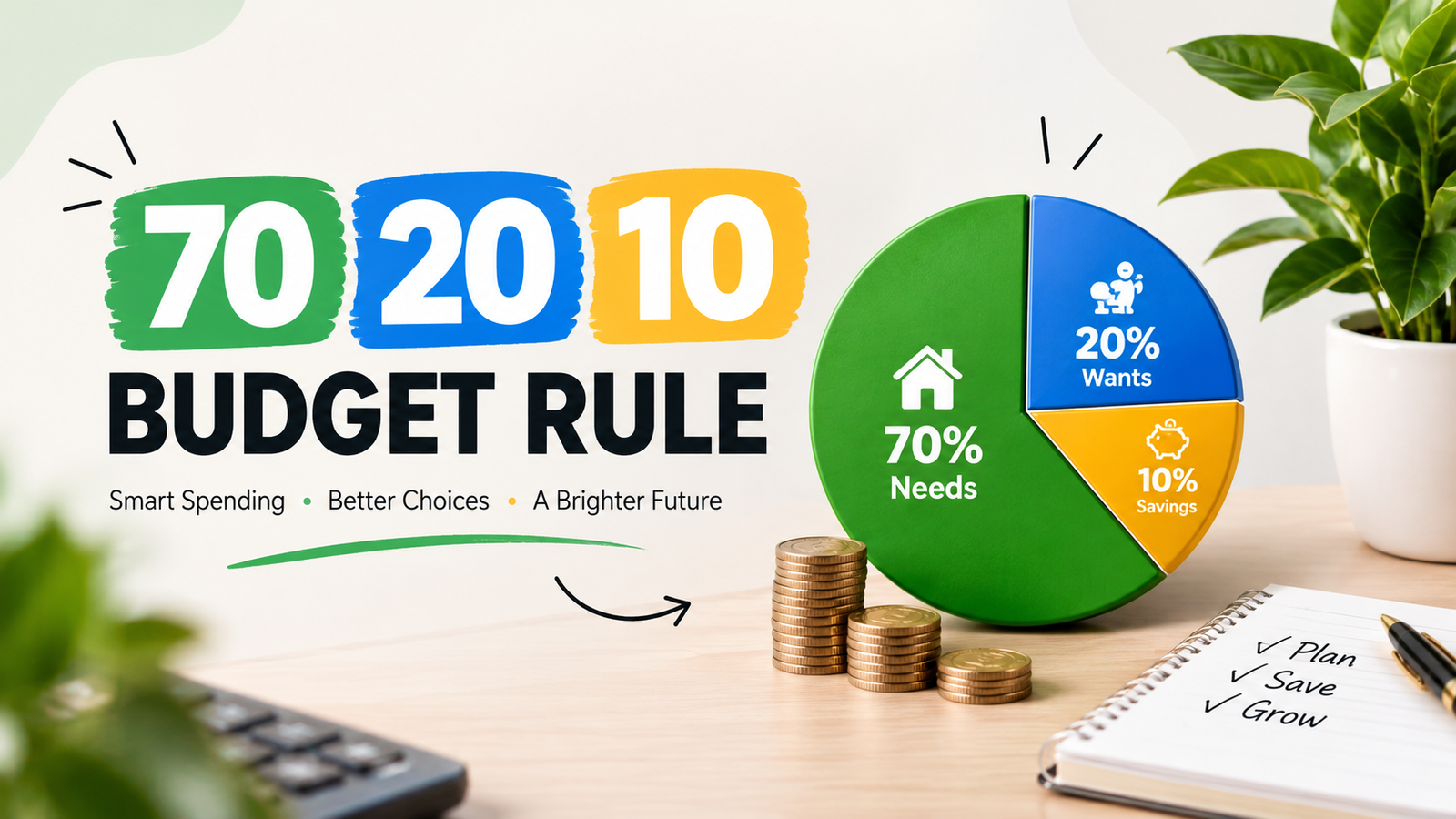
Budgeting doesn’t have to mean tracking every coffee in a spreadsheet. With the 70/20/10 approach, you just split your take-home pay three ways: 70% covers your living expenses, 20% builds your savings, and 10% goes toward debt payoff or investing. It’s a great starting point because you can map it out on the back of a napkin in five minutes.
Nobody wants to manage 30 budget categories. It lasts about two weeks, you miss a few receipts, get annoyed, and quit. Percentages are way easier. Split your pay into three buckets, run the quick math, and tweak things as real life happens.
Here’s how the 70/20/10 rule works in the real world, and why a lot of people pick it over standard budgeting apps. We’ll break down the math, look at where it falls apart if you’re renting in a pricey city, and walk through two realistic examples so you can set it up this afternoon.
Quick heads-up before we start: this is purely educational, not tailored financial advice. Everyone’s tax picture, debt load, and financial goals look different, so if you’re making major money moves, it’s always worth checking in with a qualified pro first.
What Is the 70/20/10 Budget Method?
At its core, the 70/20/10 rule is just three percentage cuts of your take-home pay. You use 70% to cover everyday life, put 20% into savings, and throw the final 10% at whatever priority matters most to you—whether that’s crushing debt, investing, or giving.
Here is how the three buckets usually break down:
- 70% for living expenses. This covers rent or mortgage, utilities, groceries, transportation, insurance, phone service, and everyday fun.
- 20% for savings. This includes an emergency fund, retirement contributions, and short-term goals like a car repair fund or vacation.
- 10% for debt payoff, investing, or giving. People choose whichever fits their situation.
That 10% bucket is where everyone tweaks the recipe. Some folks use it purely to murder credit card debt. Others dump it into an index fund or donate it. There’s no official governing body of budgeting handing down rules here—it’s just a practical framework people pass around online because it works.
Run these percentages on your take-home pay, not your gross salary. We’re talking about the actual deposit that hits your checking account on payday—after taxes, FICA, health insurance, and whatever else gets shaved off your paystub.
How Does This Budgeting Rule Work?
The method works by turning your paycheck into three fixed targets. You calculate the targets once, then check your actual spending against them each month.
Step-by-Step Setup
- Find your monthly take-home pay. Use your pay stub or your bank deposits. If your income varies, average the last three to six months.
- Multiply by 0.70, 0.20, and 0.10. These are your three targets.
- List your monthly expenses. Review bank and credit card statements from the last two or three months.
- Sort each expense into a bucket. Bills and daily spending go in the 70%. Savings transfers go in the 20%. Extra debt payments, investments, or gifts go in the last 10%.
- Compare the totals to your targets. Note where you are over or under.
- Adjust and automate. Set up automatic transfers so savings and debt payments happen right after payday.
What Counts as Living Expenses?
That 70% slice needs to handle two things: keeping your life afloat and letting you enjoy it. We’re talking rent or mortgage, utilities, food, gas, insurance, and the minimum payments on your debts.
That last part trips up a lot of people: Do minimum debt payments belong in the 70% or the 10%?
Most people bake required minimums straight into the 70%. If you don’t pay them, your credit gets wrecked, so they’re basically non-negotiable living costs. That leaves the 10% bucket purely for extra payments to actually knock the balances down. Either way, pick a lane and stick to it so your monthly tracking doesn’t get muddy.
What Counts as Savings?
The 20% bucket covers money you set aside for future needs. Common uses include:
- An emergency fund in a savings account
- Retirement contributions, such as a 401(k) or IRA
- Sinking funds for known future costs, such as holiday travel or car registration
- A down payment fund for a home
Money in your savings bucket should feel “off limits” for regular spending. That separation is what makes the plan work.
Why Does Percentage-Based Budgeting Matter?
The beauty of percentage budgeting is that it scales automatically. Get a raise or take a pay cut, and the math adjusts itself without you agonizing over new numbers. You don’t have to guess what you “should” save—the formula does the heavy lifting.
That matters because having any kind of cushion is tough right now. If you want the real-world pulse on how tight things are, look up the Federal Reserve’s latest Economic Well-Being of U.S. Households report. It’s the gold standard for data on how many families could actually cover an unexpected $400 expense—just make sure you’re pulling from the current year, since older stats get stale fast.
A simple structure helps for three reasons:
- It creates a savings habit. Saving 20% first, before spending, puts your future ahead of impulse purchases.
- It sets a spending ceiling. Knowing that living costs should stay near 70% gives you a quick warning signal when expenses creep up.
- It gives debt a dedicated slot. Extra payments happen on purpose, not only when money is left over.
It’s also forgiving for beginners. If you’ve never budgeted a day in your life, juggling three numbers feels doable—thirty will make you quit before lunch. You can always get more granular later once you’ve got your footing.
Plus, it acts as a built-in guardrail against lifestyle creep. When you land a raise, the instinct is to just let your spending expand to match it. With this, the math stays put: 30% of that new cash still flows straight into savings and your side goals, automatically protecting your future self from your new paycheck.
Key Factors to Consider Before You Start
The percentages are a guide, not a law. Several factors decide whether this split fits your life.
Your Cost of Living
Housing is the biggest expense for most US households. In expensive metro areas such as New York, San Francisco, Boston, or Seattle, rent alone can take 40% or more of take-home pay. A 70% cap on all living costs may be unrealistic there.
In lower-cost areas, the 70% target may leave room to spare. You could shift more toward savings or debt payoff.
Your Income Level
20% on paper isn’t the same as 20% in practice. Carving $500 out of a $2,500 paycheck is brutal when rent and groceries swallow almost everything. On an $8,000 income, stashing $1,600 is painless by comparison.
If you’re stretched thin, give yourself some grace. Start with 5%, or even 2%. The point is building the reflex of saving first—you can always crank up the percentage once you earn more.
High-Interest Debt
Credit card debt blows this whole formula wide open. Credit card interest rates are hovering at brutal highs right now, and they shift whenever the Fed makes a move. When your card is charging you 20% or 25% interest, but your savings account pays a fraction of that, hoarding cash doesn’t make sense. Knocking out that debt gives you an instant, guaranteed return that crushes any high-yield savings account.
If you carry high-interest balances, consider putting more of your 20% and 10% toward debt for a while. Then shift back to savings once the balances are gone.
Employer Retirement Match
There’s one clear exception: the 401(k) match. If your employer offers one, take every penny. It’s part of your paycheck, and capturing it is the easiest 100% return you’ll ever see. Prioritize that before padding an emergency fund or buying index funds. Since vesting schedules and match formulas vary everywhere, check with HR to see where the cutoff is.
Just don’t blow past IRS contribution caps. Check IRS.gov for this year’s maximums before setting up your auto-transfers.
Irregular Income
If you freelance, work on commission, or do gig work, your income is all over the place. Don’t budget off your best month—budget off your worst one. Build your 70/20/10 split around the lowest amount you typically bring in, then dump the extra cash from great months into a separate buffer account to carry you through dry spells.
And remember: taxes aren’t optional just because no one is withholding them. Peel off 25% to 30% for quarterly estimated taxes the second an invoice gets paid. Only apply your 70/20/10 percentages to whatever is left over after the IRS gets its cut.
Family Size and Obligations
Child care, health care, and support for relatives can push living costs above 70%. That does not mean you have failed. It means you need to customize the split.
Benefits and Potential Risks
No budgeting framework fits everyone. Here is a fair look at both sides.
Potential Benefits
- Simplicity. Three categories are easy to remember and maintain.
- Built-in saving. The plan makes saving a priority instead of an afterthought.
- Flexibility. You can adjust the third bucket to match your goals.
- Low effort. You do not need to categorize every latte.
- Scalable. It works whether you earn $30,000 or $150,000 a year.
Potential Risks and Limitations
- Not tailored to high-cost areas. Housing in some US cities can break the 70% ceiling on its own.
- May be too gentle on debt. If you owe a lot at high interest, 10% might not be enough.
- Vague categories. Without clear definitions, people mix up “needs” and “wants.”
- Not a full financial plan. It does not address insurance, taxes, estate planning, or investment strategy.
- No guarantees. Following any percentage rule does not guarantee financial security or any particular outcome.
The best approach is to treat the percentages as a starting point. If the numbers do not fit your life, change them. A budget you can follow beats a perfect budget you abandon.
Examples: How the Split Looks in Real Life
These examples use hypothetical figures for illustration only. Your numbers will differ.
Example 1: Single Renter With Moderate Costs
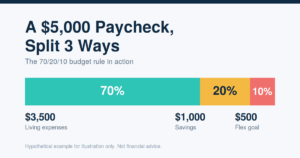
Maya lives in a mid-sized Midwest city. Her take-home pay is $5,000 per month.
|
Bucket |
Percentage | Monthly Amount |
|
Living expenses |
70% |
$3,500 |
|
Savings |
20% |
$1,000 |
| Debt payoff / other | 10% |
$500 |
Her living expenses add up as follows:
- Rent: $1,500
- Utilities and phone: $300
- Groceries: $600
- Transportation: $450
- Insurance: $250
- Dining out and entertainment: $400
That totals $3,500, exactly 70%.
She takes that $1,000 savings cut and splits it right down the middle: $500 straight into an emergency fund, and $500 toward retirement. That leaves the final $500 bucket, which she points directly at a $6,000 credit card balance running at a painful 22% APR. By throwing $500 a month at it, she wipes the card clean in about 14 months—assuming she stops swiping it and the rate holds steady.
Once the card is gone, she can redirect that $500 toward investing or a house down payment.
Example 2: Higher-Cost City, Tighter Budget
Daniel lives in a high-cost coastal metro. His take-home pay is $3,200 per month.
The 70% target is $2,240. But his essential costs look like this:
- Rent: $1,500
- Utilities: $250
- Groceries: $450
- Transportation: $350
- Health and insurance: $200
- Phone: $80
That totals $2,830, which is about 88% of his income. The standard split does not work for him right now.
Daniel could try a temporary split of 90/6/4. That would be $2,880 for living costs, $192 for savings, and $128 for extra debt or goals. It is not ideal, but it keeps saving alive as a habit.
For the long haul, he has to focus on the numbers that actually move the needle: split rent with a roommate, switch jobs for a raise, or move to a cheaper zip code. The second his earnings jump or his rent goes down, he can reroute that extra breathing room back into his 20% and 10% buckets.
The lesson: use the percentages as a benchmark, not a pass-or-fail test.
How to Get Started With the 70 20 10 Budget Rule
Setting up the 70 20 10 budget rule takes about an hour. Follow these steps.
- Gather your numbers. Pull your last two or three months of pay stubs, bank statements, and credit card statements.
- Calculate your average take-home pay. Use net income, not your gross salary.
- Set your three targets. Multiply that number by 70%, 20%, and 10%.
- Tally your real spending. Add up what you actually spend on living costs each month.
- Find the gap. Compare your actual spending to the 70% target. Note the difference.
- Trim or adjust. Look at the largest categories first. Small cuts to big expenses, like insurance, phone plans, or subscriptions, usually help more than skipping coffee.
- Open separate accounts. Keep savings in a different account from checking. Many people use a high-yield savings account at an FDIC-insured bank or an NCUA-insured credit union. Deposit insurance limits and rules apply, so confirm details on FDIC.gov or NCUA.gov.
- Automate transfers. Schedule savings and extra debt payments for the day after payday.
- Review monthly. Spend ten minutes checking your progress. Adjust the percentages if your life changes.
- Rebuild each year. Update the plan after raises, job changes, moves, or new family responsibilities.
Quick Tips for Success
- Start with a smaller savings rate if 20% feels impossible. Increase it by 1% every few months.
- Build a starter emergency fund first. A common guideline is three to six months of essential expenses, but the right amount depends on your job stability, household, and health.
- Keep a small “fun money” line in your spending bucket. Budgets with no room for enjoyment tend to fail.
Common Mistakes to Avoid
Even a simple budget can go wrong. Watch for these errors.
- Using gross income instead of take-home pay.
Applying percentages to your pre-tax salary overstates what you can spend or save. Always start with the net amount. - Forgetting irregular expenses.
Car repairs, annual insurance premiums, holiday gifts, and medical bills do not arrive monthly. Include them in your savings bucket as sinking funds. - Mixing up needs and wants.
A basic phone plan is a need. The premium streaming bundle is not. Be honest about the difference. - Ignoring high-interest debt.
If a credit card charges a high APR, minimum payments barely dent the balance. Put extra payments to work. - Never adjusting the percentages.
Life changes. A budget that worked when you rented a room may not fit after you have a child. - Treating the rule as a moral test.
If you land at 75/15/10, you have not failed. You have information. Use it to plan your next step. - Skipping the emergency fund.
Without a cash cushion, an unexpected expense can push you back onto credit cards. Even $500 to $1,000 gives you some protection. - Counting savings you spend.
If you regularly pull money from your savings bucket for everyday costs, the plan is not working. Look at why, and adjust the living-expense target.
Frequently Asked Questions
Is the 70/20/10 rule good for beginners?
Yes, it is a good starting point for beginners. It uses only three categories and requires no detailed tracking. Once you see where your money goes, you can add more detail or switch to another method.
Is the 70/20/10 rule based on gross or net income?
It is normally based on net income, meaning your take-home pay after taxes and payroll deductions. Using gross income can lead to overspending. If you contribute to a 401(k) through payroll, decide whether to count those contributions as part of your savings bucket, and stay consistent.
What is the difference between the 70/20/10 and 50/30/20 rules?
The 50/30/20 rule splits money into needs, wants, and savings. The 70/20/10 rule groups needs and wants into a single spending bucket, then separates savings and a third goal. Both are informal guidelines, not official standards.
What should the last 10% go toward?
It should go toward whatever supports your biggest financial goal. Common choices include extra credit card payments, student loan prepayments, investing, or charitable donations. If you have high-interest debt, many people focus there first. If you are debt-free, investing or giving may make more sense.
Does the rule work if I live in an expensive city?
It can, but you may need to adjust the percentages. In high-cost areas, housing may push living expenses well above 70%. A temporary split like 80/15/5 or 90/6/4 can keep the habit going while you work on raising income or lowering costs.
How much should I save each month under this method?
The rule suggests 20% of your take-home pay. On $4,000 per month, that is $800. If that is too much right now, start with a smaller amount and increase it over time. Saving something regularly matters more than hitting the perfect number.
Should I pay off debt or build savings first?
There is no single right answer. Many people build a small emergency fund first, then attack high-interest debt, then grow savings. If you have an employer 401(k) match, you may also want to capture it early. A licensed financial planner or a nonprofit credit counselor can help you decide.
Can I use this method with irregular income?
Yes. Base your budget on your lowest typical month. When you earn more, move the extra into savings or a buffer account. Self-employed readers should also set aside money for taxes before applying the percentages.
Conclusion
The 70 20 10 budget rule offers a clear, low-effort way to organize your take-home pay. It gives you a spending ceiling, a savings target, and a dedicated slot for debt payoff, investing, or giving. That structure can help you build better money habits without tracking every purchase.
Still, the percentages are only a guide. Your housing costs, debts, family size, and goals may call for a different mix. Start with the numbers, compare them to your real spending, and adjust until the plan fits your life.
For decisions that involve taxes, retirement accounts, or large debts, verify current rules with official sources and consider talking to a qualified financial professional. The best budget is the one you can maintain month after month.