

Introduction
The 70 20 10 budget rule is a simple way to divide your take-home pay. You spend 70% on living costs, put 20% toward savings, and use the last 10% for debt payoff, investing, or giving. Many people use it as a starting point because it takes five minutes to set up and needs no spreadsheet.
Budgeting often fails because it feels too complicated. Tracking 30 categories every week wears people out. A percentage-based plan asks for less. You pick three buckets, apply the percentages to your income, and adjust from there.
This guide explains how the 70 20 10 budget rule works and why some people prefer it to other methods. It also shows where the rule can fall short in a high-cost US city. You will see two worked examples, a step-by-step setup plan, and answers to common questions.
One note before we begin. This article is educational and not personalized financial advice. Your tax situation, debts, and goals are unique, so consider speaking with a qualified professional for decisions that carry big consequences.
What Is the 70/20/10 Budget Method?
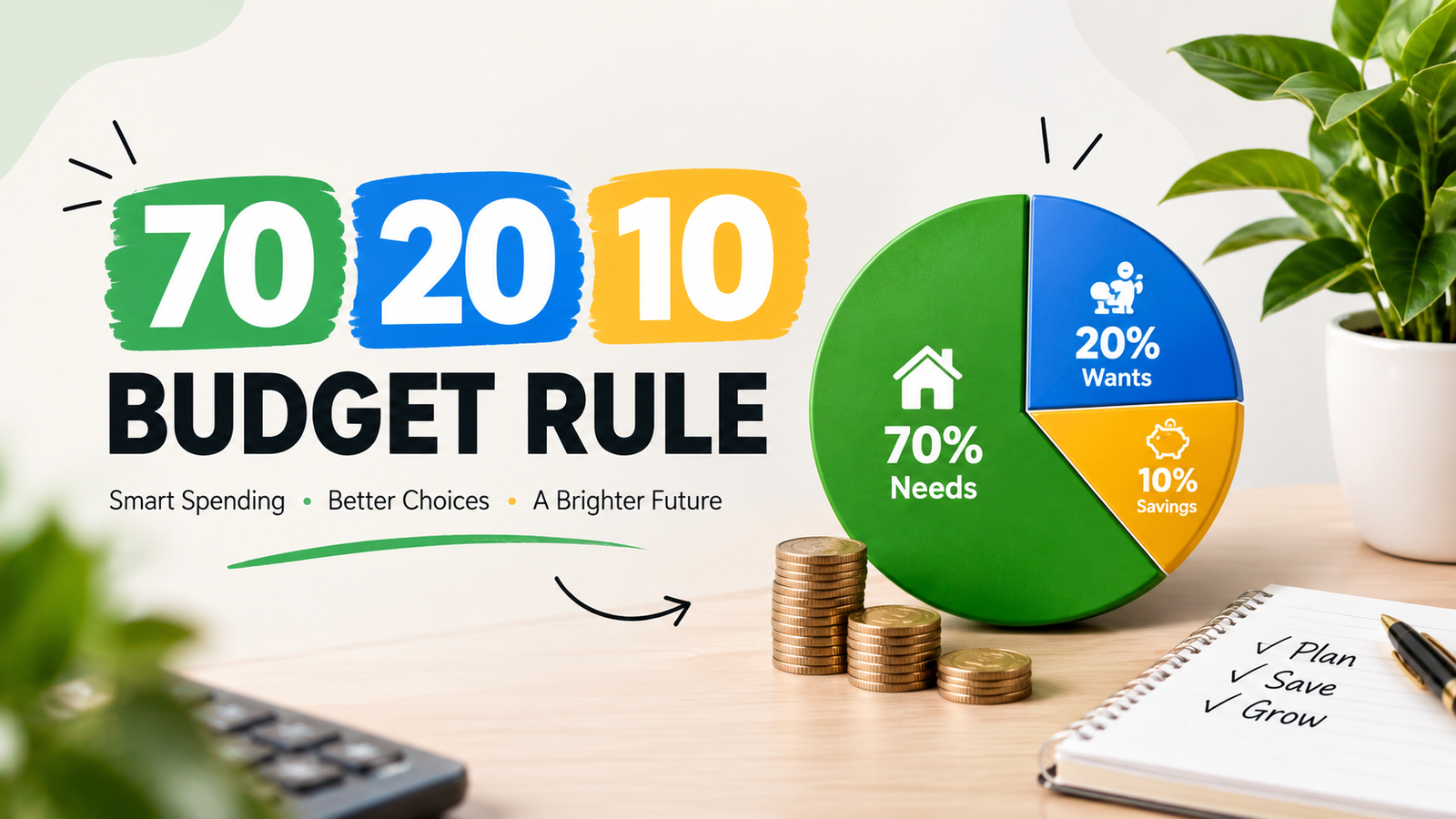
The 70 20 10 budget rule is a percentage-based budgeting framework. It assigns 70% of your after-tax income to everyday spending, 20% to savings, and 10% to a third goal such as debt repayment, investing, or charitable giving.
Here is how the three buckets usually break down:
- 70% for living expenses. This covers rent or mortgage, utilities, groceries, transportation, insurance, phone service, and everyday fun.
- 20% for savings. This includes an emergency fund, retirement contributions, and short-term goals like a car repair fund or vacation.
- 10% for debt payoff, investing, or giving. People choose whichever fits their situation.
That third bucket is where versions of the rule differ. Some people use it only for extra debt payments. Others use it for investing in a brokerage account or donating to charity. There is no single official definition, and no government agency or regulator publishes this rule. It is a popular personal finance guideline, not a legal or regulatory standard.
The percentages apply to your net income, also called take-home pay. That is the amount that lands in your bank account after federal and state taxes, Social Security and Medicare withholding, and payroll deductions like health insurance premiums. Your paycheck stub shows this number.
How Does This Budgeting Rule Work?
The method works by turning your paycheck into three fixed targets. You calculate the targets once, then check your actual spending against them each month.
Step-by-Step Setup
- Find your monthly take-home pay. Use your pay stub or your bank deposits. If your income varies, average the last three to six months.
- Multiply by 0.70, 0.20, and 0.10. These are your three targets.
- List your monthly expenses. Review bank and credit card statements from the last two or three months.
- Sort each expense into a bucket. Bills and daily spending go in the 70%. Savings transfers go in the 20%. Extra debt payments, investments, or gifts go in the last 10%.
- Compare the totals to your targets. Note where you are over or under.
- Adjust and automate. Set up automatic transfers so savings and debt payments happen right after payday.
What Counts as Living Expenses?
The 70% bucket should include the costs you need to live plus the everyday spending you enjoy. That covers rent or mortgage payments, utilities, groceries, gas, car insurance, health insurance premiums you pay directly, and minimum debt payments.
Here is a point that trips people up. Are minimum debt payments part of the 70% or the 10%? Most versions of the rule put required minimums in the 70% because they are unavoidable monthly obligations. The 10% then covers extra payments beyond the minimum. Whichever approach you choose, stay consistent so your numbers make sense over time.
What Counts as Savings?
The 20% bucket covers money you set aside for future needs. Common uses include:
- An emergency fund in a savings account
- Retirement contributions, such as a 401(k) or IRA
- Sinking funds for known future costs, such as holiday travel or car registration
- A down payment fund for a home
Money in your savings bucket should feel “off limits” for regular spending. That separation is what makes the plan work.
Why Does Percentage-Based Budgeting Matter?
Percentage budgets matter because they scale with your income and reduce decision fatigue. You do not need to guess how much to save. The formula gives you an answer.
Many Americans struggle to build a financial cushion. The Federal Reserve publishes an annual report on the economic well-being of US households, which is a useful source for current data on emergency savings and financial stress. Check the latest edition rather than relying on older figures.
A simple structure helps for three reasons:
- It creates a savings habit. Saving 20% first, before spending, puts your future ahead of impulse purchases.
- It sets a spending ceiling. Knowing that living costs should stay near 70% gives you a quick warning signal when expenses creep up.
- It gives debt a dedicated slot. Extra payments happen on purpose, not only when money is left over.
The method also works for beginners. If you have never budgeted before, this approach lets you start with three numbers instead of thirty. You can add detail later as your confidence grows.
Finally, the percentages carry over when your income changes. A raise does not automatically mean more spending. You apply the same split to the higher paycheck, which helps you avoid lifestyle creep, the tendency to spend more as you earn more.
Key Factors to Consider Before You Start
The percentages are a guide, not a law. Several factors decide whether this split fits your life.
Your Cost of Living
Housing is the biggest expense for most US households. In expensive metro areas such as New York, San Francisco, Boston, or Seattle, rent alone can take 40% or more of take-home pay. A 70% cap on all living costs may be unrealistic there.
In lower-cost areas, the 70% target may leave room to spare. You could shift more toward savings or debt payoff.
Your Income Level
Percentages behave differently at different incomes. At $2,500 per month in take-home pay, 20% is $500, and every dollar of the 70% is already committed to essentials. At $8,000 per month, the same percentage produces $1,600 in savings, and there is more flexibility in the spending bucket.
If your income is low, the rule can still teach a useful habit. Start with whatever percentage you can manage, even 5%, and build from there.
High-Interest Debt
Credit card debt changes the math. Average credit card interest rates are high, and they change with market conditions. The Federal Reserve and the Consumer Financial Protection Bureau (CFPB) publish current information. When a card charges a rate well above what a savings account pays, paying it down often does more for your finances than saving.
If you carry high-interest balances, consider putting more of your 20% and 10% toward debt for a while. Then shift back to savings once the balances are gone.
Employer Retirement Match
If your employer offers a 401(k) match, the match is part of your compensation. Many people prioritize contributing enough to earn the full match before other goals. Match rules vary by employer, so read your plan documents or ask your HR department.
Contribution limits for 401(k)s and IRAs are set by the IRS and change periodically. Check IRS.gov for current numbers.
Irregular Income
Freelancers, gig workers, and commission-based employees face uneven paychecks. If that describes you, base your budget on your lowest typical month. Move extra money from stronger months into savings or a buffer account.
Self-employed workers also need to plan for estimated quarterly taxes. Set that money aside first, then apply the percentages to what remains. The IRS explains estimated tax rules on its website.
Family Size and Obligations
Child care, health care, and support for relatives can push living costs above 70%. That does not mean you have failed. It means you need to customize the split.
Benefits and Potential Risks
No budgeting framework fits everyone. Here is a fair look at both sides.
Potential Benefits
- Simplicity. Three categories are easy to remember and maintain.
- Built-in saving. The plan makes saving a priority instead of an afterthought.
- Flexibility. You can adjust the third bucket to match your goals.
- Low effort. You do not need to categorize every latte.
- Scalable. It works whether you earn $30,000 or $150,000 a year.
Potential Risks and Limitations
- Not tailored to high-cost areas. Housing in some US cities can break the 70% ceiling on its own.
- May be too gentle on debt. If you owe a lot at high interest, 10% might not be enough.
- Vague categories. Without clear definitions, people mix up “needs” and “wants.”
- Not a full financial plan. It does not address insurance, taxes, estate planning, or investment strategy.
- No guarantees. Following any percentage rule does not guarantee financial security or any particular outcome.
The best approach is to treat the percentages as a starting point. If the numbers do not fit your life, change them. A budget you can follow beats a perfect budget you abandon.
Examples: How the Split Looks in Real Life
These examples use hypothetical figures for illustration only. Your numbers will differ.
Example 1: Single Renter With Moderate Costs
Maya lives in a mid-sized Midwest city. Her take-home pay is $5,000 per month.
|
Bucket |
Percentage | Monthly Amount |
|
Living expenses |
70% |
$3,500 |
|
Savings |
20% |
$1,000 |
| Debt payoff / other | 10% |
$500 |
Her living expenses add up as follows:
- Rent: $1,500
- Utilities and phone: $300
- Groceries: $600
- Transportation: $450
- Insurance: $250
- Dining out and entertainment: $400
That totals $3,500, exactly 70%.
She splits her $1,000 in savings into $500 for an emergency fund and $500 for retirement. The $500 in the last bucket goes toward a $6,000 credit card balance at a hypothetical 22% APR. At that pace, she would pay it off in roughly 14 months, though the exact timing depends on her actual interest rate and any new charges.
Once the card is gone, she can redirect that $500 toward investing or a house down payment.
Example 2: Higher-Cost City, Tighter Budget
Daniel lives in a high-cost coastal metro. His take-home pay is $3,200 per month.
The 70% target is $2,240. But his essential costs look like this:
- Rent: $1,500
- Utilities: $250
- Groceries: $450
- Transportation: $350
- Health and insurance: $200
- Phone: $80
That totals $2,830, which is about 88% of his income. The standard split does not work for him right now.
Daniel could try a temporary split of 90/6/4. That would be $2,880 for living costs, $192 for savings, and $128 for extra debt or goals. It is not ideal, but it keeps saving alive as a habit.
Meanwhile, he can work on long-term fixes. Options include finding a roommate, negotiating rent, looking for a higher-paying role, or moving somewhere cheaper. As his income rises or his costs fall, he can move closer to the 70/20/10 target.
The lesson: use the percentages as a benchmark, not a pass-or-fail test.
How to Get Started With the 70 20 10 Budget Rule
Setting up the 70 20 10 budget rule takes about an hour. Follow these steps.
- Gather your numbers. Pull your last two or three months of pay stubs, bank statements, and credit card statements.
- Calculate your average take-home pay. Use net income, not your gross salary.
- Set your three targets. Multiply that number by 70%, 20%, and 10%.
- Tally your real spending. Add up what you actually spend on living costs each month.
- Find the gap. Compare your actual spending to the 70% target. Note the difference.
- Trim or adjust. Look at the largest categories first. Small cuts to big expenses, like insurance, phone plans, or subscriptions, usually help more than skipping coffee.
- Open separate accounts. Keep savings in a different account from checking. Many people use a high-yield savings account at an FDIC-insured bank or an NCUA-insured credit union. Deposit insurance limits and rules apply, so confirm details on FDIC.gov or NCUA.gov.
- Automate transfers. Schedule savings and extra debt payments for the day after payday.
- Review monthly. Spend ten minutes checking your progress. Adjust the percentages if your life changes.
- Rebuild each year. Update the plan after raises, job changes, moves, or new family responsibilities.
Quick Tips for Success
- Start with a smaller savings rate if 20% feels impossible. Increase it by 1% every few months.
- Build a starter emergency fund first. A common guideline is three to six months of essential expenses, but the right amount depends on your job stability, household, and health.
- Keep a small “fun money” line in your spending bucket. Budgets with no room for enjoyment tend to fail.
Common Mistakes to Avoid
Even a simple budget can go wrong. Watch for these errors.
- Using gross income instead of take-home pay.
Applying percentages to your pre-tax salary overstates what you can spend or save. Always start with the net amount. - Forgetting irregular expenses.
Car repairs, annual insurance premiums, holiday gifts, and medical bills do not arrive monthly. Include them in your savings bucket as sinking funds. - Mixing up needs and wants.
A basic phone plan is a need. The premium streaming bundle is not. Be honest about the difference. - Ignoring high-interest debt.
If a credit card charges a high APR, minimum payments barely dent the balance. Put extra payments to work. - Never adjusting the percentages.
Life changes. A budget that worked when you rented a room may not fit after you have a child. - Treating the rule as a moral test.
If you land at 75/15/10, you have not failed. You have information. Use it to plan your next step. - Skipping the emergency fund.
Without a cash cushion, an unexpected expense can push you back onto credit cards. Even $500 to $1,000 gives you some protection. - Counting savings you spend.
If you regularly pull money from your savings bucket for everyday costs, the plan is not working. Look at why, and adjust the living-expense target.
Frequently Asked Questions
Is the 70/20/10 rule good for beginners?
Yes, it is a good starting point for beginners. It uses only three categories and requires no detailed tracking. Once you see where your money goes, you can add more detail or switch to another method.
Is the 70/20/10 rule based on gross or net income?
It is normally based on net income, meaning your take-home pay after taxes and payroll deductions. Using gross income can lead to overspending. If you contribute to a 401(k) through payroll, decide whether to count those contributions as part of your savings bucket, and stay consistent.
What is the difference between the 70/20/10 and 50/30/20 rules?
The 50/30/20 rule splits money into needs, wants, and savings. The 70/20/10 rule groups needs and wants into a single spending bucket, then separates savings and a third goal. Both are informal guidelines, not official standards.
What should the last 10% go toward?
It should go toward whatever supports your biggest financial goal. Common choices include extra credit card payments, student loan prepayments, investing, or charitable donations. If you have high-interest debt, many people focus there first. If you are debt-free, investing or giving may make more sense.
Does the rule work if I live in an expensive city?
It can, but you may need to adjust the percentages. In high-cost areas, housing may push living expenses well above 70%. A temporary split like 80/15/5 or 90/6/4 can keep the habit going while you work on raising income or lowering costs.
How much should I save each month under this method?
The rule suggests 20% of your take-home pay. On $4,000 per month, that is $800. If that is too much right now, start with a smaller amount and increase it over time. Saving something regularly matters more than hitting the perfect number.
Should I pay off debt or build savings first?
There is no single right answer. Many people build a small emergency fund first, then attack high-interest debt, then grow savings. If you have an employer 401(k) match, you may also want to capture it early. A licensed financial planner or a nonprofit credit counselor can help you decide.
Can I use this method with irregular income?
Yes. Base your budget on your lowest typical month. When you earn more, move the extra into savings or a buffer account. Self-employed readers should also set aside money for taxes before applying the percentages.
Conclusion
The 70 20 10 budget rule offers a clear, low-effort way to organize your take-home pay. It gives you a spending ceiling, a savings target, and a dedicated slot for debt payoff, investing, or giving. That structure can help you build better money habits without tracking every purchase.
Still, the percentages are only a guide. Your housing costs, debts, family size, and goals may call for a different mix. Start with the numbers, compare them to your real spending, and adjust until the plan fits your life.
For decisions that involve taxes, retirement accounts, or large debts, verify current rules with official sources and consider talking to a qualified financial professional. The best budget is the one you can maintain month after month.