

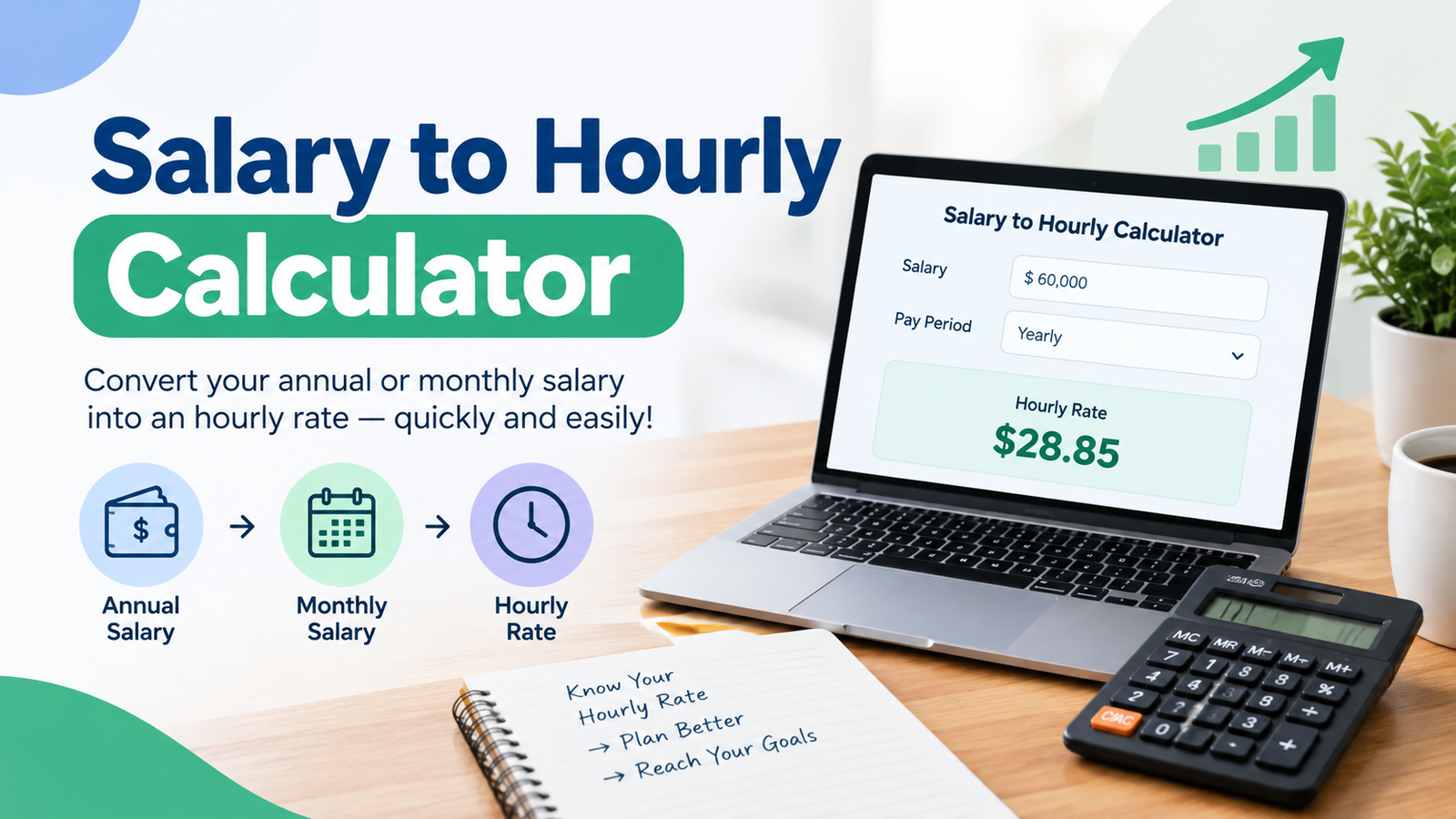
You need to divide your annual salary by the number of hours you work in one year, which for a full-time position would be 2,080 hours (40 hours per week x 52 weeks per year). An annual salary of $60,000 equates to an hourly rate of $28.85 before taxes.
The above calculation will solve the vast majority of searches. However, this figure can mislead you if you fail to take into account overtime, unpaid hours, benefits, or holidays. An annual salary of $60,000 paid for a 50 hour work week pays less per hour than the same salary for 40-hour work weeks.
This guide provides insight into how a salary to hourly calculator operates, how to calculate the conversion manually, and when the formula must be altered. The guide also discusses US-specific information, such as overtime, payroll taxes, and freelancer billing rates. The purpose of this guide is to assist you in comparing salaries, setting up freelancer rates, and getting a true value of your time.
This article is general financial education and does not constitute personalized tax, legal, or financial advice.
What Is a Salary to Hourly Calculator?
A Salary to Hourly Calculator is a calculator that will convert your annual salary to an hourly wage. All that you need to do is input your salary and the hours that you put in every week, and the calculator will divide the two to calculate the per hour wage.
Basically, the salary to hourly calculator will convert the year salary into an amount per hour worked. This makes it very useful when comparing an hourly wage to a salary.
The typical calculator requests three variables:
Annual salary: Total salary without taxes and other reductions.
Weekly working hours:
- Real working hours rather than contracted ones.
- Working weeks in a year: Usually 52, but sometimes users can remove weeks during which they do not earn money.
- There are some calculators that display weekly, biweekly, semi-monthly, and monthly salaries. Some calculators even allow calculating overtime and vacation payments.
Gross salary compared to net salary
All calculations from these calculators are gross salary. This is your salary before deduction of income tax at the federal and state level, and Social Security and Medicare. Your net salary will be less than the gross salary.
This is important when comparing salaries. Always compare gross salary to gross salary or net salary to net salary. Mixing them will cause poor decision making.
How Does the Conversion Take Place?
It is all about division math. Here is what you need to do.
- Identify your yearly salary. Your total annual salary, for example, will be $60,000.
- Determine total work hours per year. Multiply work hours per week by work weeks per year.
- If you work for 40 hours each week, that equals 40 × 52 = 2,080.
- Divide salary by hours. $60,000 ÷ 2,080 = $28.85 per hour.
- Round appropriately. People usually round off to the nearest cent.
This can be illustrated by this formula:
Hourly Rate = Annual Salary ÷ (Hours per week × Weeks per year)
Let’s look at an example with different parameters. Let’s assume that your annual salary is $60,000 and you work 45 hours a week. It means that your yearly number of hours is 45 x 52 = 2,340. Thus, your hourly rate will be $60,000 ÷ 2,340 = $25.64.
Can you see the difference? The same salary gives you $28.85 if you work 40 hours but just $25.64 when you work 45 hours.
Quick conversion table
The table below uses the standard 2,080-hour year. These figures are gross and rounded.
| Annual salary | Hourly rate | Weekly pay | Monthly pay |
| $40,000 | $19.23 | $769.23 | $3,333.33 |
| $50,000 | $24.04 | $961.54 | $4,166.67 |
| $60,000 | $28.85 | $1,153.85 | $5,000.00 |
| $75,000 | $36.06 | $1,442.31 | $6,250.00 |
| $90,000 | $43.27 | $1,730.77 | $7,500.00 |
| $100,000 | $48.08 | $1,923.08 | $8,333.33 |
| $120,000 | $57.69 | $2,307.69 | $10,000.00 |
Why is the number 2,080?
An average year consists of 52 weeks. If multiplied by 40 hours per week, we have 2,080 hours. It is the usual practice in the United States payroll and HR field.
Other companies might use 2,087 hours. The formula for computing it is by dividing 365 days by 7, then multiply by 40. Since the difference is minimal, 2,080 hours is enough.
Why Is It Important to Convert Your Salary into an Hourly Rate?
The conversion of your salary demonstrates how much you earn per hour. This one figure is used in making several important decisions. Let us take a look at some of the most common ones.
Comparing job offers. It is difficult to make an apples-to-apples comparison between a salary job and an hourly job. Converting them into the same unit will make it easier to see which is the better offer. This should be done after estimating the number of actual hours for each job.
Determining consulting or freelance rates. Lots of people go from salary work to being consultants or freelancers. Charging your former hourly wage will probably lead to making less money than before. We will explain why in a moment.
Overtime payments. Some salaried employees get overtime pay, while some do not. The hourly wage can help you ensure that the overtime is correctly paid.
Determining if promotion makes sense. An additional $5,000 in salary seems great. But if the promotion comes with ten more hours worked each week, the hourly wage may be lower.
Budgeting and personal planning. There are individuals who tend to think of their expenditures in terms of hours. A purchase worth $400 requires 14 hours of labor at an hourly wage of $28.85. This kind of attitude tends to curb impulse purchases.
Key Issues to Think About Prior to Taking the Number Seriously:
The simple equation presupposes the existence of the perfect 40-hour week. This is not true most of the time. Look at these key points before accepting any figure.
- Actual hours worked
Contracted hours and actual hours can vary. An employee who receives a salary may respond to email queries at night, travels on weekends, or skips their lunch break. Take some weeks to note down your actual hours and use the result when using the calculator.
- Paid time off and holidays
Paid vacations, sick leaves, and holidays are included in the salary. These are not additional compensations. Taking 15 days of paid leave and observing 10 holidays mean that you receive your pay for about 200 hours you don’t work.
This does not reduce your payment. Instead, it means that the rate per hour you work is higher than the calculated one. For instance, working 1,880 hours and getting $60,000 translates to earning approximately $31.91 for each hour worked.
- Employer-paid benefits
Employers usually make contributions towards health insurance and retirement plans among other benefits. The 401(k) match is an example of such contributions.
When comparing a salaried position and a freelance position, these benefits should be included in the calculation.
- Federal overtime requirements
The primary federal legislation regulating the minimum wage and overtime pay is the Fair Labor Standards Act (FLSA). According to the FLSA, non-exempt covered workers must be compensated at a rate of 1.5 times the regular rate for time worked beyond 40 hours per workweek.
Salary level alone is not enough to determine an exemption status. In order to become exempt, the employee needs to pass both the duties test and the salary-level test. The salary level has recently been adjusted and contested in regard to federal legislation. Consult the current federal salary level from the US Department of Labor.
- State and local laws
Some states and cities may require a higher minimum wage and more strict overtime pay requirements than those mandated by the federal legislation. For example, California has overtime pay regulations which regulate daily overtime in addition to weekly overtime.
Calculator Benefits and Possible Drawbacks
Internet calculators are quick and cost nothing. But there are drawbacks. Look at each side.
Benefits
Quickness: Results come instantly.
Conciseness: A single number per hour simplifies the comparison process.
Less math mistakes: The calculator does the work for you.
Versatility: Internet calculators allow for changes to be made to hours/weeks.
Negotiation: You can demonstrate to your employer how more hours will impact your pay.
Potential Risks and Drawbacks
Precision fallacy: An answer with the cent seems precise. Yet it can be as precise as the inputs are.
Missing out on perks: A bare bones calculator will not account for insurance, retirement contributions, and bonuses.
Lack of taxation analysis: The answer is the gross amount. It will not inform on how much you earn after taxes.
Legally blind to some facts: The calculator cannot determine whether you are eligible for overtime.
Predefined parameters: A lot of calculators use 40-hour work week and 52-weeks per year.
Consider the calculation as just an initial step.
Examples:
Making Sense of the Numbers
These numbers are imaginary and are used only for illustration purposes. They are not used to determine what you will earn.
Example 1: Job offers comparison
Maria is a marketing analyst in Ohio. She has got two offers.
Offer A: salary – $72,000; weekly working hours – 40.
Offer B: salary – $78,000; weekly working hours – 50.
The hourly salary for Offer A equals $72,000 / 2,080 = $34.62.
The hourly salary for Offer B: 50 × 52 = 2,600 annual working hours; $78,000 / 2,600 = $30.00 per hour.
Offer B provides Maria with additional $6,000 but lower hourly salary by $4.62. Thus, if she appreciates her spare time, Offer A should be considered.
Example 3: Determining freelance rate
Daniel is a graphic designer earning $60,000 per year through employment. She desires to become self-employed but maintain her standard of living. The following example is based on a situation where the assumptions are vastly different from those in reality.
First, she makes her list of requirements as follows:
- Desired salary: $60,000
- Health insurance cost paid by herself now: $7,200
- Costs for software, tools, and overhead: $3,000
- Saving for retirement: $2,400
Her total goal would be $72,600. But self-employment tax and income tax are additional; therefore, she gives herself a buffer of about 20%, which totals to around $87,000.
Next comes estimating her billable hours. She can’t bill for all 2,080 hours; marketing, invoicing, and administration require time as well. There are vacations and slack times that will cut into her billable hours too. Her estimate comes to about 1,300 billable hours per year.
She would have an hourly rate of $87,000 ÷ 1,300 = $66.92.
This is almost twice the $28.85 that she earns when working as an employee. This is because of the cost of taxes, benefits, overhead and non-billable time; not because of the profits. Some freelancers have a general guideline of charging one and a half to two times the hourly rate of an employee.
How to Get Started: What to Do Next
Use these tips to determine a trustworthy rate.
- Collect all data. Your gross annual salary should be found in your job offer letter or paycheck.
- Calculate your actual hours. Track your work schedule for a period of two to four weeks. Include evening and weekend working hours.
- Configure your calculator. Fill in your weekly hours and the amount of weeks per year. In case the website allows you to do that, reduce the total number of working weeks by unpaid weeks.
- Calculate your salary in several scenarios. Use your contract working hours, your actual working hours, and working hours during a busy season.
- Include benefits if comparing job offers. Calculate the estimated value of your employer’s health insurance and other additional payments.
- Check your overtime. If you are salaried, your income is not high and your job does not require you to work overtime, check with HR whether your position is exempt or non-exempt.
- Use any free salary to hourly calculator online. You can calculate your earnings using a spreadsheet as well. Spreadsheet is more popular because it allows calculating overtime and benefits in different cells.
Mistakes You Shouldn’t Make:
They are simple to make. All of these mistakes will affect your decision.
- 40 hours, but you work for longer hours. This is the most common mistake. Your hourly wage decreases each additional hour that isn’t paid.
- Comparing gross wages against net income. Always compare apples with apples – only like-for-like comparisons.
- Not accounting for paid vacation. If one position offers four weeks of paid vacation and another only offers two, the latter is better even though the pay might be higher.
- Overlooking non-salary compensation. A job that pays less but has excellent health insurance may be better than a job that pays more without any.
- Copying your employee rate to your freelance agreement. As seen from Priya’s example, you should include tax, benefits, overheads, and unbillable time as well.
- Considering salaried to mean no overtime. The determination of whether someone is exempted or not is based on their duties and salary amount.
- Treat the outcome as accurate. Try using one sample calculation twice with two different hourly amounts to see if the outcome will vary significantly.
- Ignoring official sources. The wage and overtime laws keep changing. Ensure that you get the most updated information before relying on any figures.
Frequently Asked Questions
How can I convert my salary into hourly rate?
Divide your annual salary by the number of hours worked in a year. If you work a full-time job, then use 2,080. So $50,000 ÷ 2,080 results in approximately $24.04 per hour.
In case you work more/less hours, then adjust the divisor accordingly. Multiply your weekly hours by 52 to determine the total annual hours.
What is the hourly rate of $60,000 per year?
An annual salary of $60,000 translates into an hourly pay rate of approximately $28.85 if you work 40 hours a week and 52 weeks in total. It is a gross number and doesn’t include taxes and other deductions.
If you work 45 hours weekly, then the hourly pay rate becomes $25.64.
How many hours in an annual work schedule?
There are 2,080 hours in a full-time annual work schedule. This number comes from the product of 40 hours worked in a week and 52 weeks.
It doesn’t include any unpaid vacation days you may take.
Which one is better: Salary or Hourly?
Neither of them is always better – your choice will depend on the number of your working hours, the option to earn overtime pay, benefits and income stability.
In many cases salaried positions provide a stable income and set of benefits. At the same time, in some situations, working on an hourly basis means earning more money when working overtime. Calculate both options based on your actual number of working hours.
Do salaried employees receive overtime in the United States?
Yes and no. According to FLSA, covered employees who are non-exempt have to be compensated for overtime in the form of additional hours worked, even though they have a salary.
Employees who fall under the exemption category are not eligible for overtime payments according to the federal legislation. This depends on duties performed and salary amount.
How do I calculate my hourly rate from a salary as a freelancer?
First of all, define your expected annual income. Next, calculate the cost of taxes, health care premiums, contribution to retirement accounts, and your business expenses. Divide this sum by billable hours, which will probably be lower than 2,080.
How do I determine my annual salary from my hourly rate?
Just multiply your hourly pay by your annual hours worked. If you earn $25 per hour and work 2,080 hours annually, then your annual salary is $52,000.
Here’s a faster way using this sample equation: Hourly Rate x Weekly Hours x 52. Bear in mind that unworked hours will decrease your actual annual salary.
Final Takeway:
Calculating your annual salary into your hourly rate is done with one divide function; however, making informed decisions requires more information. Start with 2,080 hours for the standard full-time workweek. Then, factor in your actual work hours, vacation time, benefits, and whether you qualify as a non-exempt worker.
A salary to hourly converter calculator is just a starting point and not gospel. Experiment with some scenarios, compare gross salary to gross salary, and run a few calculations on your numbers before resigning from a job or quitting. If you will be working as an independent contractor, remember to factor in taxes, benefits, overhead, and non-billable hours.
As a final step, ensure that you have current information on the minimum wage, overtime regulations, and tax laws by checking with the US Department of Labor, Internal Revenue Service, and your state’s labor department.




One thought on “Salary to Hourly Calculator: Convert Your Pay the Right Way”