
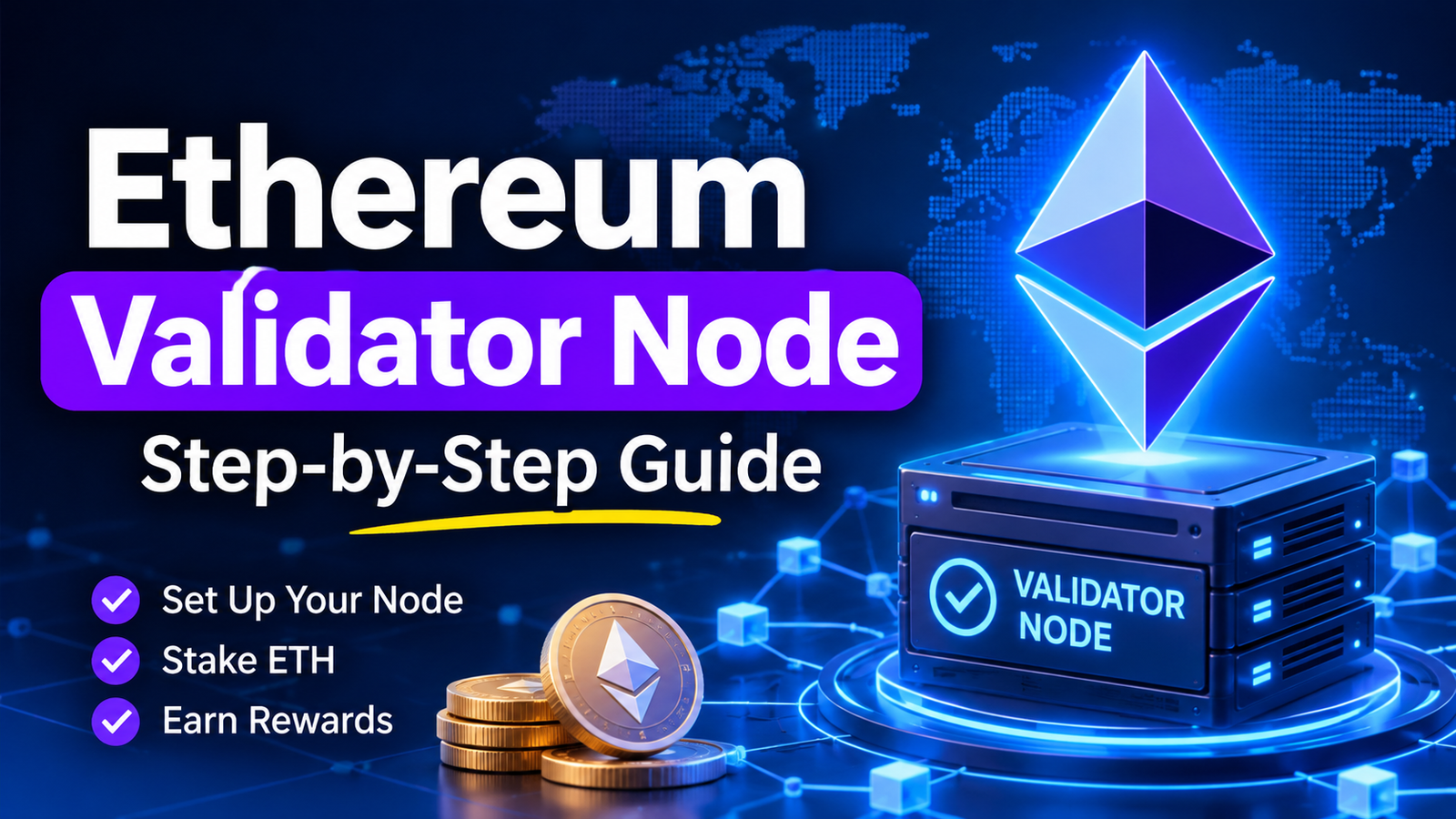
You must have 32 ETH, a computer that’s never going to go down, and two pieces of software: execution client and consensus client. You create the validator keys, put your ETH into the official deposit contract and wait in line until the network activates you. From there, your node will start getting rewards for proposing and verifying blocks.
This is a technical project that has financial risk. Errors could mean losing a share of your investment and the price of ETH can fluctuate by a lot. When it comes to staking income, however, there are tax implications for US readers.
This is a guide to what a validator does, what you need, how to set it up and what can go wrong. It’s information, not individualized financial, tax or legal advice. Ethereum’s rules and the US regulations concerning it change so double check the information on the official sources before investing money.
What is an Ethereum Validator Node?
A validator is a participant in the Ethereum network that plays an important role in securing the network by verifying transactions and proposing new blocks. It will reward her in ETH for doing it honestly. A validator node is the computer and software which does those tasks for you.
Ethereum is proof of stake. The validators are the ones who are putting ETH as a stake to solve puzzles, instead of burning electricity. They receive rewards if they are honest. When they breach the rules, the network can annihilate a portion of their stake.
There are a couple of terms you should be aware of:
Staker: An individual who has staked (or more, as detailed below) 32 ETH to be a validator.
Validator: The hardware and software that is used to run the network.
Execution client: These are the software used to handle transactions and to keep track of Ethereum’s state.
Consensus client: Software which is responsible for consensus and the duties of the validators.
Validator client: The program that carries your signing keys, and creates attestations and blocks. Many consensus clients have it wrapped up together.
What is the work of a Validator?
The main task of a validator is to take care of two aspects. It testifies — it casts a vote for what it believes to be the right chain head. Occasionally it is chosen to propose a block. The network offers rewards for both roles, and proposals are paid more but only occur sporadically.
The process is as follows:
- Set up necessary hardware and link up. You have a machine equipped with adequate storage, memory and internet connection.
- Install two clients. You select an execution client and a consensus client and they communicate with each other locally.
- Sync the chain. Your node downloads and verifies Ethereum’s data. This can take one or a few days.
- Generate keys. A tool is used to create validator signing keys and a deposit file.
- Deposit 32 ETH. ETH is sent to the deposit contract (typically the official Ethereum Launchpad).
Wait in activation queue. Network wait times are dependent on network load.
Start validating. Once activated, your validator should be online to carry out duties.
The sources of your rewards
Validators receive rewards for their participation in the consensus protocols (which include attestations and proposals), transaction tips, and potentially additional rewards related to block-building. Rewards are variable. They are based on the number of validators running, network activity and your uptime. Although some returns can be guaranteed, none can be promised so the specific yield you see online is just a snapshot, not a guarantee.
The 32 ETH rule was altered and now in the recent changes
However, for years, a validator was always equivalent to 32 ETH. The upgrade on Pectra in 2025 increased the maximum amount of Pectra tokens that one validator can stake, thereby enabling large stakers to stake in consolidated amounts. There is still a minimum price of 32 ETH for new validators. Check the existing regulations displayed on ethereum.org prior to depositing.
Withdrawals
Validators are able to withdraw rewards and withdraw completely since the Shanghai/Capella upgrade in 2023. Exits are made through a queue and you may not be able to get your ETH back immediately.
Why is it important to run a Validator?
Validators provide security to Ethereum. The greater the number of independent validators, the more difficult it will be for any group to attack or censor the network. In particular, home stakers help to keep the network decentralized by decreasing reliance on a handful of large providers.
There are pragmatic arguments for thinking about it for individuals:
- Direct control. You have your own keys rather than the keys of a custodian.
- No staking-service fees. You don’t pay with a commission that exchanges and pooled services impose.
- Network contribution. You contribute to the security of an important blockchain.
- Learning. You’ll learn hands-on about how the network functions.
However, the issue of your network is different to the issues of your wallet. There are many people for whom a simpler alternative is preferable, a simpler option explained in the next sections.
Before you begin, there are a number of factors to keep in mind.
Hardware and internet
Ethereum’s documentation provides a general guideline for a validator machine. Recommendations vary over time, so please refer to the latest information. As a rough guide:
Processor: A new multi-core processor. A typical number of cores to start with is 4.
Memory: Min 16GB, best 32GB.
Storage: A good NVMe (or SSD) of approximately 2 TB or higher. Chain data continues to increase.
Internet: A stable broadband connection that has no data cap. You can use hundreds of gigabytes per month on a validator.
Power: Uninterrupted power supply (UPS) is a good idea, because power outages cost you rewards.
A lot of US stakers purchase a small-sized mini PC or possibly construct a small desktop. The price of the hardware is in the range of $800 to $2000 and there are many different hardware costs. Use these as illustrative numbers and not as actual figures.
Client selection and variety
There are a few client programs for Ethereum. Some examples of execution clients are Geth, Nethermind, Besu, Erigon and Reth. The consensus clients are Lighthouse, Prysm, Teku, Nimbus and Lodestar.
Client diversity matters
Many validators could be penalized at the same time if most validators use one client and that client has a serious bug. By selecting less popular clients, you are helping to preserve the network as well as your own stake.
Set up at home vs. in the cloud
A validator can be set up on one’s own home computers or in rented cloud computers. Each has tradeoffs:
| Factor | Home Setup | Cloud Server |
| Upfront cost | Higher | Lower |
| Monthly cost | Mostly electricity and internet | Ongoing hosting fees |
| Control | High | Depends on provider |
| Decentralization | Better | Worse if many choose the same provider |
| Reliability | Depends on your power and ISP | Often high, but not guaranteed |
Hosting providers are also risk takers. When most of the validators are on a single cloud, an outage could impact them as well as the network.
Key security
Rewards and stake can be allocated only according to your withdrawal credentials. Your signing keys are stored on the node and signing tasks. Protect them differently:
Keep your mnemonic phrase secure on a piece of paper, or use another method of keeping it offline. Please never type it into a networked computer you don’t trust.
Validation is NOT “set it and forget it.” You must install software patches, keep the system up, and fix when it breaks. Make sure to monitor your node on a regular basis, particularly in the areas of network upgrade.
What are the advantages and disadvantages?
Potential benefits
- Rewards are received as ETH, and are historically low and unpredictable.
- You retain ownership of your property.
- No third party charges.
- You run a more distributed network.
Potential risks
- Slashing. Forcibly exiting/slashing due to provably dishonest actions (e.g. signing two conflicting messages). This is uncommon for conscientious operators, but an easy cause is a duplicate-key setup.
- Inactivity penalties. Small portions of ETH are lost if your node is down. These increase when there is a lot of offline validators.
- Price risk. ETH is volatile. The rewards in ETH may even drop in dollar worth as you create them.
- Technical risk. You can have your validator interrupted by software bugs, failed updates, or hardware failure.
- Liquidity risk. Because of the withdrawal queue, it takes some time to exit.
- Risk of smart-contract and protocol. The actual upgrade is a risk and Ethereum can change.
- Regulatory and tax risk. The law of the land in the United States is evolving in relation to cryptocurrencies.
These risks cannot be eliminated by any preparation. Stake only the money that you are willing to lose.
Realistic US Example (Hypothetical Figures)
Imagine someone who reads your story called Dana, who lives in Austin, Texas. The numbers are only indicative and not predictive.
Dana wants to stake 32 ETH. If ETH is currently $3,000, the stake will be approximately $96,000. She’s already got a speedy fiber connection, and is paying $1200 for a mini-PC running a 2 TB NVMe drive and $150 for an UPS.
Then she synchronizes and adds 32 ETH to the queue. She is then able to keep an eye on her node and receives alerts on her phone.
Suppose that the annual reward for her investment in the network is approximately 3% of her stake for each year. This would be about 0.96 ETH. At $3,000 a ETH, this is approximately $2,880 (pre-tax, hardware expenses, and electricity). If the price of ETH continues to decline by 30% for the rest of the year, her principal will lose approximately $28,800 more, which is a significant loss.If ETH’s price drops by 30% during the year, her principal loses about $28,800 more — a loss that is significant.
The example illustrates why rates of return with themselves are weak indicators. The movement in the price of the stake is more important than the yield of the stake.
US tax considerations
The Internal Revenue Service (IRS) considers digital assets property in the United States. In Revenue Ruling 2023-14, the IRS said that a cash-method taxpayer who receives staking rewards generally has gross income when they gain dominion and control over the rewards. If the ETH is sold at a later time, it may result in a capital gain or loss. The treatment of the tax depends on your circumstances and guidance can be subject to change.
Record dates, amounts and receipts dollar value of all rewards. In addition, the IRS has questions about digital asset activity being on the Form 1040. See a knowledgeable tax advisor and refer to IRS.gov for updates.
US regulatory considerations
Staking services in the USA have been a topic of debate for some time. The SEC has taken enforcement action against some staking-as-a-service programs, such as its 2023 settlement with Kraken. Being a validator is not the same as relying on a company’s pooled service and regulatory perspectives can evolve. Follow up on the latest advice from the SEC, the CFTC and the state regulator, and consult with a lawyer if your plans are significant.
Let’s Get Started: Step-by-Step
If you choose to move forward, here are the steps. This is how to run an ethereum validator node at home in a step-by-step process that is easy to follow. Remember to always verify each step with official documentation as tools and commands change.
Always test on a testnet first.Always test first on a testnet.
Ethereum has public test networks with test ETH that has no monetary value. Try out there first, before trying real money. You will become familiar with the software, identify errors early and feel confident.
Select and set up your gear.
Purchase or construct machine as per current recommendations. Install any stable Linux distribution, Ubuntu LTS is recommended. There are many who like Linux for reliability and community support.
Step 1: Secure the machine
- Use strong and unique passwords and SSH keys.
- Set up a firewall and only allow those ports that your clients require.
- Maintain the operating system with the latest updates.
- Don’t use the machine to browse the web or for other work.
Step 2: Install your clients
Install 1 execution client and 1 consensus client. Use the official documentation for each of them. You will also create a shared authentication secret that the two clients will need to be able to communicate.
Step 3: Wait for the data to complete
Take the official Staking Deposit CLI, preferably an offline computer. Make a note of your mnemonic and keep it somewhere safe. Never share it. Anyone with that phrase can be in control of your withdrawals.
Step 4: Immerse the node in the data
Start both clients and wait until they are fully synced. Many consensus clients can implement checkpoint sync, which drastically accelerates it.
Verify that the official Launchpad is present.Verify presence of official Launchpad (Step 7).
Click on the link on ethereum.org to go to the Ethereum Launchpad. Fraudsters setup fake staking sites; never click on a search ad, email or social media message. Make sure to double check the address before connecting your wallet.
Step 5: Deposit and wait
Upload your deposit file, send 32 ETH and wait for the activation. Wait in the node to keep it online.
Step 6: Warn and/or notify about incidents
Check your validator’s status via dashboard and alerts. Beaconcha.in provides an explorer that is public to monitor the performance of Validators.
Step 7: Plan for maintenance
Set aside time to update software. Before upgrading, read client release notes, follow community announcements before network upgrades.
Simpler alternatives
If that is not your preferred method, there are other ways:
- Gaining access to an exchange or a custodian. Less difficult but lose control and fees.
- Liquid staking tokens. These allow you to receive a token that represents your staked ETH, but introduce smart-contract and counterparty risk.
- Staking pools or Distributed validator technology. These offer lower stakes or co-ops and have their disadvantages.
These are not risk-free either. Read the terms, know who owns your assets and verify the provider’s regulation.
The following is a list of common mistakes to avoid
- Running duplicate keys. When migrating to another machine, be sure the machine to be migrated is completely stopped. Wait for a few minutes before restarting.
- Skipping the testnet. No value test ETH allows no mistakes, no cost.
- Relying on a popular client, without thought. Look at the diversity statistics for clients and select a minority client if available.
- Digitally saving your mnemonic. A photo, cloud notes and e-mail can be hacked. Paper or metal backups are more secure.
- Ignoring uptime. Rewards are subtly lost when the power and internet go out. UPS & monitoring support.
- Falling for scams. Fake launchpads, “support agents” in the chat groups and fake wallet apps are aimed at new stakers.
- Underestimating storage growth. Purchase more disk space than the minimum specified, to prevent repeat rebuild sooner.
- Forgetting taxes. Document everything from the get-go. It’s hurtful to go back and try to remember the rewards.
- Risking funds that you may need in the future. Withdrawals may take time and when you need cash, ETH might decrease in value.
- Chasing advertised yield. Make comparisons based on what you actually make, not on marketing numbers.
Frequently Asked Questions
How much does it cost to run an Ethereum validator node?
The primary cost is the 32 ETH being staked, valued at highs of tens of thousands of dollars based on current ETH exchange rates. In addition, hardware can cost anywhere from $800 to $2,000 and you will be charged for electricity and internet. The price ranges and you should check out your setup first.
Is it possible to host a validator node at home in the USA?
Yes. There are a lot of US stakers that use a mini PC and a stable broadband internet connection at home to operate validators. Be sure your ISP has no hard limits on data usage, and have a UPS to prevent power failures.
How much do I need to stake 32 ETH to be a validator?
Indeed, solo validators will require 32 ETH to activate. If you don’t have much, you may want to try pooled staking, liquid staking or exchange services. Both offer various risks and charges, so be sure to consider them.
Does the income from staking on Ethereum count as taxable income in the USA?
Generally, yes. The IRS has said that staking rewards can be considered income once you take control of them, and you may end up with capital gains or losses when you sell them later. Tax details can be complicated, so consult with an expert tax professional.
What is ‘slashing’ and what is the probability of it happening?
A penalty that reduces the amount of stake lost by the validator if they commit to some serious rule violations, including signing conflicting messages is known as slashing. It is rare in the case of careful operators. This is most likely due to running the same keys on two machines simultaneously.
What is the maximum return from the ETH staker?
Rewards are not guaranteed and may vary. They rely on your stakes amount, network activity and uptime. Price changes in ETH can also result in a variance in dollar returns from the ETH earned.
Can I withdraw ETH from the Staking Contract?
Yes. Ethereum allows rewards to be withdrawn and full exits can be made. Exits are in queue; may take some time depending on network condition.
Is it better to stake an exchange or stake solo?
It will depend on your objectives and capabilities. Solo staking allows you to have control and avoid fees, but it comes with technical work and with direct risk. The disadvantages of exchange staking are that they carry counterparty risk and have less ease of use.
Final Takeaway
While validator nodes can be a great way to participate in Ethereum, it’s not passive investing. Requires 32 ETH, reliable hardware, good key management, and attention. The most dangerous risks are: technical risk, slashing risk, price change risk and scam risk.
To learn How to run an Ethereum validator node: begin on a testnet, follow official docs and take it slow. If the technical requirements are too much, then simpler staking methods might work better. Either way, you should keep track of your record keeping for tax purposes, understand the regulatory developments in the U.S., and consult with qualified professionals before you make big decisions.