
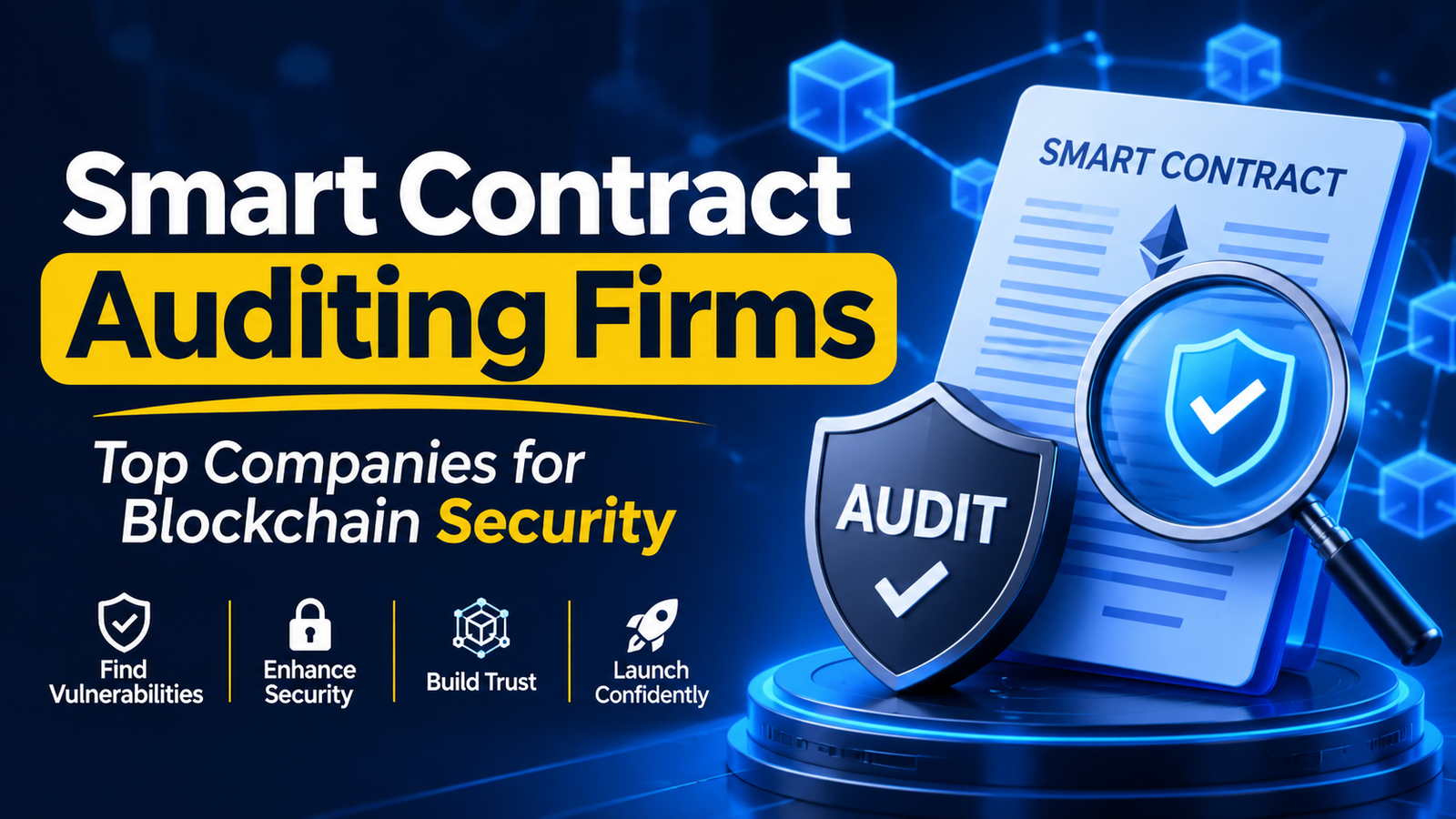
Short answer: Auditing firms with a history of experience with your specific type of code, whether it’s DeFi lending, tokenization, or stablecoins, are the best smart contract auditing firms. They do publish detailed reports, have a human reviewer, and are available after the audit. Trail of Bits, OpenZeppelin, Diligence (Consensys), Spearbit, Cyfrin, Sigma Prime, ChainSecurity, Zellic, Halborn, CertiK, Certora are some of the well-known names among them. There is no one best solution provider for all projects.
Smart contract is a program that stores and transfers funds on a blockchain. When they are deployed, they are usually irreplaceable, and a coding mistake can cost the user a few minutes’ worth of money. That risk is financial and legal for US founders, fund managers and fintech teams.
An audit is a systematic security evaluation of your code by a third party expert. It doesn’t ensure security, but it does help minimize risks, and demonstrates to investors, partners and users that you were serious about maintaining security.
This guide describes the role of auditors, the audit process, audit costs and how to compare audit firms. It also includes some US specific considerations and common pitfalls. It’s educational content, not legal or investment or personal finance advice.
So, what are the top smart contract auditing companies?
Smart Contract Auditing Companies: These are security firms who examine the security of a blockchain code prior to its release for bugs, design flaws and attack paths. The most effective ones include solid technical expertise, a clear process, experience with projects of a comparable nature, and detailed reports written in a manner that conveys information.
It all depends on the project “Best”. A small NFT Minter is going to require a different review than a lending protocol with hundreds of millions of dollars. A company that does really great at Solidity code for Ethereum may not be the right company to do Solana or Move based.
Most of the companies are clustered into four categories:
- Founded their own small security companies. Deep manual review small and medium sized teams. These are frequently stored here: Trail of Bits, Sigma Prime, ChainSecurity, and Zellic.
- Big security firms with a lot of services. They provide audits, monitoring, penetration testing and bug bounty assistance. Examples include CertiK and Halborn.
- Models include the marketplace and the researcher network. These are several programs that gather independent researchers together in a custom group. One of the more popular examples is Spearbit.
- Formal verification specialists. They employ mathematical techniques to establish the correctness of code. There is an example called Certora.
There is also another way using competitive audit platforms like Code4rena and Sherlock. Your code is looked at by several independent researchers and rewards are given for valid findings.
Rosters and all ownership and specialties of a firm vary from year to year. Before contacting a company, check what they’re doing, what people have been saying about them, and who they’re working with.
How Does a Smart Contract Audit Work?
Short answer: An audit is a multi-week process. You submit your code and documentation, the auditors examine your code and documentation using tools and manual inspection, they return the results in order of severity, you correct the errors, and the auditors verify your corrections.
The typical steps of most engagements are:
- Scoping. The repository, documentation, and architecture are shared. The firm estimates effort based on lines of code and complexity.
- Quote and scheduling. A price and a starting date are provided. Quality firms may book up several weeks or months in advance.
- Kickoff. Developers and auditors agree on the protocol’s actions. This call will help avoid many misinterpretations.
- Review. Automated tools are used by auditors, who then read the code line-by-line. They search for logic flaws, weak access controls, and monetary attack routes.
- Interim findings. Good teams get serious problems resolved early so you can begin to resolve them.
- Draft report. Each finding is reported with a severity rating, typically critical, high, medium, low or informational.
- Remediation. Your developers resolve the problems and record the changes made.
- Re-review. Auditors check the fixes and revise the report.
- Final report. A large number of companies release it and some companies provide it in a private manner.
The following are the types of things auditors are searching for:
Auditors verify that there are no common types of weakness:
- Reentrancy. An attacker gets in touch with your contract before it has fully updated its records. This concept was exploited in the DAO attack against Ethereum in 2016, for which investors lost tens of millions of dollars.
- Access-control flaws. A sensitive function is being called by someone who doesn’t have admin access.
- Oracle and the manipulation of prices. Attackers manipulate price feeds the protocol is based on.
- Math and rounding errors. With a large deployment, small calculation errors can be played.
- Risk of upgrading and proxying. Problems with the contract updating process can re-open closed matters.
- Logic errors. The code is correct, but is not the expected business rules.
Content of a typical report
Most reports follow a structure, although there are variations from firm to firm. One of the best things that you can do is to read a sample report before you hire anyone. For a scope section, see if they mention anything that is clear.For severity, look for a framework.
Why Smart Contract Audits are Important?
The short answer to why are audits important is that smart contract errors are expensive, public, and sometimes irreparable. An audit reduces technical risk, promotes trust with users and investors, and facilitates reasonable care if things go wrong.
This is why they are important in real life:
Irreversibility. A bank may typically be able to reverse a fraudulent transfer. Generally, a blockchain cannot.
Public code. There are numerous contracts that can be read by anyone, even attackers.
Investor expectations. Audit reports are frequently requested in due diligence by exchange, venture investors and institutional investors.
User trust. Retail customers typically look into the auditing of a protocol before funding their account.
Insurance and custody. Some cover providers and custodians look at audit history when evaluating risk.
US-specific considerations
When it comes to builders, the US teams are in a different environment than other teams. There are some points to keep in mind:
- There is no legal obligation for an audit. A smart contract audit in the United States is not mandatory for federal law. The decision is a business and risk-management decision.
- An audit is not a safe harbor! A clean report will not shield you from securities claims, commodities claims or consumer-protection claims.
- Regulators are interested in the harm to investors. SEC, CFTC, FTC, and state regulators can take action when customers lose money as a result of inadequate controls or deceptive claims. This is a legal determination for a qualified attorney to consider – how your token or product is classified.
- Claims must be attended to. If a protocol can be called “fully secure” or “risk-free” due to an audit, it may be a liability to the protocol. Provide accurate description of audits and relate to the audit report.
- Sanctions and AML. The Treasury’s OFAC regulations rules and the FinCEN anti-money-laundering expectations are independent of code security. Generally, auditors aren’t involved in reviewing your compliance program.
- Rules for both the stablecoin and the digital asset are changing. There have been changes in the federal and state systems. Verify the current need with official means and counseling.
Regulations, priorities for enforcement and legislation may change. Verify the status with the SEC, CFTC, FinCEN, the OFAC, your state financial authority and a licensed attorney.
How to Select the Best Smart Contract Auditing Companies?
First, short answer: do research on the firms’ experience, the quality of the reviewers, the transparency of their reports, pricing, timeframe and post-audit support. Request a sample report and references for projects of a similar type.
1.Factors to take into account:
A good understanding of the kind of project you’re working on.Experience in your kind of project.
An auditor that works only with token contracts would not be familiar with cross-chain bridges or perpetual futures. Inquire what similar protocols they have read and if the people on your team have read similar protocols.
2. Coverage of chain and language.
The most prevalent is Solidity written on Ethereum and EVM chains.The most common is Solidity written on Ethereum and EVM chains. The Rust based chains like Solana, Move based chains, and other ecosystems require experts. Make sure the firm has a genuine depth in the pile.
3. Who knows where your code is going to be used?
Some companies give higher-level researchers. Others rely on the junior staff for much of the job. Inquire about the names of and backgrounds for your designated reviewers and how many hours they will dedicate to reviewing.
4. Methodology
The best companies use manual review, automated analysis, fuzzing and (sometimes) formal verification. If a process is automated, without any human interaction, then that’s a red flag. Business-logic vulnerabilities are not identified by scanners.
5. Quality and transparency in reporting
Check the newspaper. Good ones describe the scope, list findings in terms of severity, demonstrate how the team responded, and indicate limitations. When a report specifies only “no issues found”, it should be taken with a pinch of salt.
6. Timeline and availability
You may find there are waiting lists at top companies. If you have a set date for your launch, ask in advance. Do not rush a firm, as this will mean that problems will not be identified in the review.
7. Clear price/scope
Ask for a written scope, a fixed or capped price and the cost of a re-review. There may be some hidden extras that can alter your overall budget.
8. Post-audit support
Inquire about their availability to respond to questions after launch, review upgrades and assist in incident response. Security requirements do not come to a halt on audit day – and contracts change.
9. Reputation and independence
Look for public track record, researchers’ credibility and how the company dealt with incidents in the past. Beware of businesses selling any marketing badges in addition to audits. Do not take any “security score” as a sure thing, but rather a sales tool.
| Approach | Best For | Main Tradeoff |
| Boutique manual audit | Complex or high-value protocols | Higher cost, longer wait |
| Large full-service firm | Teams wanting several security services | Quality can vary by assigned team |
| Researcher marketplace | Custom-built review teams | Needs active coordination |
| Competitive audit contest | Broad coverage on a deadline | Less control over who reviews |
| Formal verification | Critical logic that must be provable | Needs precise specifications |
In many serious projects, a mix of techniques are used, for instance, a private audit, then a contest, and then a bug bounty.

What is the cost of a Smart Contract Audit?
A short answer is that it varies in cost. Simple contracts can be $5,000, and complicated, high-dollar contracts from leading firms can be six figures or higher. The cost will vary depending on the coding size and complexity, firm reputation and timelines.
It’s hard to get a good price and any range should be viewed as a general guideline and written price quotes should be requested. These are typically factors that influence cost:
- Lines of code and complexity. The more logical, the more time spent on review.
- Novel design. It takes longer to analyze new mechanisms than well-known ones.
- Number of integrations. For every external dependency, there is attack surface.
- Reviewer seniority. Professional scientists can charge more.
- Timeline. Quick turnarounds tend to be more expensive.
- Re-reviews. The verification may be included or charged separately.
A cheap price may not necessarily be a good deal. A poor and superficial review can be much more expensive than a good and detailed review.
Advantages and Disadvantages
- An audit offers a number of advantages.A professional audit has several benefits.
- Discovers serious flaws before that others do.
- Enhances coding and documentation.
- Assists investors and partners in due diligence.
- Establishes user trust if it is public and sincere.
- Provides your team an outside perspective of your design assumptions.
Risks and limitations
- False confidence. An audit is a review at a specific time. Does not guarantee correctness of the code.
- Scope gaps. Outside the scope is unchecked. That also covers the front-end apps, off-chain servers, and key management.
- Post-audit changes. Changes to code after the review is not covered.
- Human error. Even a great reviewer has errors.
- Operational failures. Many large losses are caused by stolen keys or admin accounts compromising the contracts, not from bugs on the contracts.
- Avoid economic and governance attacks. These can’t be in the form of obvious coding mistakes.
- Cost and delays. The budget of an audit can be stressful, and it can delay a launch.
These restrictions make an audit just one piece in a security program, so consider it in this way. It is not intended to be a substitute for testing, monitoring, and good operational practices.
Example: A Hypothetical US Startup Plans Its Audit
The following scenario and all figures are hypothetical and for illustration only.
A Texas-based fintech startup is about to introduce a tokenized money-market type product to an EVM-compatible blockchain. Holding customer funds in smart contracts makes them vulnerable to a bug.
Step 1: Define scope. The team has three core contracts, one upgradeable proxy and an oracle integration. It doesn’t include the web app or its cloud servers, and it says so in writing.
Step 2: Request quotes. The team reaches out to three companies who are familiar with tokenized assets. It requests each to submit a sample report, reviewers’ bios and a timeline.
Step 3: Budget. The start-up requires an audit for $60,000 and a re-review and contingency of $15,000. It sets aside a separate amount for a bug bounty.
Step 4: Correct and check. Two high severity and some medium severity findings are reported by auditors. The developers are able to address them and the company verifies the fixes.
Step 5: Communicate carefully. The startup publishes the report and accurately describes the report as “reviewed by an independent security firm; see full report. It does not use the term “secure” or “risk-free” for the product. It also seeks counsel with regard to its disclosure and regulatory status.
Here’s an example of how scope, budget and honest communication work together. REAL projects will vary.
How to Get Started: What to Do Next
The short answer is to get your code and documentation ready, narrow the list of companies, request quotes and arrange for the audit ahead of launch.
Follow these steps:
- Freeze the code. Complete features and write tests prior to auditing.
- Write clear documentation. Describe what each contract should do, who has privileged roles and what assumptions you are making.
- Do your own due diligence. Conduct unit tests, static analysis tools and internal review. Then auditors engage in more time using time on deeper issues.
- Write a definition of scope. Include any excluding or chain contracts, hash, list contracts.
- Narrow down your list to 3-5 companies. Match them to your chain, language and type of your project.
- Ask to see a sample report and references. Check depth and clarity.
- Ask detailed questions. Include names of reviewers, hours, methodology, re-review terms and availability following launch.
- Book early. Book a slot much earlier than your desired date.
- Plan remediation time. Time taken for solving issues and checking them takes longer than expected by most teams.
- Add layers. Consider: bug bounty, continuous monitoring, and incident response planning.
- Consult US professionals. Discuss with your securities or fintech attorney what are the risks of regulation and discuss with your insurance company coverage.
Commonly made mistakes
- Selecting based on price only. The lowest price quote might indicate less review time.
- Viewing the audit like a marketing award. Users and regulators are interested in substance and accuracy.
- Auditing too late. Finding will be missed because one cannot make corrections up until days before launch.
- Making changes to code since the audit. Changes, no matter how minor, can create new vulnerabilities.
- Not considering medium and low findings. A number of relatively minor issues can merge into a major vulnerability.
- Skipping documentation. If intent is not apparent, it is not possible for the auditor to determine the intent.
- Excluding key management. Frequent weaknesses are admin keys and deployment processes.
- Overstating results. The term “hack-proof” can be problematic in terms of legal and reputation issues.
- Taking a single audit is sufficient. There needs to be a fresh review of major upgrades and new features.
- Neglecting ongoing security. Monitoring, bug bounties and response plans remain relevant post launch.
Frequently Asked Questions
Who is the most suitable firm for smart contract audits?
No one firm is best for all projects. Select according to the chain, type of project, budget and time available, and compare sample reports. Trail of Bits, OpenZeppelin, Consensys Diligence, Spearbit, Sigma Prime, ChainSecurity, Zellic, and Certora are all trusted names. Confirm what services the companies are offering at present before making a decision.
What is the time taken for a smart contract audit?
Typically, a typical audit requires 1-6 weeks of active review with more complex protocols potentially taking longer. Additionally, there should be an allowance for the waiting period before the start date, as well as allowance for the remediation/re-review phase. Bookings are done to prevent delays for launches.
Should smart contract audits be mandated in the USA?
A federal law does not require one in general. But investors, exchanges, partners and insurers may be looking for audits. The regulators may also assess if you took “reasonable measures” to safeguard customers. Ask a qualified attorney what you should do with your product in the United States.
Does an audit mean that my contract is safe?
No. An audit minimizes the risk, but doesn’t guarantee that there are no bugs present. It only addresses the scope that the parties agreed to, at a particular time. Combine audits, testing and monitoring, bug bounties, and robust operation security.
What is the difference between an audit and bug bounty?
An audit, in particular, is a third-party security examination conducted by a selected team for a specific fee. Generally, the product owner arranges this assessment before launching the project. Furthermore, the audit follows a structured process and takes place within a predetermined timeframe. During this period, security experts carefully review the smart contract’s code to identify potential vulnerabilities. Additionally, they examine possible weaknesses, assess security risks, and recommend necessary improvements. As a result, the project team can address critical issues before deployment and, ultimately, improve the overall security and reliability of the smart contract.
May be able to use automated tools rather than a firm?
Common errors can be caught using automated tools; use them. They can’t reliably detect business-logic weaknesses and sophisticated economic attacks. Manual expert review is deemed necessary for contracts with significant value.
Should my audit be released as a report?
Generally, publishing is good for transparency and trust. Provide the complete report with findings not resolved and what you did about it. Be accurate in describing the results and get counsel to review claims made in the public.
If there are critical issues identified in an audit, what should I do?
Stop launching, correct the issues and verify the fixes with the firm. If significant changes are made, consider another review. Never go over a deadline with the risk of losing user money.
Final Takeaway
The top smart contract auditing firms have some common characteristics: they have the proper experience, they have good reviewers, they provide clear and transparent reports, they offer transparent pricing models, and they provide follow-up support after the launch. This is subject to your chain, product, budget and timelines.
Use an audit as one of the many components of protection, not a substitute for protection. Write Code carefully, Document Scope, Check a sample report before writing, Incur no shortcuts in fixing findings. Be honest about your results, and ask legal and regulatory questions of US sources and professionals.


One thought on “Smart Contract Auditing Firms: Top Companies for Blockchain Security”