
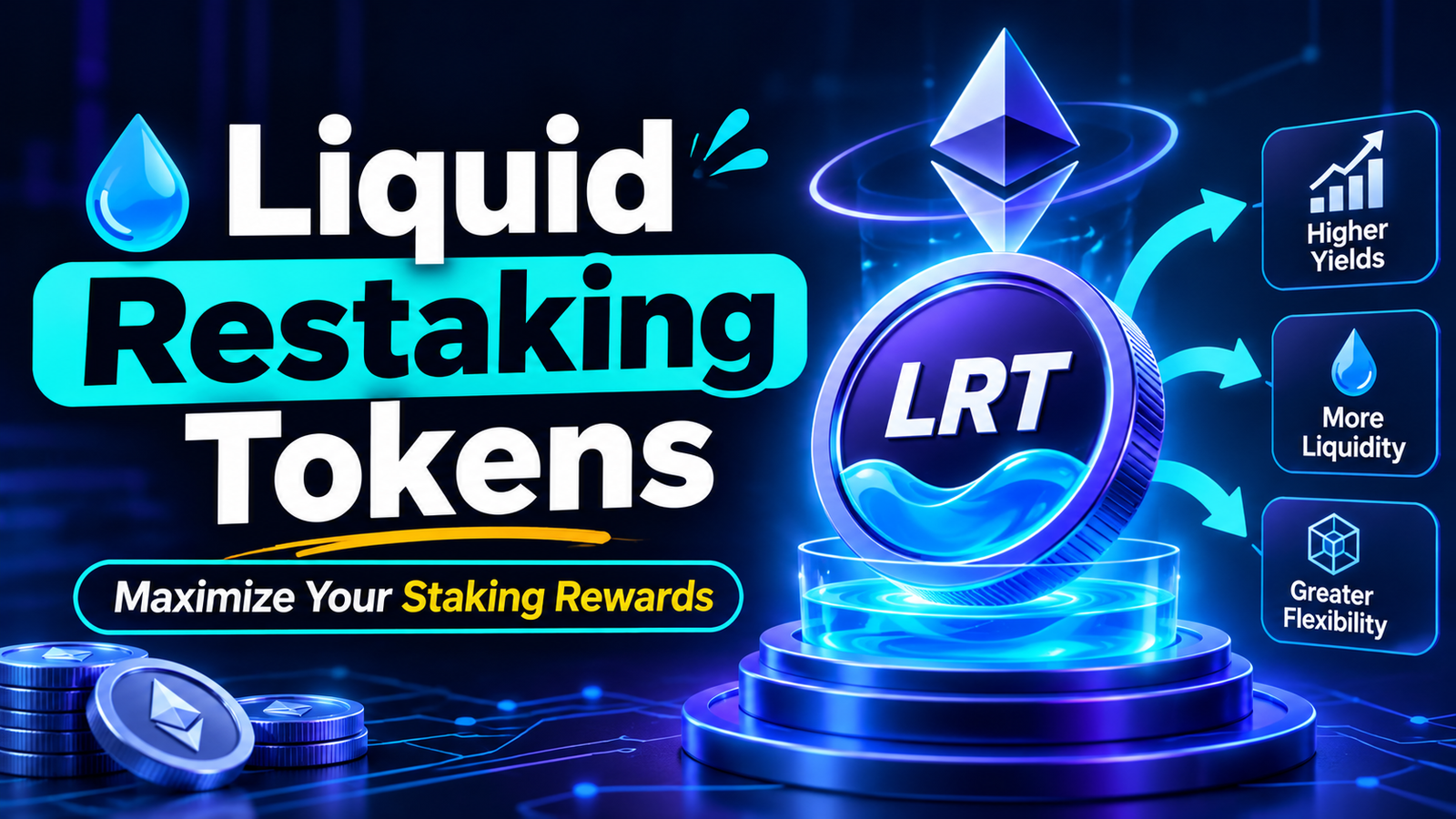
A liquid restaking token (LRT) is a crypto token that is a representation of ether staked and then “restaked” to provide further services on the blockchain. The token is given in exchange for your initial investment. Then you can swap it and use it in the other applications without interrupting your original ether. Simply put, an LRT seeks to generate additional returns from staked ether without sacrificing the capital.
A promise that people will notice but puts risk upon risk. If you are only familiar with the word staking then the concept may seem confusing. This guide runs you through the basics of liquid staker tokens in a simple, everyday example, provides basic US tax information, and illustrates some pitfalls to avoid.
This article is for education purposes only. It is not financial, tax or legal advice directed at a particular individual. Crypto assets are subject to volatility and may result in loss of all or part of your investment.
Quick summary:
LRTs are derived from liquid staking tokens (LSTs) that are derived from Ethereum staking. They are looking to receive staking rewards and additional rewards for restaking. They introduce smart contract risk, slashing risk and price risks. For US holders, tax reporting requirements and changing tax regulatory landscape.
What Is a Liquid Restaking Token?
A liquid restaking token is a receipt token that a protocol provides when you stake ETH in a restaking system. The token is the proof that you will have to the deposit and any awards. You retain the flexibility that is not possible with normal staked Ether, as the token can be freely traded.
To gain insight into the meaning of that definition, divide it into three parts.
Layer 1: Staking
Ethereum is a proof-of-stake blockchain. Validators lock up ether to help confirm transactions. They, in turn, receive rewards. The direct running of a validator requires 32 ETH, as well as technical maintenance, which is why it is common to stake their Validator through services.
Layer 2: Liquid staking
Liquid staking services stake your ether for you. They provide you with a token (Lido’s stETH or RP’s rETH) which acts as a stake. The token can be used to trade, collate or stored in decentralized finance (DeFi) apps.
Layer 3: Restaking
Restaking enables reusing ether tokens to provide security on other networks and services. The most popular example is EigenLayer on Ethereum. The services are frequently identified as actively validated services (AVSs). They reward restakers and impose additional rules upon restakers. Those rules include the option of “slashing” (partial loss of deposit due to misbehavior or failures).
It is in the “liquid” part where the “liquid” comes in.
Lockups and withdrawal delays may be involved in direct restaking via a protocol. You deposit the liquid restaking protocol and it gives you a token. They include such tokens as ether.fi (eETH and weETH), Renzo (ezETH), Kelp DAO (rsETH) and Puffer (pufETH). Product names, features, and market shares evolve rapidly and this list should not be used as the final authority on a project’s documentation; please consult the documentation available at the time of the project.
What is the working of Liquid Restaking Tokens?
The general process of liquid restaking tokens is as follows: Deposit ETH or LST, receive an LST, select services to secure, earn rewards as an increase in the value of the LST or an additional payout.
The actual design is dependent on the project. The overall flow is:
- Deposit. You deposit ETH or a token that is approved for the protocol’s liquid staking.
- Restake. The protocol stakes the ether with validators and/or delegates it to restaking contracts such as EigenLayer’s.
- Receive an LRT. The protocol creates a token that indicates what portion of the pool you own.
- Allocate. The protocol selects the node operators who want to participate in AVSs. The protocol determines the share of the accumulated stake each service is backed by.
- Earn and use. Rewards are earned from Ethereum staking, AVS payments, and frequently project points or token incentives. The LRT can be held or deployed in DeFi.
The two popular models of rewards are:
- Rebasing tokens. Your tokens will increase as you go.
- Value-accruing tokens. This won’t change your balance, but over time each token will be redeemable for an increasing amount of ETH.
Both models are risk-free, in the sense that they do not guarantee a specific return. Rewards are based on network conditions, services selected and protocol rules.
In reality what is meant by the term yield?
There are typically a number of pieces of LRT yield:
- Base Ethereum staking rewards
- Payments from restaked services
- Rewards that are given in the form of an incentive token or “points” which may or may not accrue value.
- Additional DeFi yield when you lend or trade the LRT on the outside market.
Points are not income you can count on. Points programs can be modified or terminated by a project. A quoted yield is an advertised yield which is subject to change and should not be considered a promise.
Who is involved?
- The depositor who puts money into the account.
- The LRT protocol is responsible for deposits and issuance of tokens.
- The people who are operating the nodes that provide infrastructure for the validators.
- Investing in restaking infrastructure, including EigenLayer.
- AVSs, who pay for security.
- The LRT can be traded on or used as collateral by DeFi platforms.
What is the significance of Liquid Restaking Tokens?
They are important as they allow investors to chase additional returns from the same ether without compromising their marketability. Their ability to illustrate the speed at which crypto products get built on top of one another also brings an element of innovation and risk.
Restaking is a mechanism that enables new services to borrow security from existing stakers, thereby enhancing the Ethereum ecosystem. Newer networks and services have a lot of trouble attracting enough capital to defend themselves. Restaking provides them with the opportunity to do so.
The attractiveness of the plan for individual investors is efficiency. In terms of other uses, a traditional staking position lies idle. In theory, an LRT can operate in multiple locations simultaneously.
From a U.S. perspective, the issue is also relevant due to regulation and taxes. Securities and Exchange Commission (SEC) and other agencies have been busy in crypto and the regulations on the staking products have been changing. The legal and tax situation behind a seemingly straightforward product on a website could be quite complex.
When using an LRT, it is important to take into account the following factors:
After considering each of the factors listed below, don’t invest any money.
Smart contract risk
LRTs rely on code. Money can be depleted due to bugs or exploits. Look for independent security firm audits of the protocol. Audits do not eliminate risks, they reduce them.
Slashing risk
Restaking adds conditions. A part of stake may be sliced off if any node operator or service violates the regulations. Discuss what is done when someone is slashed and who loses what.
This carries the risk of depegging and liquidity
The price of the underlying asset ETH should be the same as the number of LRTs that are active. Stress can cause the price to drop below that value. For instance, in April 2024, Renzo’s ezETH dipped significantly from the expected price on certain exchanges following a sell-off. These kinds of events demonstrate that “liquid” is not “always redeemable at full value”.
Withdrawal mechanics
Inquire about the time it will take to get ETH for the token. Queues are used in some protocols. Leaving through a trading venue would be quicker, but if the price dips, it could cost you more.
Concentration and governance
Examine who is in charge of the protocol upgrades and treasury. If a small group have admin keys, examine them. Consider also if there’s a small number of node operators that rely heavily on the protocol.
Fees
Rewards are usually split in protocols. The network gas fees also apply to the deposit, swap, and withdrawal on the Ethereum network. Gas can rob small deposits of a lot of value.
Layered DeFi risk
The more you borrow in an LRT, the greater the potential for gains, but also losses. Pressured liquidation is a possibility for leveraged loans when the price declines.
The advantages and disadvantages of the policy.The pros and cons of the policy.
Potential benefits
- Possible extra yield. There is a possibility that there are rewards from a number of sources that could go beyond plain staking, but it is not certain.
- Liquidity. The token can be traded or moved without validator exit waiting.
- Simplicity. The protocol takes care of the technical aspects like validator operations.
- Composability. There are many DeFi apps that accept popular LRTs.
- Smaller entry point. No 32 ETH is required to play.
Potential risks
- Stacked risks. All risks of Ethereum, liquid staking, restaking, protocol and DeFi are stacked against you.
- Slashing losses. Penalties can decrease the worth of the underlying stake.
- Price volatility. The price of ETH can plunge and the price of the LRT can plunge even further.
- Depeg events. During panic, the token may trade at a lower price than its inherent value.
- Complexity. It’s difficult to compare reward, points, and incentives.
- Regulatory uncertainty. Treatment of these products in the United States could be changed.
- No deposit insurance. The Federal Deposit Insurance Corp. (FDIC) doesn’t insure crypto, and the Securities Investor Protection Corp. (SIPC) can’t protect you from crypto losses like it can certain brokerage failures.
Quick comparison
| Feature | Plain ETH Holding | Liquid Staking Holding | Liquid staking token |
| Earns staking rewards | No | Yes | Yes |
| May earn extra service rewards | No | No | Yes |
| Tradable | Yes | Yes | Yes |
| Slashing exposure | No | Limited | Higher |
| Layers of risk | Low | Medium | High |
Example: A Hypothetical US Investor
The numbers below are only examples and not actual figures. They do not constitute forecasts or advice.
Maria has 5 ETH, she is a US software engineer. Assume ETH is priced at $3,000, so her holding is worth $15,000. She is trying to learn more about liquid restaking tokens in an applied context, to better understand the option before she decides to take it.
Step 1: She sets a risk limit. Maria feels she is capable of losing the money she bettakes. She picks 1 ETH ($3,000) as a test amount, which is 20% of her ETH.
Step 2: She researches. She reads the documentation, audit reports, and existing rules of the protocol for withdrawals and fees.
Suppose that the protocol promises a total of 4% per year from every source. Based on that rate, 1 ETH would appreciate by approximately 0.04 ETH over a one year period. This is only a guess. Actual returns may be below or equal to or even negative.
Step 5: She takes the tax issue into account. If she later redeems the LRT for an ETH or sells it for dollars, it would be considered a taxable event. She writes down the date, the fair market value (in dollars), and her cost basis each time.
What could go wrong: If the price of ETH drops 40%, her one ETH is valued at $1800 before any LRT-specific issues. If the LRT further depegs by 5% during a panic, then she may have to see more losses if she decides to sell at the time. Here are some examples of risk combinations.
What are the U.S. Tax and Regulatory Issues?
The IRS classifies digital assets as property in the United States, meaning that trading, selling or creating crypto may result in taxable events. Guidance on staking/re-staking rewards is evolving, so be sure to check with a tax expert.
The information provided below is general information. Laws and guidance are subject to change.
Tax basics
- Property treatment. Since Notice 2014-21, the IRS has regarded virtual currency as property. The cost basis is typically used to determine gains and losses.
- There is a possibility of taxes on swaps. The conversion of ETH to an LRT may be considered a redemption of ETH. Ask a tax professional on whether or not it is taxable based on the facts and current guidance.
- Rewards can be earnings. IRS Revenue Ruling 2023-14 dealt with staking awards received by cash-method taxpayers, and ruled that they must be declared as income at the time of receipt. It might not be as obvious in the case of incentives, points, and restakes.
- Reporting. Digital asset activity is inquired on the tax return. Broker reporting is also growing and, among others, the recently introduced Form 1099-DA is getting attention for some of the transactions involving digital assets. Please refer to the IRS instructions for the year you are filing taxes.
- Record keeping. Store transaction hashes, transaction dates, USD, and wallet addresses. Reporting is simplified with good records.
Regulatory picture
- The SEC, the Commodity Futures Trading Commission (CFTC), the Treasury Department, and state regulators all have a part to play in crypto regulation in the United States.
- In 2025, SEC staff made statements in regard to some liquid staking activities. These were only partial statements. Restaking and LRTs may present different questions; don’t assume that they are addressed.
- Certain products might not be available in all states and through all platforms in the United States.
- As laws change, court rulings are made, and agency direction is provided, so can rules.
Before taking action consult with the most recent information from the IRS, the SEC, the CFTC and your state securities regulator. The SEC’s Investor.gov is a good place to start.
What Do You Need to Do?
Learn: Start with small losses and keep careful records for tax purposes.Establish a clear loss-control limit; use a clear protocol; test with a small number of losses.
Now perform this numbered process:
- First learn about the basics. Before progressing to restaking, grasp both the concept of staking and liquid staking on Ethereum.
- Set a risk limit. Decide in dollars how much you can afford to lose. Lots of individuals invest a small part of their crypto assets in experimental items.
- Select a secure wallet. Employ a trusted self-custody wallet or a trusted platform regulated in the U.S. and that supports the product. Keep your seed phrase in a secure place away from the internet.
- Research the protocol. Read any audits, governance papers, fee schedules, and incidents that have occurred.
- Observe the relaxation process. Be familiar with exit, exit time and exit cost.
- Start small. Make a small deposit and a small withdrawal.
- Monitor regularly. Listen to announcements, price difference LRT/ETH and security alerts.
- Track taxes. Record all transactions as they occur. Think about using crypto tax software or a CPA who is knowledgeable about crypto.
Here are some questions to ponder:
- Do I have an understanding of the origin of the yield?
- How much margin for error can I have?
- Do I feel comfortable with the team and governance of the protocol?
- Can I explain the impact to my tax man(s)?
If you can’t answer these, STOP. It is OK not to buy a product you don’t know.
Common misconceptions and pitfalls.
- Pursuing the most promising results of the best advertised producer. When yields are high, it’s a warning sign of risk, or a short-term lure.
- Ignoring slashing. Many newcomers are more concerned with the reward than they are with the penalties.
- Over-leveraging. A decrease in prices could result in liquidation during the process of buying more with LRT.
- Failure to conduct audits and document. A slick website = No safe site.
- It is assumed that the token is always equivalent to ETH. Market prices may be different from the value.
- Leveraging money you might need in the near future. Volatile and complicated products are not appropriate for emergency money.
- Forgetting taxes. Penalties may be incurred for not reporting transactions. Maintain the records, starting from day 1.
- Falling for scams. Common are fake websites, links in emails which look like they are from your bank, and “guaranteed return” pitches. Check URLs and don’t give away your seed phrase.
- Considering points as money. Points may be adjusted in the course of the game and their ultimate worth is unpredictable.
- Integrating all in a single protocol. If something fails, it will be more harmful due to concentration.
Frequently Asked Questions
Are Liquid restaking tokens safe?
There isn’t a single crypto product that’s risk free and LRTs have multiple types of risks. These include smart contract bugs, slashing, market volatility, and depeg. Some risks will be mitigated by auditing and careful selection of protocol but will not be eliminated.
How do liquid restaking tokens make money?
They hope to benefit from Ethereum staking rewards and payments from services they procure via restaking. A few also give away incentive tokens or points. No one of these is guaranteed and all can change.
Is it legal to use liquid restaking tokens in the U.S.?
Trading and holding crypto assets is legal in the United States, although the laws surrounding crypto are still changing. Certain products or platforms may not be available to users in the United States of America. Review SEC and CFTC guidance and seek legal counsel if necessary.
What are the tax implications of liquid restaking tokens in the USA?
Digital assets are considered property and if you sell or trade them, they can generate capital gains or losses. Rewards can be considered part of your earnings. The restaking details are complicated, please consult a tax professional and refer to current IRS guidance.
Is it possible to lose money on a liquid restaking token?
Yes. ETH can drop in value, the token may be worth less than its market worth, slashing may happen, or a smart contract may be exploited, resulting in potential losses. Only risk what you can afford to lose.
What is the required amount of ETH for using one?
Most protocols of No. LRT pool deposits, which means it’s possible to join in with a smaller investment. Very small deposits may not be efficient due to network fees.
Final Takeaway
LRTs enable you to continue holding a flexible token while your staked ether is used again to provide other services. While that structure may provide additional rewards, it also carries with it the additional risk of smart contract, slashing, liquidity, tax and regulatory risk. If you are interested in learning more about the basics of liquid restaking tokens, here are three key points to keep in mind:
Yields are based on advertising and not guaranteed.
The more layers you add, the more complex and the more possible losses.
Applicable tax and regulatory policies in the USA may apply and are subject to change.
If you wish to visit this area, do so in small steps, record everything that happens, check with official US and qualified professionals. Indeed, not investing is a sensible option.
Disclaimer: It is important to note that this content is not intended to be a source of financial or investment advice, nor is it a tax or legal advice. Crypto assets are subject to volatility, and it is possible to lose everything. Seek professional advice about your situation.