
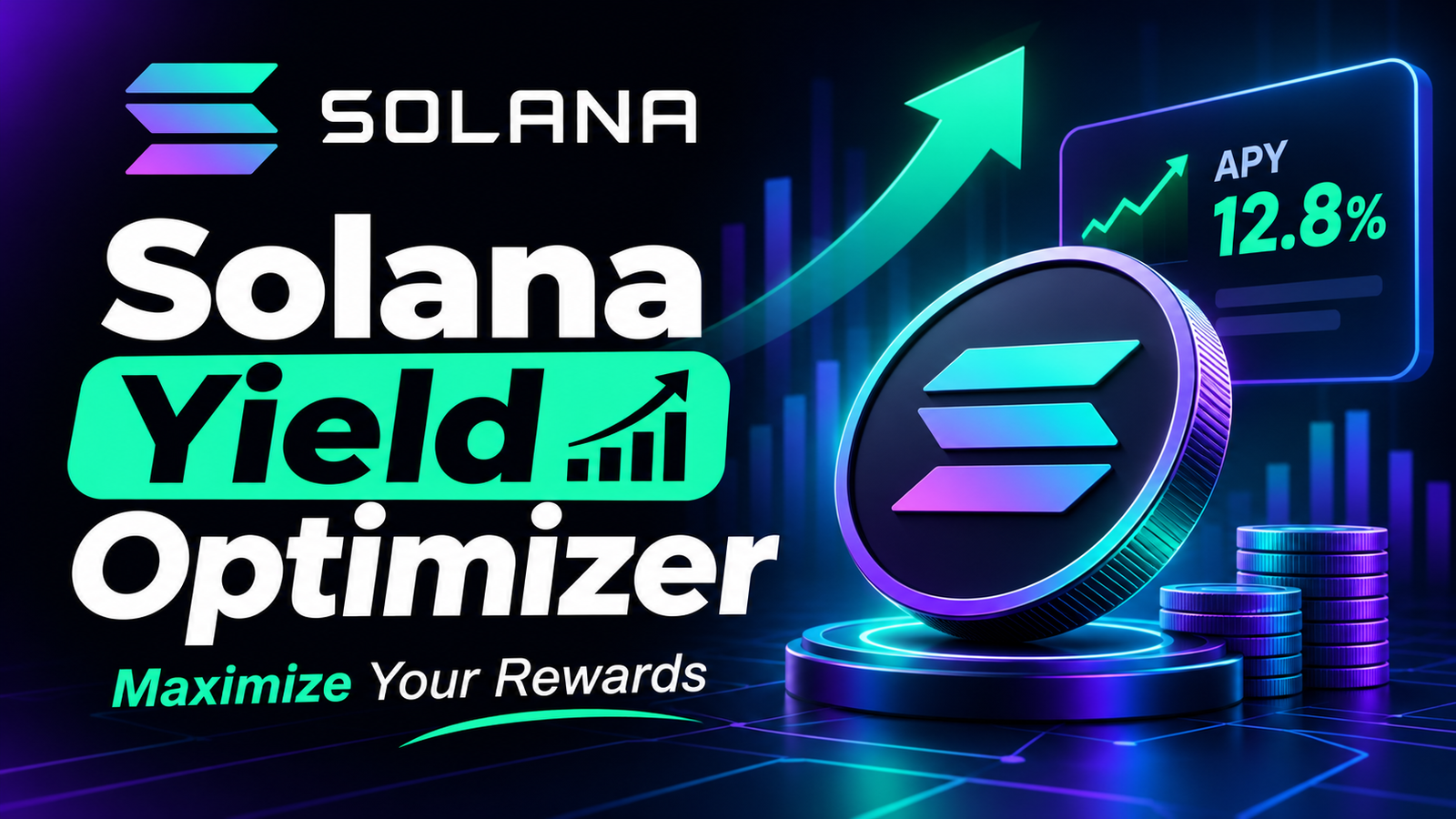
A Solana yield optimizer is a decentralized finance (DeFi) tool that identifies and takes your crypto into strategies that yield returns, after which it automates the processes of gathering those returns and reinvesting them. Can help save time and costs. It can’t eliminate risk and will never promise a return.
The concept is often introduced to many investors in the USA as the possibility of earning much higher annual percentage yields (APY) than those of a bank savings account on Solana. Those numbers are subject to change, and they are not risk free like a Federal Deposit Insurance Corp. (FDIC) account. The key is to know both sides of the story.
This guide will tell you what they do, how they work and where the money is going. It also includes information about the hazards, US tax implications, a sample calculation using hypothetical numbers, and common pitfalls of new users. This article is designed to provide general information only, and should not be viewed as legal, financial or tax advice.
Quick summary:
Yield optimizers take care of lending, providing liquidity, and staking strategies.
Returns are generated by borrowers, trading fees and network rewards and are subject to continuous change. The primary issues that concern US users are smart contract exploits, price volatility, and the tax rulings.
DeFi products and services are not FDIC-insured or protected by the Securities Investor Protection Corporation (SIPC).
What is a Solana Yield Optimizer?
A yield optimizer on Solana is any protocol that bundles users’ deposits and automatically sends them into earning opportunities on the Solana chain. It gathers the rewards and saves them on a schedule, which can compound rewards without the user having to do all the steps by hand.
There are three common terms which overlap:
- Yield aggregator: A service that analyzes various earning opportunities and redirects money to various services.
- Vault: A smart contract that has pooled deposits and one defined strategy.
Auto-compounding: Rewards are automatically reinvested, so that rewards are computed on a larger balance.
Smart Contracts are pieces of code deployed on a blockchain that run automatically when certain conditions are fulfilled. There is no financial middle man or broker. This code processes deposits, executes strategies and withdraws funds.
Why Solana specifically?
Solana is a high-throughput blockchain that typically has low transaction costs. This is important because there are typically a lot of individual transactions involved in compounding. With high fees, frequent compounding can cost you money. It is more feasible on a low-fee network.
Many popular Solana DeFi platforms provide vaults, lending platforms, liquid staking or automated liquidity management. They are not endorsements, and the features, terms, and availability of each platform is subject to change, and may not be available to users in the United States.
What is the basis behind the Yield Optimizer on Solana?
A yield optimizer accepts your deposit and deposits it into a strategy, collects the rewards and re-invests them. The user will usually link a crypto wallet, then send the tokens into a crypto vault, and an account receipt token will be sent to the user, which will be proportional to their stake in the pool.
The standard process, step-by-step:
- Connect a wallet. A non-custodial wallet, where you have access to the private keys. Some popular examples include Phantom and Solflare.
- Choose a vault or strategy. Every vault provides details about its assets, strategy, fees, and risks.
- Deposit tokens. Your tokens are accepted by the smart contract and a receipt token is created or your share is recorded.
- The strategy involves the deployment of capital. The vault lends, offers liquidity, stakes or some combination of the above.
- Rewards accumulate. Rewards can be either the deposited token or a platform token or both.
- Optimizer cuts and invests. It trades or trades rewards and restores them to the position.
- You withdraw. The redeemed receipt token is given for the assets and any growth, with fees deducted.
What is the source of the yield?
Yield is NOT a free ride! It’s a fee for risking and/or a service. The following are the major sources:
- Lending interest. A lending market has borrowers who pay interest to the lender to borrow the assets. Borrowers typically post collateral, and may borrow in order to go into leveraged positions. This interest is shared with the lenders.
- Trading fees. Liquidity pools are employed in decentralized exchanges (DEXs). For traders who trade tokens, they need to pay a fee for the swaps. Some of the fees are paid to liquidity providers.
- Staking rewards. Solana uses proof-of-stake. Holders hand over SOL to validators who, in turn, assist in securing the network. Stakers are rewarded with newly minted SOL and with fees. Liquid staking will allow users to hold a token that can be traded while SOL is staked.
- Incentive tokens. Protocols may issue their own tokens to lure deposit. These prizes can be substantial in the abstract, but can turn out to be worth very little in reality.
What about automated – what does it do?
The three jobs are automated. For one, it values rewards, and does so more regularly than someone might want to. Secondly, it balances positions, such as moving a liquidity range when prices change. Third, it allocates money to more profitable options when the market shifts.
There is an expense associated with each job, typically in the form of a performance fee and/or a management fee. There are some platforms that also have withdrawal charges. Please check the fee section before making a deposit.
Why is it important to have a Yield Optimizer?
The importance of yield optimizers is that they reduce the amount of effort and technical expertise required to take part in DeFi. Manual yield farming involves monitoring rates, claiming rewards, swapping tokens and reinvesting, and doing this on a daily basis. A vault is a collection of such steps that are deposited together.
They also are significant for a number of practical reasons.
Compounding efficiency. The more frequently that rewards are compounded, the higher will be the effective returns over leaving them unclaimed. The benefit will be dependent upon the rate and fees. If the interest rate is low, there is not much increase in compounding.
Lower transaction overhead. The advantage with pooled vaults is that it is spread among all of the depositors. This is less significant than on higher-fee chains, as base fees are already low on Solana. It still saves you time on position managing.

Access to strategies. Concentrated liquidity management is difficult for novice in a safe way. The mechanics can be dealt with in a vault. That convenience bolsters people’s confidence in the code that powers the vault and the team that creates those codes.
The primary purpose of understanding these tools if you are a US reader is to use them. DeFi yields can be contrasted with savings accounts, certificates of deposit (CDs), and treasury bills. It’s futile to compare without talking about risk. Generally, bank deposits are insured up to the FDIC insurance limit. There isn’t similar protection for a DeFi vault deposit.
Before you put any money into a casino, there are a number of factors to take into account.
Before investing in a vault, judge them on multiple factors. The following factors are most important.
The yield source and sustainability.
Inquire about the origin of the return. If it primarily comes from newly earned incentive tokens, it might lose its effectiveness on the termination of incentives.
If an advertized APY is very high, it’s not a deal – it’s a warning. High returns are likely to be accompanied by high risk at some point.
APY versus APR
APR (annual percentage rate) does not take compounding into account. It is part of the annual percentage yield (APY). APY might be displayed on a platform just because it appears bigger. Verify the assumption that is being used, such as the frequency of the compounding and whether it includes any incentive tokens at current market prices.
Search for these fees:
- Performance fee on earned yield
- Interest money that a customer pays to the bank to use their money.
- Deposit or withdrawal fees
These fees are paid by the transaction fee paid in SOL, network transaction fees
Swap cost & slippage for the vault’s trading of tokens
Security and audits
An audit is an external security firm’s inspection of smart contract code. Audits are a good tool, but don’t guarantee safety. Audited code has been buggy. Search for several audits, a public bug bounty program, years of experience looking back, and documentation.
Total value locked (TVL)
TVL (Total Value Locked): The amount of dollars that are locked into a protocol. Even though a large TVL indicates high confidence in the market, it does not mean safety. TVL can also plummet due to panic selling.
Liquidity and withdrawal conditions
Find out if you are able to pull out at any time. There are some vaults with lockups or cooldowns. Others might be hesitant to pull out if there is high utilization in the underlying lending market, that is, a lot of money is being lent out.
Asset type
The vaults that hold single assets, like the USDC vault, don’t suffer from the price divergence issues of liquidity pools. Bear in mind that price risk plies on top of strategy risk when holding volatile tokens with vaults. There is still risk associated with stablecoin strategies, such as stablecoin de-pegging.
US availability
Some protocols have geographical limitations for U.S. users, or reject U.S. IP addresses in their terms of service. Others have no restrictions. Look at conditions and see if it’s ok to use a platform in the US.
Advantages & Disadvantages
Here a balanced perspective is important. While convenience is a huge benefit, the trade-offs are significant and largely unknown to new adopters of yield optimizers.
Potential benefits
- Automation: Rewards multiply, no work required.
- Simplicity: One deposit equates to many steps.
- Transparency: Smart contract activity can be viewed in public blockchain explorers.
- Self-custody: As opposed to custodial designs, you have your own keys and not a company’s.
- Low network fees: Solana’s fees keep typical transactions low cost.
Smart contract risk.
There can be bugs in code or it can be exploited. Across various blockchains, including the recently made headlines exploit of the Wormhole bridge on Solana, hackers have stolen funds from DeFi protocols. A hack losing is often irreparable.
Market and price risk.
For example, if you buy SOL, the value of SOL can drop significantly more than the yield you are receiving. Yield is not in lieu of price movement.
Impermanent loss
With liquidity pools, there is a risk that prices will differ from the tokens, resulting in less value than holding the tokens. There may be any recovery of the loss, depending on how much fee is charged.
Liquidation risk
Leverage/borrowing strategies can be unwound when the value of the assets being pledged as collateral declines. Part or all of a position can be eliminated during liquidation.
The risk of depeg and stablecoin. Assets that are pegged can go ‘ung Pegged’ during stress.
Oracle risk
Price feeds, also known as oracles, are the foundations of DeFi protocols. It can cause malfunctions or manipulation in the price data, resulting in bad liquidations or in a possibility of exploitation.
Network risk
The Solana Network has experienced downtimes in previous years. A halt could save a company from withdrawals or liquidations when they are most needed.
The risk associated with counterparty and governance. Teams are able to modify parameters, update contracts, or maintain an administrative key. See what rules can be changed and what the parameters are for such changes.
Regulatory risk
The regulations for digital assets and DeFi in the United States are developing. Recent enforcement actions show how regulators have changed their approach to certain staking and lending products in recent years. Review the latest Securities and Exchange Commission (SEC) and Commodity Futures Trading Commission (CFTC) tips.
No deposit insurance
The FDIC insures qualifying bank deposits, while the SIPC protects eligible brokerage customers if their brokerage firm fails. Both do not support deposits into DeFi vault.
US Tax and Compliance Considerations
There are complexities to US tax treatment of DeFi activity. The following are general information and tax laws are subject to change. Verify existing regulations with the Internal Revenue Service (IRS) or qualified tax advisor.
Cryptocurrency can be regarded as property
For federal tax purposes, the IRS considers digital assets property. Capital gains or losses can happen if you sell, receive crypto gifts, or use it for transactions.When you sell, receive a gift of crypto, or use crypto in transactions, you can experience capital gains or losses.
There may be tax consequences with deposits and withdrawals. In some situations, receiving a token receipt for a deposited token counts as an exchange, while other situations do not. The IRS determines the outcome based on each case and how the parties structure the transaction.It is a spot where expert guidance is of great assistance.
Rewards may consist of earnings. IRS guidance has been issued on staking rewards as income for the taxpayer when he or she acquires control of them, which is typically defined as fair market value in U.S. dollars at that time. Other types of rewards, like interest for loans or incentive tokens, can be treated the same way. Check the treatment of your situation.
There are several events associated with compounding. A frequent scheme of auto-compounding can involve numerous taxable transactions. Monitor them from the beginning. Reporting. Taxpayers report digital assets on their federal income tax returns (Form 1040). The IRS is developing Form 1099-DA to help brokers report digital asset transactions. However, many DeFi activities may not require brokers to file this form. It does not matter, you still have to report. Follow current IRS instructions.
Record keeping. Document all deposits, withdrawals, winnings, exchanges and charges. Use dates, amounts and the US dollar value at the time. Crypto tax software will be able to import wallet activity, though the outcome needs to be reviewed. State rules vary. Digital asset treatment varies from state to state, as does their income tax rules.
An example is a Hypothetical $5,000 Vault Deposit.
The numbers in this example are hypothetical. It is not a prediction of actual results or of a specific platform.
If a US investor, Jordan, puts $5,000 of a USD-pegged stablecoin, USD Coin (USDC), into a lending vault on Solana, what happens to that capital in the system?What happens to capital that a US investor, Jordan, puts into a lending vault on Solana when he uses a USD-pegged stablecoin, USD Coin (USDC)? The variable annual percentage yield (APY) is 8%.
STEP 1: Make an estimate of gross yield.
With a 1% interest rate of 8%, the gross return would be approximately $400, assuming the interest remained the same over the year.
Step 2: Subtract fees
Make the assumption that the platform charges 10% performance fee on yield. That fee is $40. The net yield before tax is approximately $360. Activity may add a few cents to a few dollars to network fees.
Step 3: Take rate changes into account
The interest rate for the loan varies according to demand for loans. This will be less than the headline rate if the rate drops to 4% for half of the year. This is the best case scenario, given stable conditions, of $360.
Step 4: Consider taxes
Assume the IRS treats the reward as ordinary income and Jordan pays a 22% marginal federal income tax rate. This would cost about $79 on $360 in federal taxes. If any tax is applicable, this would be in addition to state tax. In this case, the after-tax return of the 5,000 investment would be approximately $281, which would be equivalent to approximately 5.6%.
Step 5: Do compare with the risk!
Then think about all the things you could do wrong! In the event of a smart contract exploit, Jordan could lose a portion of or all of the $5,000. In the case of a temporary depegging of the stablecoin, the price might temporarily change. The $360 return is a small price to pay for a loss of $5,000.
A volatile-asset version.
If Jordan had put $5,000 of SOL, instead, then the price of SOL had decreased 30%, this position would lose about $1,500 in value. It wouldn’t be worth $360 to me.
The teaching point is easy to understand. But yield isn’t the only thing on the ledger. These can be outweighed by price movement, fees and taxes, and security risk.
The best approach to starting is to be careful.Starting wisely is the best approach.
New players should start with small games, learn the website’s mechanics, and experiment with their first deposit. The following steps provide a safe route.
Set a goal and risk tolerance. Determine a complete loss limit. Use only funds that you have to lose, and not hurt your finances.
Review the fundamentals
Pay off credit card debt and maintain an emergency fund in an insured account before risking crypto investments.
Select on-ramp that is US compliant. A lot of people purchase cryptocurrencies from an exchange website located in the United States, and then move them to their own wallet. Verify exchange is registered with the relevant US agencies.
Create a self-custodial wallet. Keep your recovery phrase away from other devices. Don’t give it to anyone, and don’t enter it on a Website.
Record all the information for tax purposes. Produce day-by-day records of transactions.
Monitor your positions. Keep an eye on rates, news and security alerts regularly.
Plan your exit. Be familiar with the withdrawal process and factors that may slow down the process. Before making any real investments, you may want to consult a tax advisor or financial advisor.
Discover common mistakes and how to prevent making them.
A large percentage of losses in the DeFi space are due to a handful of common mistakes. Avoid these:
- Seeking the best APY. The risks are often biggest, and are buried in the biggest number.
- Not knowing the origin of yield. Do not deposit if you don’t know where it comes from.
- Omitting the cost of the fee. A little money goes a long way.
- Making audits an assurance. There are cases where audited code fails.
- Combining all in a single protocol. Concentrating exacerbates the impact of a single failure.
- Leverage without knowledge of liquidation. Debt from borrowings can be cleared up rapidly.
- Falling for phishing. DeFi users are the target of fake websites and fake support accounts. Make sure to bookmark sites and check links.
- Signing transactions blindly. Take time to read a wallet prompt that asks you to approve.
- Forgetting taxes. If you wait until April to deal with many little events, they can become a big burden to keep records.
- Putting money into an investment that is due to be used shortly. Price cuts and withdrawal timings can take their toll.
Frequently Asked Questions
What does a crypto yield optimizer do?
A protocol that automatically deposits crypto into earning strategies and reinvests profits is called a yield optimizer. It brings together tasks such as lending, providing liquidity and compounding in a single vault, thus saving you the trouble of doing it yourself.
Is yield optimizing on Solana safe?
It isn’t a safe place. Both the quality of the platform’s code and its track record, audits, and strategy will determine your platform’s safety. There are several ways to lose money, including smart contract glitches, price declines, and liquidations, with deposits being uninsured by the FDIC or SIPC.
What is the yield of Solana yield vaults worth?
The returns are variable and follow a trend, hence no prediction is possible. Rates are based on the volume of trading, the size of the borrowing and incentive programs. When looking at an APY that’s displayed, take it with a grain of salt.
Can DeFi yield earnings be taxed in the US?
Generally, yes. The IRS considers any crypto reward you receive as income and treats it as property. You may also generate gains or losses when you swap or withdraw your cryptocurrency. Review the IRS rules and regulations or consult a tax advisor.
Why is it that staking and using a vault are different?
Staking involves delegating SOL to a validator to support the network and generate rewards. A vault is a smart contract that runs a broader strategy, which may include lending or liquidity provision. The additional strategy risk is added to the network risk with the vaults.
Are there any DeFi platforms available on Solana for the U.S.?
Generally yes, but sometimes not. Check the terms and conditions on each platform and consult the latest guidance from the U.S. regulators before depositing money.
What is meant by the term “impermanent loss”?
Impermanent loss occurs when token prices fluctuate in a liquidity pool, causing liquidity providers to receive less value than they would by holding their tokens outside the pool. Trading fees can offset this loss, but they do not always cover it. If you withdraw your tokens while prices remain different, you lock in the loss permanently.
Which Vault should I pick?
Check the source of yield, fees, audit history, code’s age, the conditions of withdrawal, and asset types. Go with the easiest and least. If you don’t know how to explain the strategy in a few sentences, then do not do it!
Final Takeaway
A yield optimizer on Solana does just that, optimizing how crypto earns and compounds returns, and can even make DeFi more convenient for US users. The returns are from real sources like borrower interest, trading fees, network rewards etc. and fluctuate and are subject to risk.
Beware of advertising claims. Due to fees, audits, US-specific terms and tax implications, please check before you deposit. If you have to move your money, do it in small amounts, maintain records and never invest more than you can afford to lose.
Digital asset and tax regulations are evolving. Always confirm the details with the IRS, SEC and CFTC, and seek expert counsel before making a decision. This article is not specific advice, it is general education.
One thought on “Solana Yield Optimizer: How It Works, Risks, and US Taxes”