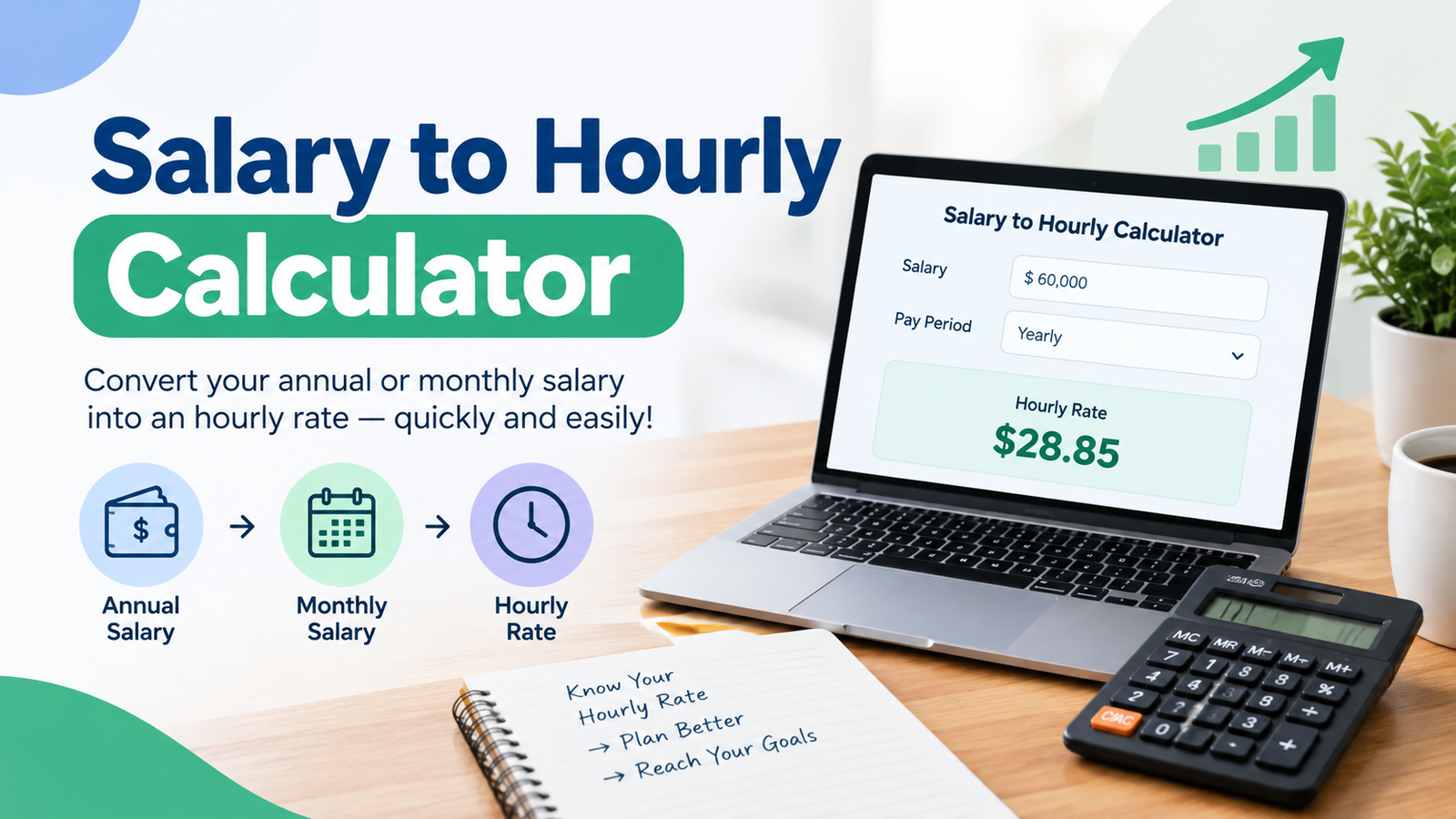


Working full-time at a pay rate of $23 per hour equates to earning $47,840 per annum before taxes. These calculations are based on an assumption of working 40 hours weekly in 52 weeks a year. The amount of your paycheck may be different depending on factors such as overtime, unpaid leaves, and deduction for benefits among others.
Asking yourself, “how much is 23$ an hour a year” is a prudent decision to make before accepting a job, negotiating for a salary raise, and even while budgeting for your monthly expenses. The following guide will take you through all the necessary information regarding $23 per hour as well as how to convert it into a year or month.
All calculations used below are in US Dollars. Please note that tax calculations are hypothetical.
What’s the Quick Answer to an Hourly Rate of $23?
An hourly rate of $23 amounts to $47,840 annual gross income for a typical full-time workweek. Gross income refers to your income before any tax or deductions. This translates to approximately $3,987 monthly, $1,840 twice monthly, and $920 weekly.
Here is the short answer:
- Hourly: $23
- Daily (8 hours): $184
- Weekly (40 hours): $920
- Twice Monthly (80 hours): $1,840
- Monthly (average): $3,987
- Annual (2,080 hours): $47,840
This is just the starting figure. The remainder of this article discusses how things actually change from here.
What Does an Hourly Wage Mean?
Hourly wages are the amount that an employer pays for the time spent working by employees. Such compensation is common for retail positions, healthcare support workers, skilled tradespeople, administrators, logistics positions, and numerous other occupations that deal with services. Working more hours leads to more money earned; working fewer – less.
This is not like salary that is set up once a year and does not depend on actual hours worked. Hourly wages always depend on timesheets. The hourly workers in the US are considered as non-exempt under the Fair Labor Standards Act (FLSA) and, thus, receive overtime pay. It is important to know the difference between such wages and salaries.
It makes sense to consider the differences since the same dollar sum can mean very different things. While a salary of $47,840 per year gives steady earnings, $23 per hour can give more or less income.
How Do You Convert Hourly Pay to Annual Pay?
Here’s how to convert hourly pay to annual salary. Multiply your hourly wage by the number of hours you work in a week, then multiply by 52. The full-time work schedule is 40 hours a week or 2,080 hours a year.
Follow these steps:
- Use your hourly wage. Here it is $23.
- Multiple by weekly hours. $23 × 40 = $920 weekly.
- Multiple by 52 weeks. $920 × 52 = $47,840 annually.
- Multiple by 12 for the month approximation. $47,840 ÷ 12 ≈ $3,987.
The trick is simple. Multiply your hourly rate by 2,080 to get a full-year estimate of the full-time work schedule. You can go backwards too. To calculate the hourly rate from salary, simply divide by 2,080.
Why 2,080 Is the Standard Number?
The figure 2,080 comes from multiplying 40 hours and 52 weeks together. The payroll department uses this figure to make things easier for comparison purposes. The figure does not consider the holidays, sick days, or vacation days that you may have.
How Much Is $23 an Hour by Pay Period?
Employers use different pay cycles. The chart below provides gross earnings for 40 hours per week.
| Pay period | Hours worked | Gross pay |
| One Our | 1 | $23.00 |
| One Day | 8 | $184.00 |
| One Week | 40 | $920.00 |
| Two Weeks | 80 | $1840.00 |
| Twice a month | About 86.67 | $1993.33 |
| One month | About 173.33 | $3986.67 |
| One Year | 2080 | $47840.00 |
The difference between “bi-weekly” and “semi-monthly” should be observed as “bi-weekly” implies “every two weeks” that results in 26 paychecks per year, while “semi-monthly” implies “twice a month” that results in 24 paychecks per year, and both schedules result in the same yearly amount paid, but each paycheck is of a different size.
In two months of the year, employees receive three paychecks on a bi-weekly pay schedule. Employees use those months for paying off their debts or saving money.
How Do Your Weekly Hours Change the Yearly Total?
Not everybody works a regular 40-hour workweek. Reduced work hours and extra work hours make your annual amount fluctuate faster. The following are the implications of $23 hourly wage based on varying weekly hours, considering 52 paid weeks.
| Hours per week | Weekly gross | Yearly gross |
| 20 | $460 | $23920 |
| 25 | $575 | $29900 |
| 30 | $690 | $35880 |
| 35 | $805 | $41860 |
| 40 | $920 | $47840 |
A difference of $12,000 annually exists between 30 and 40 hours. This is one reason why people inquire on scheduling issues before agreeing to any offers. If there is an offer of $23 hourly but with only 30 scheduled hours, the offer can result in earning lower than someone who gets less hourly but guarantees 40.
Why Does Knowing Your Annual Income Matter?
Many of your financial choices will be made based on your annual income. Your landlords require proof that your income will cover your rent payments. The financial institutions analyze annual income when considering the loans such as auto, personal and mortgage loans. The budgeting, retirement savings and taxation also depend on it.
It is useful for comparing offers when you have more than one choice. For example, an offer of $23 per hour and another of $48,000 annually can seem similar; however, there may be differences in benefits, overtime, etc. Converting the numbers into the annual income allows to compare the offers properly.
Finally, it allows you to make negotiations easier. You will need to calculate the desired hourly rate from the annual income.
How Does $23 an Hour Compare With the Federal Minimum Wage?
The federal minimum wage in the US is $7.25 an hour. This is the rate determined by federal law; however, you can get the most up-to-date information from the US Department of Labor. In case of earning $23 an hour, you will get almost three times more than the aforementioned minimum rate.
Some states and even some cities have higher minimum wages. This means that it is important to know the minimum wages set by the state and local governments, because you should be paid at least the highest one. You can check these rates at your state labor department or the US Department of Labor website.
Earning $23 an hour does not mean living on minimum wage in the vast majority of locations. It is still quite difficult to say whether it is comfortable or not depending on your location.
Key Factors Affecting How Much Money You Actually Make
$47,840 is a nice round number. However, there are some additional variables that exist in the real world. Here are some of them.
Overtime Pay
According to the FLSA, nonexempt covered workers usually receive one and a half times their pay rate for each hour of overtime (beyond 40 hours a week). With an hourly pay rate of $23, the overtime pay will be $34.50.
Now, if you work 45 hours a week all year long, your earnings for the first 40 hours would be $920, and your overtime pay would be $172.50. So your earnings for the week would be $1,092.50, which would come to $56,810 a year. It is just a hypothetical calculation because hardly does anyone work exactly the same amount of overtime in each week of the year.
Unpaid Time Off
Not all hourly paid positions give money for holiday, sick, or vacation time. When you take two weeks of unpaid leave, then your annual gross drops to $46,000 (50 weeks × $920). It will depend on your company policy.
Shift Differentials and Bonuses
Certain firms may provide additional income for night shift, weekend shifts, or dangerous work. Some firms may provide you with additional income in the form of bonuses or commissions. You should include any amount of income that adds to your total salary during the year as long as it is guaranteed and documented in your employment contract.
Taxes and Payroll Deductions
The gross pay is not what you take home as salary; certain things like taxes and deductions cut it down. All this will be explained in the following segment.
Benefits
Medical coverage, pension match, and vacation pay may bring in some serious benefits with the job. In many cases, benefits outweigh the additional money per hour.
How Much Is $23 an Hour After Taxes?
How much one takes home out of the $23 an hour rate depends on your filing status, your state, your deductions, and benefits. While for most singles, the percentage will be somewhere around 80% to 85% of your gross, your personal amount may vary. This chapter should be viewed as an example, not a personal calculation.
The Main Deductions
These are the taxes that are common for the majority of US employees:
- Federal income tax. Progressive tax brackets make sure that the more income you have, the higher the rate of tax is.
- Social Security tax. Workers usually contribute 6.2 percent of their wages per year until reaching an annual cap.
- Medicare tax. Workers usually contribute 1.45 percent of their wages.
- State and local income tax. There are no taxes of that sort in some states, while in other states there is a flat or progressive rate.
- Voluntary deductions. These may include health premiums, retirement contributions, and flexible spending accounts.
Social Security plus Medicare is referred to as FICA taxes. In case of earning $47,840, this 7.65% totals up to $3,660.
A Simplified Hypothetical Estimate
For the purpose of example, take into consideration a case of an individual with no children and without any additional income or pre-tax deductions. In this case, federal income tax can be expected to fall in the range of about $3,500 – $3,600, considering the present tax brackets. On top of it add about $3,660 in FICA taxes and you will get total federal deductions in the amount of about $7,100 to $7,300.
This will leave $40,500 to $40,700 as pre-state tax income. This is equivalent to approximately $3,380 per month.
The above estimates are illustrative only. Please refer to the official IRS website or use IRS Tax Withholding Estimator for the updated information.

Is $23 an Hour Good Pay in the US?
The question of whether $23 an hour is fair pay will depend largely on where you live, the number of people you have to support, how much debt you might be carrying, and at what point in your career you are at.
Do some research regarding your living expenses and see where you stack up to the cost of living in your area. Housing, transportation, child-care, and health care costs can vary greatly between regions. The US Bureau of Labor Statistics reports wage data by industry and region, which could help you gauge your standing relative to your peers.
Think about opportunities for advancement too. If you have a $23 an hour wage at the beginning of your career and there is a clear path for advancement, that’s good.
Hourly Pay vs. Salary: What Is the Difference?
Hourly rate and salary are both ways of describing income; however, they operate quite differently. Below are some basic comparisons between them.
| Feature | Hourly pay | Salary |
| Pay basis | Hours worked | Fixed yearly amount |
| Overtime | Often eligible | Often exempt, depending on role and pay level |
| Income stability | Can vary with schedule | Usually steady |
| Flexibility | Easy to add or cut hours | Less tied to the clock |
| Best for | Variable or shift-based work | Predictable, role-based work |
In case you are getting paid $23 per hour and offered a salary of $47,840, then you will have the same amount of money but the major distinction will be made due to overtime pay, working hours, and other benefits. In case there is a need to work for 50 hours a week in a salaried job, it might reduce your hourly wage rate.
For calculation purposes, you will need to divide your salary by actual hours you are going to work. In the mentioned case, it will be $47,840 / 2,600 hours = $18.40 per hour.
Benefits and Potential Risks of a $23 Hourly Wage
Every pay structure has tradeoffs. Weigh both sides honestly.
Potential Advantages
- Clear link between time and pay. You are compensated for every hour that you work.
- Overtime opportunities. Workers eligible for it can earn more by working additional hours.
- Flexibility. Certain positions give you a chance to do shifts whenever you need money.
- Easy tracking. It is easy to calculate hourly rate, hence easier budgeting.
Potential Risks
- Income variability. Seasonal downturns or fewer hours can reduce your income.
- Unpaid time off. Not working means not earning money.
- Benefit gaps. Not all hourly positions provide generous health care or pension plans.
- Inflation. The cost of living may increase faster than your wage.
None of these factors is a reason to avoid hourly work. They are the reason to prepare for variable income, create a rainy day fund, and monitor your schedule.
Example: Budgeting on $23 an Hour
These figures are for illustrative purposes and have been assumed for ease of calculation. Consider one individual who is working at $23 an hour for 40 hours a week. In this case, after considering federal taxation, a low state tax, and a minimal health premium, the take home salary would be about $3,300 each month.
An example budget following the 50/30/20 method:
| Category | Target share | Monthly amount |
| Needs (rent, utilities, food, transport, insurance) | 50% | $1650 |
| Wants (dining out, entertainment, hobbies) | 30% | $990 |
| Savings and debt payoff | 20% | $660 |
It is just a guideline and not a rule. If one lives in an expensive area, the needs could be above 50%. This is the time when you would allocate the proportions differently and reduce costs in the wants category.
How does all this relate to the bigger picture? In trying to find out how much is 23 dollars an hour annually, what people really look for is planning like the one discussed above. The annual salary becomes meaningful only when associated with expenses such as rent and other expenditures.
How to Get Started: Practical Next Steps
To convert your hourly wage into a financial plan, use the following guidelines.
- Confirm your real hours. Examine your calendar and find out if your hours are guaranteed.
- Calculate gross annual pay. Multiply $23 with your number of hours per year.
- Estimate take-home pay. Look at your last pay stub and use the IRS Tax Withholding Estimator.
- Check your withholding. Review your W-4 form so that you neither end up with an overwhelming tax bill nor pay too much all year round.
- List your fixed costs. Include rent, utilities, insurance, debt payments, and transportation costs.
- Build an emergency fund. Some financial gurus advise saving three to six months of basic living expenses, but this may be different for you.
- Use workplace benefits. If there is a 401(k) match offered at your company, find out about it. The 401(k) match is additional compensation, but investments are risky and nothing is guaranteed.
- Plan for raises. Document your achievements and get information about pay for your job position before an annual review.
Focus on the first three steps right now. They require less than an hour and will provide you with an accurate estimate.
Common Mistakes to Avoid
These common mistakes people make when trying to figure out their annual salary from hourly rates need to be avoided.
- Budgeting with gross pay. You should always create your budget based on net, or after-tax, pay.
- Assuming 52 paid weeks. Unpaid leave lowers the number of weeks you get paid.
- Ignoring overtime rules. Make sure that you understand if you have overtime at all and how it is calculated.
- Counting overtime as guaranteed. Your overtime may not be there one day, so base your budget on regular hours.
- Forgetting benefits costs. Benefits like health insurance and retirement plans lower the amount of money you get.
- Skipping the W-4 review. You may end up owing taxes or getting a huge refund due to this mistake.
- Comparing offers by wage alone. You might be better off with a lower pay but with benefits than a higher pay without them.
- Ignoring local costs. The cost of living varies widely in different places.
Frequently Asked Questions
How much is $23 an hour monthly?
An hourly rate of $23 equals $3,987 a month (before taxes). The number of hours used for calculation is 173.33 hours (2,080 hours / 12 months). Your total salary per month may vary according to the number of working hours and your pay frequency.
How much is $23 an hour biweekly?
If you make $23 per hour, then your gross pay is $1,840 every other week (assuming 80 working hours). Your net pay is less after tax deductions.
Is $23 an hour considered middle class?
This will depend on the number of people living in your home, your location, and how you define middle class. There are different definitions across various scholars and organizations, and the cost of living varies widely according to location. To gain more insight, you can use your income relative to the cost of living and income of households according to the US Census Bureau.
How much is $23 an hour if I work 30 hours a week?
The salary of $23 per hour for 30 hours in a week translates to $690 per week and $35,880 annually, not including taxes. It is based on 52 paid weeks. With less number of paid weeks, the overall figure would be reduced.
How much overtime would I earn at $23 an hour?
According to labor laws, overtime pay is normally 1.5 times the usual hourly pay rate for eligible employees. In this case, it is 1.5 times $23, which gives $34.50 per hour. An additional 5 hours of overtime will translate to $172.50.
What is the take-home pay for $23 an hour?
Hourly take-home pay of $23 may vary, but a single tax filer can retain 80 percent to 85 percent of their gross pay before deducting state taxes and benefit premiums. This is a rough estimate only. Use your pay slip, IRS Tax Withholding Estimator, or a tax professional to get an accurate estimate.
Can I afford a mortgage or apartment on $23 an hour?
Yes, maybe, depending on the cost of living, debts, savings, and credit score. Lenders and landlords usually check your earnings, debts, and credit score. Most landlords expect you to earn a certain multiple of your rent every month. The requirements are different. Information about purchasing a house from Consumer Financial Protection Bureau will be helpful.
How can I earn more than $47,840 a year at this rate?
The methods to increase your annual income include working more hours, earning overtime, making shift differentials, or negotiating for a higher hourly pay. You can also earn qualifications or acquire skills to join a better paying position. Take into consideration any added working hours due to health issues, personal and family life considerations.
Final Takeaway
Using the standard full-time work schedule of 2,080 hours per year, the annual salary from 23 dollars per hour is 47,840 dollars. For simplicity, one can consider 23 dollars per hour salary to mean 920 dollars per week, 1,840 dollars per bi-weekly period, and 3,987 dollars per month.
Keep in mind that gross salary and net salary are two different concepts. There are factors such as taxes, deductions, vacation days, and even overtime that affect your actual earnings. It is best to plan your budget according to your net income and keep your calculations up-to-date.
The above article provides information on personal finance, and should not be treated as personalized tax, legal or financial advice. Laws, regulations, and requirements on salaries, taxes, and benefits are always changing and can be verified with the Internal Revenue Service (IRS), the U.S. Department of Labor, and your respective states.